
Borrowed Chairs
This week, being stuck in a role you don’t want. Has the fiction become truth, and are you living to a family script? Finally, being an optimistic realist.

"Today, we gently choose to notice the chairs we have been sitting in for others, trusting that our Shen has never asked us to remain where truth, honesty, and integrity can no longer breathe. As we turn these pages together, may we discover that the greatest freedom is not found by escaping our lives, but by quietly standing up and returning to who we have always been."
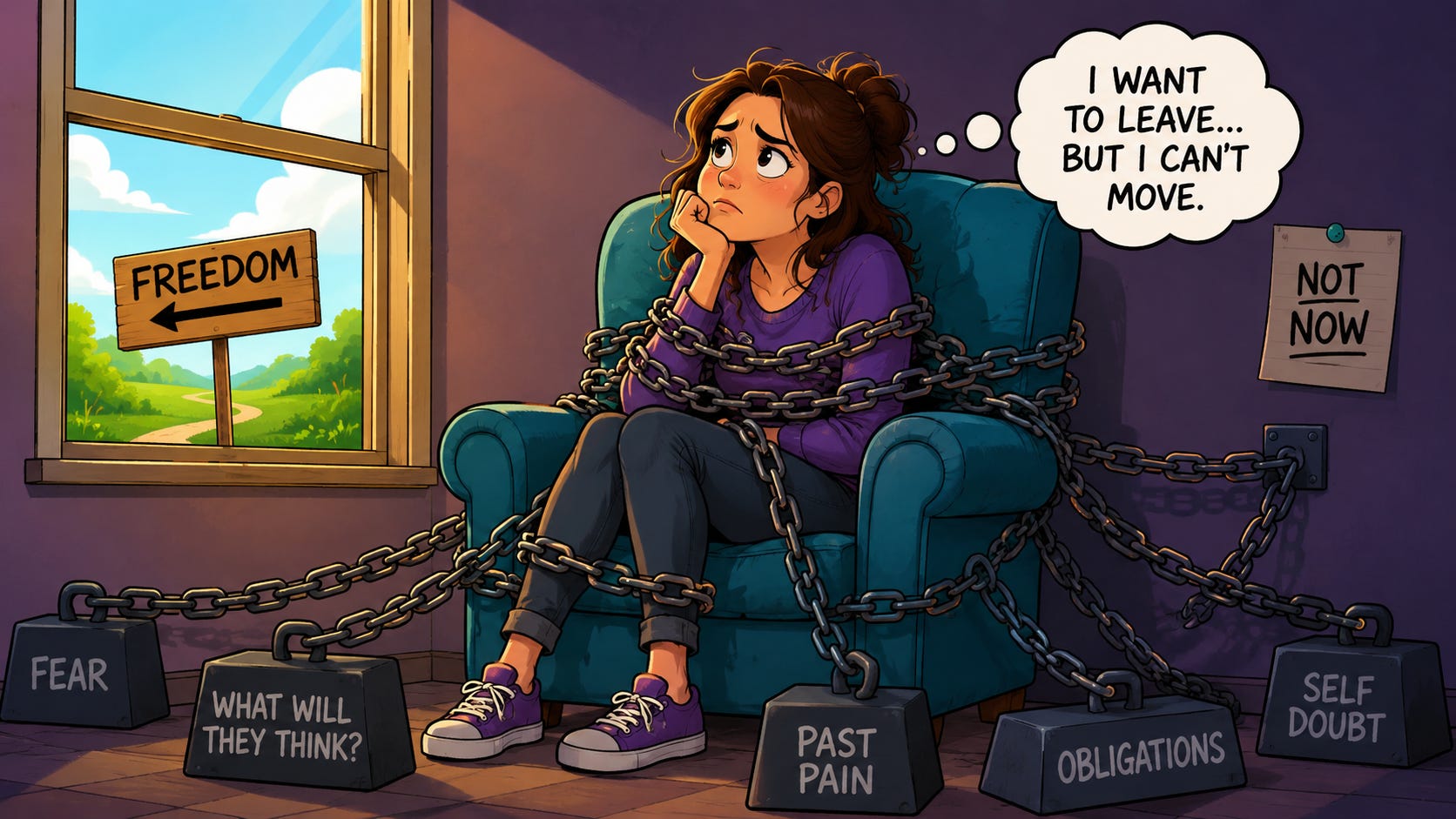
Have you ever remained seated in a role that quietly exhausted you, simply because you feared what others might think if you stood up and walked away? Have you smiled politely through traditions, gatherings, conversations, or expectations that no longer aligned with your Shen, convincing yourself that endurance was kindness and silence was maturity? And when you finally chose honesty, why did your Inner Child immediately begin to criticise, reproach, and pressure you with thoughts such as, “Perhaps I should have just gone along with it,” or “Maybe my truth was selfish after all”?
These moments are far more common than most of us realise. Many people live entire lives sitting in what we might call ‘Borrowed chairs,’ emotional roles, identities, obligations, and expectations that were never fully aligned with their authentic nature, yet became familiar through repetition and emotional conditioning. Some become the peacekeepers in the family. Others become the helper, the rescuer, the agreeable partner, the grateful child, the endlessly accommodating friend. Over time, our Inner Child begins to believe that maintaining the role is safer than questioning it. The role becomes emotionally fused with acceptance, belonging, and a sense of worth. Yet, the Tao gently asks another question: “What happens when the role no longer reflects your truth?”
This teaching is not about rebellion or withdrawal. It is about alignment. It is about recognising that there are moments in life when our Shen quietly outgrows an emotional costume our Inner Child has been wearing for years. We may still deeply love the people involved. We may appreciate their intentions sincerely. But somewhere within us, something no longer aligns. The gathering, the expectation, the emotional arrangement may seem increasingly heavy, not because anyone is cruel or intentionally harmful, but because we are no longer abandoning ourselves to maintain others’ comfort.
In our previous teaching, ‘Anchored in Truth’, we explored how emotions are signs rather than masters, guiding us toward the beliefs beneath our reactions. This doorway takes us one step further. Sometimes the red-light emotion is not warning us that something terrible is happening externally. Sometimes it is simply showing us that we have quietly drifted away from ourselves.
The difficulty is that our Inner Child interprets change through ‘Emotional Logic’ rather than ‘Shen Logic’. If we stop performing the familiar role, the Inner Child immediately begins to badger us with fearful predictions. “They’ll reject us. They’ll think we are selfish. We’ll disappoint everyone.” Yet these reactions often reveal something important: the role was never truly sustained by alignment, but by emotional negotiation.
This is where many people become trapped inside what we call ‘The Pit of Familiarity’. Familiar discomfort can seem emotionally safer than authentic uncertainty. We continue to attend, agree, apologise, compensate, or overexplain because our Inner Child equates familiarity with emotional protection. However, the Tao reminds us that flow requires movement. When we cling to an old identity that no longer reflects who we are becoming, emotional stagnation quietly develops beneath the surface.
Our Tao Te Ching translation reminds us in Verse 47: “Without leaving your door,
You may know the whole world. The Sage understands without forcing, Accomplishes without controlling, and aligns without needing to possess.”
There is profound wisdom hidden within these lines. The Sage does not force itself into emotional arrangements to preserve appearances. Alignment does not require self-abandonment. Our Shen already knows when something has drifted from authenticity, even as our Inner Child continues to pressure us to maintain emotional harmony at any cost.
One of the deepest insights within ‘Borrowed Chairs’ is understanding that inclusion and belonging are not always the same thing. We may be welcomed into a room, yet still experience a quiet emotional misalignment within ourselves. This distinction matters greatly. Many people invalidate their emotional responses by saying, “But nobody did anything wrong.” Yet the Tao never teaches us to ignore truth simply because no one intended harm. Sometimes the unresolved issue is not external rejection at all. It is the belief our Inner Child created around identity, comparison, and worth.
Consider how many emotional reactions emerge from silent comparisons. Someone without children attends a family celebration centred around parenthood. Someone who is divorced attends a wedding anniversary gathering. Someone struggling financially joins conversations focused entirely on success and achievement. The event itself rarely creates the pain. It is created through the Inner Child’s interpretation of what the event seems to say about their value, place, or completeness.
This is why the ‘Golden Thread Process’ becomes so important. Rather than reacting to the emotion itself, we trace the emotional reaction back toward the originating belief. The emotion may say, “I don’t belong here.” But what belief created that emotion? Perhaps: “My worth depends on fulfilling a role.” Or: “If I cannot participate in the same way as others, then something must be wrong with me.” Once the belief is illuminated, the emotional grip begins to soften.
In our previous teaching, ‘Already Whole’, we explored how our Inner Child often confuses being chosen with being worthy. That insight becomes deeply relevant here. Many borrowed roles are maintained because our Inner Child believes emotional approval equals emotional safety. Yet Shen understands something far quieter and more stabilising: our value was never dependent on how successfully we performed for others.
‘Truth becomes lighter when we stop carrying the weight of performance.’
Still, there is another side to this conversation worth exploring compassionately. Some may argue that adapting ourselves for family harmony is part of maturity. They may say that attending to uncomfortable situations occasionally is simply what loving people do. And there is wisdom in recognising that not every discomfort requires withdrawal. Taoism does not encourage emotional avoidance disguised as spirituality. However, the distinction lies in intention and alignment. Are we occasionally stretching ourselves with openness and generosity? Or are we repeatedly abandoning our truth to avoid others' emotional reactions? One connects the Shen. The other disconnects from it.
Our Inner Child often struggles to recognise this difference because it views emotional discomfort as immediate danger. If someone becomes upset with us after we speak honestly, the Inner Child immediately interprets the reaction as proof we were wrong. Yet this is another example of ‘Emotional Logic’. Someone else’s emotional reaction cannot determine the validity of our truth.
This becomes especially difficult in close family dynamics, as families unconsciously assign emotional roles over decades. Once someone steps outside that familiar arrangement, resistance often appears. The person who always accommodated suddenly says “no”. The peacekeeper chooses honesty. The helper prioritises their own well-being. To the family emotional system, this can seem threatening because the established balance has shifted. Our Inner Child then pressures us to restore the old arrangement quickly. “Just apologise. Just go back. Don’t upset people.”
Yet wu wei teaches something far more balanced. Wu wei does not mean passivity or emotional suppression. It means responding from alignment rather than emotional reactivity. Sometimes wu wei is a gentle movement forward without defending, explaining, or fighting. It is the calmness of standing in truth without needing everyone else to approve of it immediately.
This is beautifully reflected in our previous teaching, ‘Before Belief Speaks’, where we explored how our Inner Child absorbs emotional survival patterns long before we consciously understand them. Many of us learned very early that maintaining emotional peace in the family required self-adjustment. Over time, these patterns become automatic. We stop asking ourselves whether the role still aligns because the role itself becomes emotionally fused with safety. But Shen does not flow through performance. Shen flows through authenticity.
There is also something deeply compassionate about recognising that others may react strongly because our truth disrupts their emotional expectations. Their reaction does not necessarily mean they are malicious or uncaring. Their own Inner Child may simply be struggling with disappointment, confusion, or unmet expectations. When viewed this way, we stop turning emotional reactions into villains and victims. We begin to see human beings navigating their unresolved issues at different levels of awareness. This perspective softens resentment while still allowing boundaries. We do not need to become emotionally hard to become authentic.
In many ways, this teaching invites us into a deeper version of ‘The Shen Test’. When making decisions, are we acting from truth, honesty and integrity, or from fear, guilt, emotional management, and avoidance? The answer often becomes visible through the emotional energy surrounding the decision. Shen tends to bring calm clarity, even when difficult. Our Inner Child tends to create a sense of urgency, pressure, catastrophising, and emotional bargaining. The challenge is that choosing authenticity rarely creates immediate emotional comfort. Sometimes it creates temporary emotional turbulence, both within ourselves and in others. Yet turbulence is not always misalignment. Sometimes turbulence is simply a transition.
Our Tao Te Ching translation reminds us in Verse 8: “The highest goodness is like water. Water benefits all things and does not compete. It flows naturally to places others avoid,
And so aligns with the Tao.”
Water does not force itself into shapes that no longer fit. It moves naturally toward alignment. In the same way, we are invited to stop forcing ourselves into emotional spaces that quietly disconnect us from ourselves. This does not mean isolation. It does not mean superiority. It does not mean becoming emotionally distant. It simply means recognising that authentic connection cannot grow through self-erasure.
‘Alignment begins the moment we stop asking our Shen to sit quietly beneath the noise of expectation.’
There is immense freedom in understanding that we are allowed to evolve emotionally and spiritually. The role we accepted twenty years ago may no longer reflect the person we are becoming today. Taoism teaches us that all life is movement, transformation, and flow. Why, then, do we expect ourselves to remain emotionally frozen within identities that no longer align? Perhaps one of the greatest ‘Life Lessons’ within ‘Borrowed Chairs’ is learning that saying no peacefully can sometimes be an act of love, both toward ourselves and toward others. Honest relationships can eventually deepen through authenticity. Performance can only maintain appearances temporarily.
This teaching also reminds us not to confuse guilt with wrongdoing. Our Inner Child often feels guilt when we fall short of expectations, even when our actions align with the truth. Guilt then becomes another emotional strategy attempting to pull us back onto the ‘Carousel of Despair’, where self-doubt, overexplaining, and emotional self-criticism begin circling endlessly again.
Yet every time we gently return to Shen, we step off that carousel. We begin choosing calm truth over emotional performance. We begin recognising that our worth does not fluctuate based on whether others fully understand our choices. We begin to trust that alignment may initially unsettle familiar emotional patterns, yet ultimately create more authentic relationships with ourselves and others.
As we bring ‘Borrowed Chairs’ toward its conclusion, perhaps the deepest insight is this: we do not dishonour love by being honest about our emotional reality. We honour both ourselves and others when we stop pretending. Taoism never asks us to become emotionally perfect. It gently encourages us toward alignment, authenticity, and flow.
So, if there is a role in your life that no longer reflects your truth, pause before criticising yourself immediately. Sit quietly with ‘The Power of Three’: truth, honesty and integrity. Ask yourself whether your discomfort arises from genuine misalignment or simply from the unfamiliarity of choosing to be different. Use ‘The Shen Test’. Notice whether your Inner Child is pestering you toward fear-based performance or whether your Shen is calmly guiding you toward authenticity.
Take small, consistent, manageable steps. There is no need for emotional drama or grand declarations. Wu wei reminds us that transformation often unfolds softly, through quiet choices repeated consistently over time. One honest conversation. One respectful boundary. One moment of choosing alignment instead of emotional performance. Never doubt your ability to grow beyond old emotional roles. The fact that you are becoming aware of them already means your Shen is guiding you forward. Continue gently stepping away from Criticism, Comparing and being Judgemental (CCJ). Continue questioning the beliefs beneath the emotions. Continue to allow your Shen, rather than your Inner Child, to guide your life.
Because eventually, through patience, awareness, and alignment, we discover something beautiful: The chair was never truly ours to begin with. And standing up was not rejection. It was returning home to ourselves.
Have you ever caught yourself reacting to life as though an old story were still happening? Have you ever created fear because someone seemed distant, then used that fear as proof that we were unloved, unsafe, or not enough? Have you ever depended on another person’s happiness so deeply that your Inner Child began to pressure you into believing, “If they are okay, then we can be okay”?
This is one of the quietest places where emotional confusion begins, because our Inner Child does not simply create emotions from beliefs; it can also write an entire inner fiction around those beliefs, then defend that fiction as though it were spiritual truth.
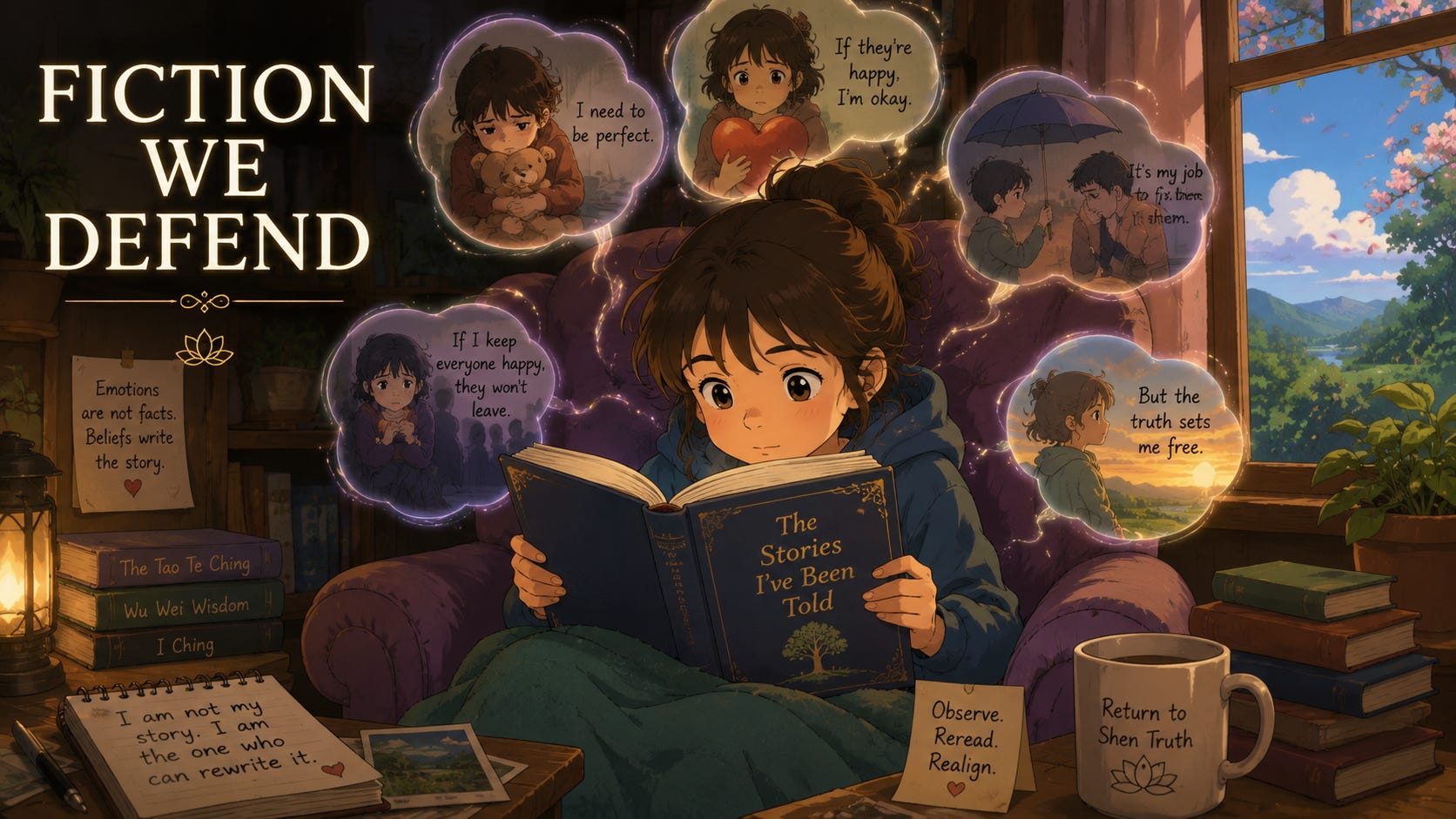
In this journal post, ‘Fiction We Defend’, we will explore how our Inner Child becomes the author of protective stories, why those stories can seem more familiar than truth, and how red-light emotion is often used to guard a mistaken identity. We will look at the belief that emotions are transferable, the illusion that love must come from others before it can exist within us, and the deeper misunderstanding that someone else’s happiness can become the foundation of our own. Most importantly, we will learn how to reread the story without attacking the author. This is where wu wei becomes practical, because effortless effort does not rip the book from our Inner Child’s hands; it sits beside our Inner Child with compassion, truth, honesty and integrity, and gently asks, “Is this still the whole story?”
The Story We Forgot We Wrote
Many of us are living inside a story we did not consciously choose. Our Inner Child may have written the first chapters during moments of confusion, uncertainty, rejection, pressure, or emotional need. At the time, the story seemed useful. It explained why people behaved as they did, why love seemed unreliable, why happiness seemed dependent on family, approval, reassurance, or being needed. The story may have said, “If they love me, then I can love myself.” “If they are unhappy, I must fix them.” It may even have said, “If I make everyone happy, no one will leave.” These are not truths from Shen; they are protective conclusions created through ‘Emotional Logic’, and because they were repeated over time, they began to seem like identity.
This is where the teaching deepens. We already understand that we create our own emotions through the meanings, beliefs, and interpretations we choose. Yet there is another doorway here. Our Inner Child not only creates a red-light emotion; it often creates a character who must live inside that emotion. We become the rescuer, the abandoned or unlovable one, the responsible one, the one who must keep everyone together, the one who must not disappoint. Then, when reality challenges that identity, our Inner Child pesters and badgers us to protect the familiar role. This is the beginning of ‘The Pit of Familiarity’, where even discomfort can seem safer than truth because it confirms the story we already know.
‘A story can comfort us and still keep us smaller than truth.’
When Emotion Protects Identity
A red-light emotion is not proof that the story is true. It is a signal that a belief needs our attention. This distinction is essential because our Inner Child often uses emotional intensity as evidence. If fear is strong, danger must be real. If sadness is heavy, loss must define us. If jealousy burns, love must be under threat. Yet emotional intensity only tells us that a belief has been activated; it does not prove that the belief is aligned with Shen. This is why we need ‘The Shen Test’. We ask, “Does this belief reflect truth, honesty and integrity, or does it reflect control, dependency, fear, and old emotional bargaining?”
The belief that emotions are transferable is one of the most powerful examples of emotional fiction. We cannot place our emotions into another person’s body, and they cannot place theirs into ours. We may respond to, influence, and care deeply for one another, but the emotions we create come from our own beliefs and interpretations. If someone seems unhappy, our Inner Child may pressure us to create guilt. If someone seems distant, our Inner Child may create fear. If someone loves us, our Inner Child may briefly create relief and call it self-worth. But Shen knows something steadier. Love does not arrive from outside and install worth within us. Our worth is already present, and love becomes clearer when we stop asking others to prove what only truth can reveal.
Nature teaches this with quiet simplicity. One tree does not become less rooted so another tree can stand taller. The river does not apologise for flowing, even though the stone is still. The moon does not bargain with the night for permission to shine. Each part of nature belongs to the whole by being authentic to itself. So, when our Inner Child says, “If I sacrifice my peace, they will give me happiness,” we can recognise that this is fiction. Harmony is not an emotional trade. Love is not a debt exchange. Happiness cannot be built at the expense of truth, because what is gained through self-abandonment will always ask for another payment.
Rereading Without Shame
There is a beautiful tenderness in admitting, “I wrote a fiction and have been living it as a true story.” This is not a failure. This is awakening. The moment we can see the book, we are no longer completely trapped inside it. We become the observer, the rereader, the one who can turn the page slowly and notice where fear became identity, where protection became limitation, where a childhood conclusion became an adult rule. This is the compassionate heart of ‘Fiction We Defend’. We are not here to shame our Inner Child for writing the story. We are here to help our Inner Child understand that the story was written with limited information.
Our Tao Te Ching translation offers a gentle reminder in Verse 17: “It is better to say little and act authentically by following your path, and allow others to follow theirs.” This wisdom applies beautifully to our inner world. Shen does not need to dominate our Inner Child, argue with every sentence, or force a dramatic rewrite. Shen guides by example. It offers calm direction. It shows our Inner Child that truth does not need to shout to be trusted. This is wu wei, the quiet leadership that helps us return to alignment without turning growth into another battlefield.
In our previous teaching, we said, “A practised pattern is not the same as our deepest truth.” This line matters here because the fiction often survives through repetition. We repeat the old belief, create the familiar emotion, act from the familiar identity, then use the outcome as proof that the story was right. This is how the ‘Carousel of Despair’ keeps moving. The same belief creates the same emotion, the same emotion pressures the same behaviour, and the same behaviour seems to confirm the same belief. The way out is not force. The way out is authorship awareness. We pause and ask, “What story am I defending right now, and what belief is this story protecting?”
‘The pen returns to Shen when we question the sentence our fear keeps repeating.’
The Life Lesson in the Fiction
Every protective fiction contains a ‘Life Lesson’. The story may be inaccurate, but the need beneath it deserves compassion. If our Inner Child says, “I am unlovable,” the lesson may be to stop confusing another person’s behaviour with our worth. If our Inner Child says, “My family is my only source of happiness,” the lesson may be to recognise emotional dependency and return authorship to Shen. If our Inner Child says, “I must keep everyone happy,” the lesson may be to understand that love, guided by truth, is kinder than pleasing, guided by fear.
This is where ‘The Power of Three’, truth, honesty and integrity, becomes our compass. Truth says, “We create our emotions through our beliefs.” Honesty says, “We may have been using others as proof of our worth.” Integrity says, “We now choose a belief that honours both ourselves and others.” This does not make us cold or detached. It makes us more loving because we stop asking relationships to carry the weight of our unresolved issues. We stop turning people into emotional oxygen. We stop demanding that others become the source of what Shen already holds within us.
So, how do we practise this in ordinary life? We begin with one red-light emotion and trace it through the ‘Golden Thread Process’. We do not ask only, “What am I feeling?” We ask, “What am I believing that creates this emotion?” Then we go deeper and ask, “What identity does this belief protect?” This question opens a new doorway. Perhaps fear protects the identity of being helpless. Perhaps guilt protects the identity of being responsible for everyone. Perhaps anger protects the identity of being unseen. Once we can identify it, we can test it with Shen. We can say, “This identity may be familiar, but does it reflect our truth now?”
The answer may not arrive dramatically. It may arrive as a small softening, a little more space, a quiet willingness to question what once seemed unquestionable. That is enough. Wu wei does not demand that we rewrite the whole book in one sitting. It invites us to reread one page with clarity. One belief, moment, choice and pause before emotional urgency becomes behaviour. This is how we step out of the ‘Maze of Confusion’ and back into flow.
Let us return to ‘Fiction We Defend’. The title matters because many of us do not defend pain. We defend it because it has become familiar, meaningful, and tied to who we thought we had to be. But Shen is not fiction. Shen is the reader, the witness, the quiet truth beneath every chapter. Our Inner Child may still complain, pester, and pressure us to keep the old ending, but we can respond with compassion and authority: “We honour why this story was written, and we now choose to live from truth.”
So, let this be our call to action. Never doubt yourself because an old story still speaks loudly. Loud does not mean aligned. Familiar does not mean true. Begin with small, consistent, manageable steps, without expectations or Criticism, Comparing, or being Judgemental (CCJ). The next time a red-light emotion rises, pause before obeying it. Ask what belief created it. Ask what identity it protects. Ask whether that identity passes ‘The Shen Test’. Then choose one honest thought that brings you closer to truth, honesty and integrity.
We are not here to burn the book of our past. We are here to stop mistaking one frightened chapter for the whole of who we are. Our Shen remains whole, steady, and quietly luminous beneath every old sentence. And when we remember this, ‘Fiction We Defend’ becomes more than a title; it becomes a turning point. We become the conscious author again, aligned with the Tao, guided by wu wei, and willing to let truth write the next page.
Have you ever looked at your family and wondered whether you were born into a story already written? Have you ever believed that unhappiness, anxiety, emotional struggle, or self-doubt somehow belonged to you because it seemed to belong to those around you? Perhaps you have carried a role for so long that you stopped recognising it as a role at all.
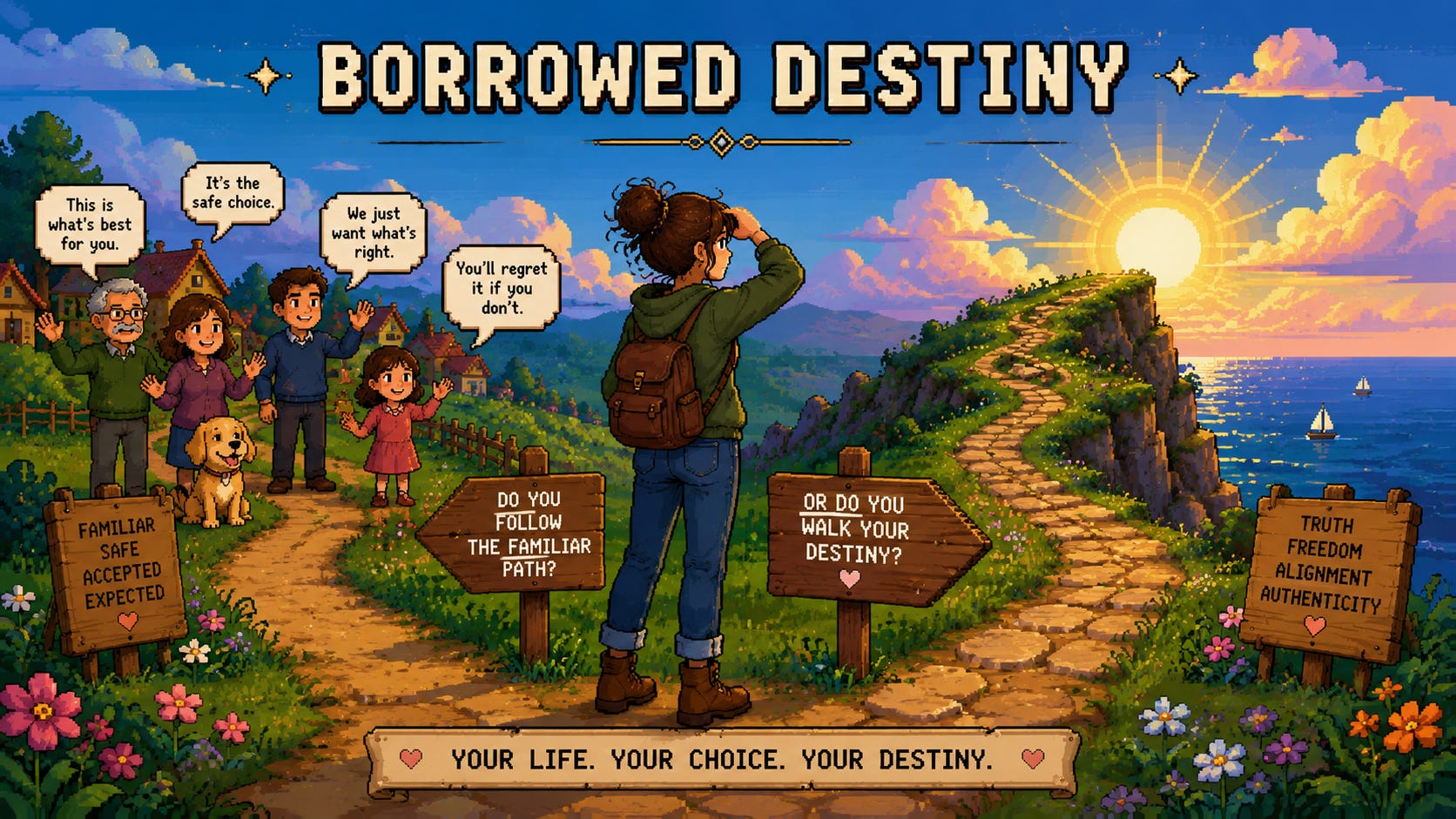
We can become the fixer, the quiet one, the rescuer, the disappointed one, the responsible one, or the next person in the family line who must struggle because struggle seems to be the family language. This is where the teaching of ‘Borrowed Destiny’ begins, in that sensitive and confusing place where our Inner Child mistakes inherited emotional patterns for truth and begins to believe, “This is who we are. This is what happens to people like us. This is our fate.”
In this journal post, we will explore how our Inner Child can adopt a family identity and conflate belonging with emotional fusion. We will look at the idea of a family spell not as something mystical but as a recurring belief system passed from one person to another through fear, silence, duty, expectation, and unconscious storytelling. We will also examine why individuality can seem frightening when our Inner Child believes that becoming authentic means betraying the family. Most importantly, we will return to Shen, our spiritual essence, which reminds us that we arrive into this life whole. Family may shape us, but family emotions do not own us. We may love our family deeply, but we do not need to inherit their unhappiness as proof of loyalty.
The Family Spell
A family spell is a pattern that has been repeated for so long that nobody remembers who first believed it. It may sound like, “People in our family never get what they want.” “We are unlucky in love.” “Happiness never lasts here.” “You must carry the burden because that is what good people do.” These sentences may never be spoken directly, yet our Inner Child absorbs them through the atmosphere, tone, reactions, silence, facial expressions, disappointment, and the emotional habits of the home. Over time, the spell becomes a shared emotional climate. Everyone breathes it in, and because everyone seems to, our Inner Child concludes that it must be reality.
This is why many people do not see themselves as individuals. They see themselves as part of the family story. They believe their worth comes from being useful to the collective, loyal to the pain, obedient to the old script, and willing to stay inside the same emotional house even when every room seems too small. Our Inner Child may pressure us with the belief, “If we become ourselves, we will no longer belong.” This is ‘Emotional Logic’, not ‘Shen Logic’. Shen knows that real belonging does not require self-erasure. The Tao does not ask the river to become the mountain to prove that it belongs to the landscape. Each has its nature, its movement, its place, its beauty.
‘We do not break the family spell by rejecting the family; we soften it by refusing to confuse love with self-abandonment.’
When our Inner Child takes on family unhappiness as destiny, it often believes it is being loving. It says, “If they suffered, I must suffer too.” “If I become happier than they were, I am disloyal.” “If I step into freedom, I leave them behind.” These beliefs can create a deep red-light emotion because our Inner Child is not only afraid of change but also of becoming separate. Yet separation is not the same as rejection. Authenticity is not cruelty. Growing into Shen does not erase our love for others; it makes that love cleaner, calmer, and less entangled with guilt.
The One-Person Play
There is a powerful moment when we realise that much of the emotional drama we believed was happening outside us is being maintained inside us. We may have cast ourselves as the victim of the family spell, then waited for someone else to arrive as the rescuer. We may have imagined that love, approval, family change, or a perfect apology would finally break the spell and make us happy. Yet the magic wand was always in our hands because the belief was always being created within us. This is not to blame. This is authorship. It is the moment we realise the play has been performed by our Inner Child, directed by old fear, watched by our emotional system, and repeated because the ending seemed familiar.
Our Inner Child may complain, “But if nobody saves us, we are alone.” Shen gently reveals another truth. We are not alone when we stop waiting to be rescued; we are finally in relationship with ourselves. The fantasy of rescue often seems comforting because it allows us to postpone responsibility. One day, someone will understand, the family will change, the spell will lift. One day we will be chosen, seen, released, and made whole. Yet our Taoist teaching brings us back to ‘The Power of Three’: truth, honesty and integrity. Truth says we create our own emotions. Honesty says we may have been waiting for others to permit us to live. Integrity says we can begin choosing differently today.
Our Tao Te Ching translation reminds us in Verse 33, “Truly knowing yourself and enjoying your journey, it also means sincerely knowing the Oneness of the Tao.” This is a beautiful correction to inherited identity. Knowing ourselves does not disconnect us from Oneness. It helps us authentically participate in Oneness. We are not meant to disappear into the family’s collective emotion. We are meant to bring our clear Shen into relationship with life. When we know ourselves, we stop acting from the old performance and begin living from inner truth.
The Fear of Being Real
One of the most honest questions we can ask is, “Do we know how to be ourselves?” At first, this question may seem frightening because the role has been practised for so long. If we are no longer the generational victim, who are we? If we are no longer the rescuer, what do we do with our caring nature? If we are no longer waiting for someone to break the spell, what do we do with our hope? This is where our Inner Child may pester us to return to ‘The Pit of Familiarity.’ Familiar unhappiness can seem safer than unknown authenticity because the old role gives us instructions. It tells us how to behave, what to expect, and why nothing can change. Shen gives us something quieter and more powerful: choice.
Often, when the old role softens, our true qualities remain. We may discover that we are still caring, kind, loving, thoughtful, creative, steady, humorous, and capable. This is a beautiful “aha” moment because our Inner Child believed that if the family role disappeared, we would disappear with it. But the role was never our essence. It was a costume. A well-practised costume, and convincing costume, perhaps. But Shen was always beneath it, waiting patiently, not demanding applause, not needing a stage, not asking anyone else to validate its existence.
‘The self we fear losing is often only the role we were tired of performing.’
This is where ‘The Shen Test’ becomes essential. When a red-light emotion rises around family, belonging, loyalty, guilt, or independence, we pause and ask, “What belief is creating this emotion?” Then we ask, “Does this belief reflect Shen, or does it protect the family spell?” If the belief says, “I must be unhappy to belong,” it fails ‘The Shen Test’. If the belief says, “I can love my family and still live authentically,” it brings us closer to alignment. If the belief says, “I am only worthy as part of the family identity,” it is ‘Emotional Logic’. If the belief says, “My worth is innate, and my relationships can flow from that truth,” we are listening to ‘Shen Logic’.
Choosing a New Lineage
The most loving thing we can do for a family pattern is to stop unconsciously passing it on. This does not require blame. It requires awareness. In our previous teaching, we said, “We are not here to serve a role. We are here to live a life.” That line belongs at the heart of ‘Borrowed Destiny’ because it restores the distinction between love and performance. We can honour where we came from without becoming trapped by what others never questioned. We can care for people without carrying their emotional responsibilities. We can respect the past without treating it as a command.
The ‘Golden Thread Process’ helps us make this practical. We begin with the emotion, perhaps guilt, fear, sadness, resentment, or pressure. We follow it back to the belief. Maybe the belief says, “A good family member never disappoints anyone.” Then we follow deeper. Maybe beneath that is, “If I disappoint them, I will be rejected.” Then deeper still. Perhaps we find, “I am only safe when I am approved of.” Now we are no longer lost in the ‘Maze of Confusion’. We have found the thread. We can bring the belief into the light and ask whether it is true, honest, and aligned with integrity.
So, our new lineage begins with one conscious choice. We may choose to speak more honestly. We may choose to stop rescuing when rescuing is really control disguised as love. We may choose to let others have their emotions without making those emotions our identity. We may choose to stop using family unhappiness as evidence that happiness is unrealistic. We may choose to become living proof that a pattern can end gently, without war, without drama, without CCJ.
This is the quiet power of wu wei; we do not need to fight the family spell as though it were an enemy. We stop feeding it with unquestioned belief. We stop repeating the line, “This is our destiny,” and begin practising a truer one: “This was a pattern, and now we bring awareness to it.” We stop waiting for a rescuer and become lovingly responsible for our own choices. We stop calling ourselves victims of the family story and begin living as students of the Tao, guided by Shen, aligned with truth, and willing to take one manageable step at a time.
Let us bring ‘Borrowed Destiny’ to a warm and hopeful close. We may have inherited emotional weather, but we do not have to become the climate. We may have been handed roles, but we can set them down with kindness. We may have acted in the one-person play for many years, but we can smile gently at our own performance and choose a new scene. Never doubt yourself because the old story still nags loudly. Loudness is not wisdom. Familiarity is not destiny. Begin where you are, with one red-light emotion, one honest question, one belief examined through ‘The Shen Test’, and one small step toward authenticity.
The magic wand was never outside us. It was awareness. It was a choice. It was Shen. And when we choose truth, honesty and integrity without expectations, without forcing, and without CCJ, we do not abandon our family. We become the place where the old spell begins to soften, and where a new way of living can quietly begin.
Moments of Inspiration…
Clear-Eyed Hope
Being an optimistic realist means we do not deny the rain, but we also do not forget the sky. We look at life honestly, without pretending everything is easy, while still trusting that every challenge can reveal a doorway, a lesson, or a deeper return to Shen.
Our Inner Child often believes optimism means disappointment waiting to happen. It may say, “Do not hope too much,” or “Prepare for the worst, then you cannot be hurt.” Yet this is not wisdom; it is protection dressed as realism. True realism is not fear. True realism sees what is here, names it clearly, and then asks, “What is the next honest step?”
This is where wu wei becomes so practical. We do not force a bright feeling over a difficult moment. We breathe, observe, and align. We allow truth, honesty, and integrity to guide us, knowing that peace is not found by controlling every outcome, but by meeting life with steady presence.
To be an optimistic realist is to say, “Yes, this may be difficult, and yes, we have the inner wisdom to walk through it.” We do not need fantasy, denial, or emotional drama. We need grounded hope, compassionate clarity, and the courage to trust the quiet strength already within us.
Affirm: “We see life clearly, we meet it kindly, and we trust our Shen to guide the next step with wisdom, courage, and peace.”
This week, let us choose one situation we have been fearing and meet it with calm honesty, not panic. Let us ask what is true, what is useful, and what brings us back into alignment.
In the Next ‘Inner Circle’ (Paid) Journal…
The Quiet Compass
Joy Without Permission
Reality Without Dreams
Moments of Inspiration
In the Next Free Journal…
No Rescue Needed
Almost Accountable
The Honest Path
Moments of Inspiration
Journal #F089 13/07/2026
Contact: info@wuweiwisdom.com
Website: www.wuweiwisdom.com
YouTube: www.youtube.com/user/WuWeiWisdom
Facebook Community: www.facebook.com/groups/wuweiwisdomcommunity/