
Borrowed Happiness
This week we discover the joy of flowing, silencing the 'Monkey Mind' and learning to trace emotions back to their source. Finally, the beauty of the unknown.

“I no longer borrow happiness from tomorrow's dream; I return to this moment, open and unguarded, where the Tao meets me with quiet generosity. Here, in the stillness of ‘now’, I rediscover that I was never lacking, only waiting to trust myself.”

Have you ever paused long enough to notice how often happiness seems borrowed from the future? Building entire inner lives around anticipation, hope, or the promise that something later will finally allow us to relax into ourselves? And if that future promise were gently removed, would we trust what remains, or would our Inner Child protest, panic, and pressure us to find another dream to cling to?
In this journal post, we examine a subtle yet powerful pattern many of us live within without questioning. It is not about ambition or creativity, both of which are natural expressions of life. It is about dependency. The dependence on dreams, goals, people, achievements, or even on habits such as needing, wanting or planning, not for what they are in themselves, but for the emotional states we believe they will generate. We will examine why our Inner Child becomes attached to future-oriented promises, why emptiness appears threatening rather than fertile, and how Taoist wisdom invites us into a radically different relationship with happiness, purpose, and authenticity.
This matters because borrowed happiness is never stable. When it depends on outcomes, it quietly keeps us anxious. When we do not understand where our emotions come from, we can spend years chasing experiences that were never meant to carry the weight we place on them. Together, we will gently question these beliefs, not to strip life of meaning, but to return meaning to its natural home.
The Emotional Economy of the Inner Child
Our Inner Child does not use Shen logic. It uses emotional logic. Emotional logic is simple, immediate, and reactive. It says, “When I get this, I can relax,” or “When they respond like that, I am safe,” or “When this dream succeeds, I will finally be happy.” This logic is not foolish; it is immature. It was formed early, often in environments where attention, approval, or stability seemed inconsistent. From those experiences, our Inner Child learned to create strategies.
Dreams can become one such strategy. So can hope. So can wanting, needing, planning, fantasising, or constantly trying to improve ourselves. Each of these can seem productive, even admirable. Yet underneath, there may be a belief quietly operating: “I am not enough as I am right now.” From that belief, emotions are created. Excitement is generated when the dream seems close. Fear is elicited when one perceives a threat. Anxiety is invented when the future ‘feels’ uncertain. None of these emotions is wrong. They are signals.
The Tao invites us to look beneath the emotion rather than argue with it. If we believe a dream is required to generate happiness, then fear will naturally arise at the thought of losing it. This fear is not about future events; it is about identity. “Who am I if I am not moving toward something? Who am I if I stop striving? Who am I if there is no imagined reward waiting for me?”
Our Inner Child often answers these questions with alarm. It nags, complains, and pressures us to keep going, even when we are exhausted. It chastises us for slowing down. It reproaches us for resting. It badgers us with urgency. This is not because it wants to harm us, but because it believes that striving equals safety and that ‘chasing the dream will bring happiness’.
Emptiness Is Not Absence
One of the most misunderstood concepts in Taoist wisdom is emptiness. Our Inner Child hears the word and translates it as nothingness, loss, or meaninglessness. From an emotional logic perspective, emptiness seems dangerous. If there is nothing to chase, nothing to anticipate, nothing to fix, then what will generate warmth, joy, or happiness?
The Tao offers a different understanding. Emptiness is not absence; it is capacity. It is space. It is openness. It is the condition that allows life to move. In one of the lesser-quoted passages of the Tao Te Ching, we are reminded that “The Tao opens and closes like a pair of bellows. Empty, yet never exhausted; the more it moves, the more it produces.” This teaching is not poetic decoration; it is practical instruction. What appears empty is not depleted. What is not grasping is not lacking. What is open can receive.
When we constantly fill our inner world with dreams, plans, and future bargaining, we leave no space for authenticity to emerge in the ‘now’. We become emotionally busy. Our Inner Child stays occupied, but the Shen remains unheard. Emptiness, when allowed, does not erase us. It reveals us. This is why the fear of giving up a dream is rarely due to boredom or a lack of purpose. It is about mistrust. A mistrust that something genuine could arise without effort, control, or projection.
Hope as a Substitute for Authenticity
Hope is often celebrated as a virtue, and rightly so, when it arises authentically. Yet hope can quietly become a substitute for authenticity. When we hope instead of engage, imagine instead of inhabit, and anticipate instead of align, we live one step removed from our own lives.
Our Inner Child often prefers hope to authenticity because authenticity requires accountability. Hope allows delay. Hope says, “Later.” Authenticity says, “Now.” And “Now” it can seem confronting when we have unresolved issues we would rather avoid.
Shopping, for example, can appear harmless, even enjoyable. Yet when it becomes a way of generating emotional uplift, it reveals a belief that well-being must be externally stimulated. The same is true of dreams that depend on recognition, approval, or future success. We are not wrong for wanting these things. The confusion arises when we believe they are the source of our emotional state.
From the Taoist understanding, we create our own emotions. Others cannot put emotions into our bodies, nor can they take them away. What we experience emotionally results from how we interpret, believe, and assign meaning. When we assign happiness to a future condition, we also assign fear to its absence. Wu wei invites us into a different relationship with life. It does not ask us to abandon dreams. It asks us to stop using them as emotional leverage.
Purpose Emerges, It Is Not Invented
When someone begins to see through their attachment to dreams, the mind often rushes to replace them. “I need a new purpose,” it says. Something independent. Something that does not rely on others. Something meaningful but safe.
This urgency itself is revealing. It shows how uncomfortable we are with open space. Yet the Tao never suggests that purpose must be invented. Purpose is not a job description we assign ourselves. It is an expression that arises when we are aligned with the Tao.
In the I Ching, there is a teaching that speaks to this beautifully. In Hexagram 24, Return, the emphasis is not on advancement but on coming back to what is essential. The commentary reminds us that progress does not always mean moving forward; sometimes it means realigning with what was always true. When we stop forcing direction, direction clarifies.
Writing, teaching, consulting, creating, sharing insight, or simply living attentively are not purposes to cling to. They are natural life movements, not ones we use to compensate for insecurity. When our Inner Child stops using activity to bargain for worth, authenticity becomes effortless.
We often forget a simple, essential truth: tending to ourselves is not selfish, it is sacred. In fact, the opposite is true; it becomes a form of quiet selfishness when we don’t. When we refuse to take responsibility for our own care in the “Now”, attention, and emotional nourishment, we place that weight onto others, asking them to carry what is ours alone to hold.
When we choose to attend to ourselves, “Now”, something beautiful begins to unfold: we no longer seek attention as a substitute for self-attunement. We no longer crave recognition or approval because we are providing it for ourselves, from the inside out. Self-attention is not indulgence; it is integrity. It is a conscious act of alignment, a declaration that we are worthy of the love, guidance, and care we so willingly give away to others.
This, then, is the path of maturity, not in age, but in spirit. It is the sacred responsibility of our Shen, our inner spiritual essence, to parent our Inner Child with clarity and compassion. Rather than allowing our ‘little one’ to dictate our emotional weather through outbursts, neediness, or withdrawal, we gently lead them. We say, “I see you. I hear you. But we no longer need to scream or project into the future to be noticed. I am here now. I will not abandon you again.”
Many of us were conditioned to believe that self-care is selfish, that putting our needs first is a betrayal of love or duty. But the Tao reminds us of a deeper rhythm, a natural flow that honours balance and interconnection. When we pour from an empty cup, we are not generous; we are depleting. True giving comes from fullness, from abundance. And that abundance begins within.
This is not selfishness. This is self-responsibility, the highest act of emotional and spiritual maturity. To care for ourselves every day with dignity and discipline is to model wholeness. It liberates others from the burden of saving us and frees us from the illusion that we must earn love in the future by being needed.
When we look to others or our dreams to provide what we will not offer ourselves, we become spiritually dependent. But when we honour our needs, through rest, reflection, honest enquiry, and loving boundaries, we reconnect with the Tao, the natural flow that never demands, only invites.
Returning to Flow
Flow is not something we impose on ourselves. It emerges when resistance softens. Wu wei, effortless effort, is not inaction. It is action without emotional manipulation. When we stop trying to manufacture future happiness, we notice something unexpected. There is already a baseline of okayness available. Not excitement, not euphoria, but stability. From that stability, genuine joy can arise without conditions.
In one of our previous journal reflections, we wrote, “When we stop negotiating with the future, life meets us in the present with surprising generosity.” This is not philosophy; it is observable truth. Small, consistent, and manageable steps are essential here. Not steps toward becoming someone else, but steps toward honesty. Toward noticing beliefs. Toward questioning emotional assumptions. Toward reducing CCJ, Criticising, Comparing, and being Judgmental, especially toward ourselves.
Alignment is not dramatic. It is subtle. It is choosing not to abandon ourselves to promises that may never be fulfilled. It is trusting that who we are, here and now, is not empty, not lacking, and not unfinished.
A Gentle Closing
We began this reflection by questioning the concept of ‘Borrowed Happiness’. We end by remembering where happiness truly lives. It does not live in dreams, though dreams may visit. It does not reside in outcomes, though outcomes may arrive as expected. It lives in authenticity, alignment, and trust in our own capacity to meet life as it is, in the “Now”.
When we stop borrowing happiness from the future, we discover it was never missing. It was waiting beneath the noise of anticipation. Let us move forward gently. Without urgency. Without self-attack. Without expectation. Let us take small, consistent steps back into ourselves, guided by honesty and kindness. Let us remind our Inner Child that it no longer needs to bargain, pressure, or perform.
And as we do, may we return again and again to the quiet wisdom at the heart of ‘Borrowed Happiness’, remembering that nothing real has ever been dependent on a dream.
A Taoist Journey into Stillness and Self-Trust
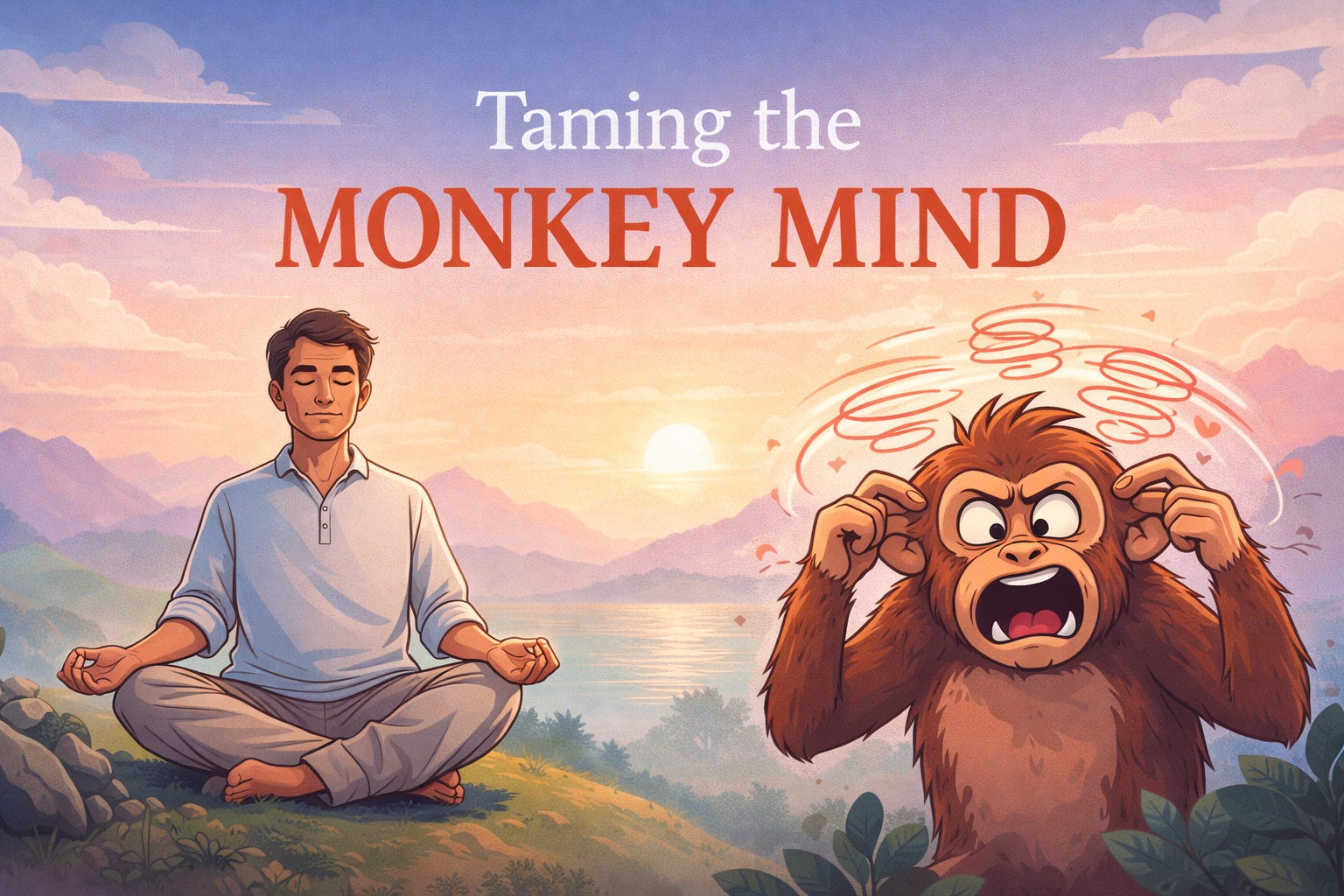
Have you ever caught yourself spiralling into a web of thoughts that seem to multiply faster than you can manage? Do your thoughts ever seem louder than your Shen, leading you further from clarity and deeper into uncertainty? Has your inner world ever seemed less like a sanctuary and more like a noisy street market, voices pulling you in every direction? You are not alone. What you are experiencing is not a flaw nor a failure, but a part of the human condition that Taoist sages have known for centuries: the ‘Monkey Mind’.
In this journal post, ‘Taming the Monkey Mind’, we explore how to gently disempower this restless voice, not by force, not by fear, but by truth, compassion, and alignment. Together, we’ll discover that this mental chaos is often the voice of our Inner Child, desperately searching for certainty, safety, and control. And through Taoist wisdom and the gentle grace of wu wei, we’ll learn how to quiet the noise, return to stillness, and reclaim our inner peace.
This isn’t about trying to be calm. This is about remembering that we already are calm. That stillness is not something we create; it is something we return to. The ‘Monkey Mind’ is not our enemy, but it must not be our guide. Let us walk together into a deeper understanding of what it is, where it comes from, and how to lay it down gently.
The Monkey Mind: Not Broken, Just Misguided
The ‘Monkey Mind’ is an ancient metaphor for the part of our consciousness that is restless, reactive, and overly analytical. It jumps from thought to thought, grasping, fearing, calculating, judging. Its voice is rarely quiet. It negatively questions everything, anticipates disaster, and tries to protect us by preparing for the worst. But it is not truly protecting us; it is exhausting us.
The ‘Monkey Mind’ is the language of our Inner Child’s emotional logic. It doesn’t speak in grounded truths; it speaks in panic, urgency, and doubt. It is our Inner Child badgering us: “What if this goes wrong?” “What if they leave?” “Did I do enough?” “Should I have said that?” “Am I falling behind?” And because the monkey mind is so persistent, we often mistake its voice for the truth.
But the truth doesn’t shout. Truth doesn’t harass. Truth doesn’t torment. Shen, the energy of truth and spiritual alignment, whispers calmly. It waits. It does not try to convince. It invites. To tame the monkey mind is to turn down the volume of emotional logic and tune into Shen’s clarity. Not because the monkey is bad or wrong, but because it is tired. It is overwhelmed. It is doing a job it was never meant to do.
Wu Wei: Effortless Effort, Natural Stillness
One of the most beautiful teachings of Taoism is wu wei, often translated as “effortless effort.” But what does this mean for our overthinking? It implies that clarity doesn’t come from more thinking. It means we don’t battle the monkey; we stop feeding it.
When we stop trying to control the uncontrollable, when we stop demanding answers from questions that don’t matter, when we stop chasing reassurance through analysis, we enter wu wei. We return to a place where doing less accomplishes more, and where truth emerges not through strategy but through alignment.
Trying to think our way into peace is like trying to stir still water into calm. The more we stir, the more muddied the water becomes. The Tao teaches: “When nothing is done, nothing is left undone.” In other words, when we stop interfering, truth has space to arise. That space is your natural state. That stillness, that clarity, that quiet strength, has never left you. It has only been covered by emotional noise.
The monkey is loud because it doesn’t trust. It believes you must do something, anything, to feel better. But wu wei is the courage to pause, to listen, to allow truth to arise in its own rhythm.
Hearing our Inner Child Beneath the Thoughts
Behind every storm of overthinking is a frightened voice. Our Inner Child, through the monkey mind, is often trying to protect us using the only strategy it knows: over-preparing, over-analysing, over-functioning. It is like a child lost in a crowded place, shouting your name because it thinks you’ve disappeared. But you haven’t disappeared. You’ve forgotten to lead.
The monkey mind nags because our Inner Child doesn’t yet trust you to listen. So, it panics. It makes up stories. It demands action. This is not because you are weak or broken. This is because part of you learned to associate stillness with danger and control with safety.
Our work is not to silence the child, but to guide it. We must become the wise, calm parent it never had. We create what we call a ‘Shen Sanctuary’ within, a space where truth, trust, and spiritual honesty reside. We speak to our Inner Child, not in anger, but with leadership: “I know you’re scared. But I’m here now. I will not abandon you. We are safe. We do not need to chase every thought. Let’s breathe together.”
In this sanctuary, we do not solve every thought. We do not respond to every fear. We do not rehearse every possible outcome. Instead, we build a foundation of trust and truth, not tactics. Alignment, not answers. This is what tames the monkey.
From Mental Noise to Mindful Stillness
We must relearn how to use our minds, rather than letting our minds use us. Our minds are brilliant, creative, adaptive tools. But when our Inner Child’s fears power them, they become compulsive, obsessive, and disorienting. They no longer reflect reality; they distort it.
‘Taming the Monkey Mind’ means no longer believing every thought is true. It means recognising that just because an idea is loud, it doesn’t mean it’s wise. Just because it seems urgent doesn’t mean it’s essential.
Mindfulness in the Taoist sense is not about perfect focus or an empty mind. It is about returning to what is true, again and again. We breathe. We ask: “What belief created this storm?” We listen, not to the thoughts, but to our Shen. We stop searching and start observing.
As the I Ching teaches in Hexagram 52: “Stillness within leads to clarity without.” This doesn’t mean passivity; it means presence. It means stillness, not as inactivity but as integrity. And so, we rest, not because the monkey has stopped, but because we no longer need to follow.
A New Relationship with Thought
The goal is not to erase our thoughts, to silence the mind or banish its chatter, but to recognise that not every thought is worthy of our trust. Thoughts are part of human experience, a natural flow of mental activity. Yet, we must learn to stop treating every thought as a sacred truth or a reliable guide. Many are simply emotional echoes, the voice of our Inner Child attempting to avoid discomfort, responsibility, or vulnerability. They often seem honest, but they are born from fear, not wisdom; from past pain, not present clarity. Their intention is not to illuminate, but to distract, to preserve old familiar narratives and deflect the quiet invitation to grow.
This is where discernment becomes essential. Just as we tune a radio to the right frequency to hear music clearly, we must learn to distinguish between the static of the monkey mind and the calm resonance of Shen. The monkey mind is immediate, loud, and reactive. It pushes, panics, and persuades. It speaks from urgency, trying to future-proof our emotions. Shen, on the other hand, whispers. It allows space. It invites presence. Its voice encourages us to drop our shoulders, breathe deeply, and respond from a place of authenticity, truth, and love. When we learn to pause, to create a small space between thought and reaction, we begin to hear Shen more clearly, and that is where real guidance resides.
When the monkey says, “They made me feel rejected,” we must pause. Others do not give us emotions. That sense of rejection is our Inner Child interpreting an experience through an old belief: “I’m not lovable unless I’m approved of.” When the monkey says, “I must fix this now,” we ask, “What happens if I don’t?” And in the silence, we may find the truth: nothing is broken. Nothing needs fixing. Only guiding. Only truth. Only love. Thought becomes trustworthy again when it is filtered through Shen. We return to a place where our thoughts reflect, not distort, our truth.
Living from Stillness, Not Struggle
To live in alignment with the Tao is not to stop thinking; it is to stop struggling. It is to return to the calm centre within and to stop chasing safety through control. We remind ourselves: “We are not the thoughts. We are the one who hears them. We are not the monkey. We are the tree it swings from.”
And we are not broken. We are awakening. With each breath, we teach our Inner Child something new: you are no longer alone. You are no longer powerless. You are no longer at the mercy of the noise. You are loved. You are led. You are home. This is what it means to live in wu wei. To live from truth, not turmoil. To trust the unfolding, even when we do not understand it. To let the monkey rest, and let Shen rise.
Taming the Monkey Mind: A Daily Practice
Each time we observe without reacting, we take a step closer to stillness. Each time we pause rather than analyse, we honour our Shen. Each time we speak to our Inner Child with clarity and compassion, we rebuild trust.
And this is the path. Not perfect. Not always quiet. But always honest. Always loving and always returning. Let this week be your practice. Let the monkey mind chatter if it must. You are not here to fight it. You are here to guide it. Not by force, but by truth. Not through rushed answers, but through calm alignment. Not with shame, but with leadership. Affirm: “I no longer follow every thought. I choose stillness over noise, wisdom over worry, and alignment over control. My Shen is my guide, and in its truth, I am safe, calm, and free.”
Take this with you. One breath at a time. One choice at a time. One moment of honesty at a time. Together, let us walk in the truth of ‘Taming the Monkey Mind’. Let us live from stillness, not struggle. And let us never again mistake noise for wisdom. You are already the calm you seek. You are already the clarity you crave. All that’s left… is to return.
Shall we begin?
Have you ever caught yourself doing something out of habit, not because it was wise or nourishing, but simply because it was familiar? Have you noticed how one emotion can spill into the next, how frustration in the morning quietly snowballs into impatience, anxiety, and even disconnection by the evening? This is emotional momentum, the unspoken force beneath the surface of our lives, where unconscious choices take root and slowly steer us away from the authenticity of our Shen.
When we move through life unaware of the beliefs that drive our emotional habits, we are swept along by patterns we did not consciously choose. The Taoist path reminds us that while these habits may seem natural or inevitable, they are not reflections of our true nature. They are echoes, created and recreated by our Inner Child’s emotional logic, not our Shen’s quiet wisdom. This journal post explores how to recognise emotional momentum, trace it back to its source, and gently redirect it using the power of wu wei, effortless effort. We will examine how each emotion is not a master but a messenger, and how every recurring feeling points to a belief ready to be questioned and realigned.
Let’s slow down together and begin to turn toward what we often avoid, those familiar yet unchallenged inner patterns. This is not a call for dramatic change, but for gentle awareness. As we open space within, we invite clarity, balance, and choice to return. With each small act of accountability, we loosen the grip of emotional momentum and allow our Shen to lead.
The Invisible Engine of Habit
What propels our behaviour when we’re not fully present? It’s rarely logical. More often, it is an emotion we’ve learned to follow, resentment disguised as fairness, guilt mistaken for love, or worry confused with care. ‘Emotional Momentum’ is created when our Inner Child responds to the world through emotional logic. It nags, pressures, complains or criticises, insisting that emotions mean truth and that comfort lies in repetition, not awareness.
We do not create emotional habits in adulthood; they are often remnants of beliefs formed in childhood, carried forward unchecked. Our Inner Child draws on these early conclusions to interpret new experiences. If that part of us believes safety comes from avoidance, then anxiety becomes the daily ritual. If worth is tied to achievement, then busyness becomes the disguise for self-doubt.
And once a belief takes root, it rarely stays idle. Emotions begin to repeat. One anxious thought gives rise to bodily tension, which in turn becomes irritability, then overthinking, and perhaps withdrawal. Each stage seems separate, yet they are parts of the same momentum, a river that, once flowing, gathers strength with every emotional choice we leave unquestioned.
Taoist wisdom asks us to pause not when the river floods, but at the first ripple. The ‘Golden Thread Process’ question: “What if this emotion is a product of a belief I’ve never examined?”
This single question can interrupt ‘Emotional Momentum’. The ‘Golden Thread Process’ teaches us to follow the emotion back to its cause, recognising that every feeling is a creation, not a commandment. We might begin with anger and discover beneath it the belief, “No one respects me,” which, in turn, reveals a deeper belief: “I am not worthy unless I am in control.” In that awareness, space opens. Momentum softens. Choice returns.
The I Ching and the Power of Course Correction
The I Ching speaks to this concept of redirection through Hexagram 18 (Ku / Correcting the Decay), a powerful reminder that while disharmony may set in slowly and subtly, so can renewal and alignment. This Hexagram teaches that inherited patterns and habits must be acknowledged with clarity and corrected with intention, not through blame or force, but through honest observation and gentle intervention. “If decay has set in, do not conceal it. Step into awareness, and bring renewal through right action.” — I Ching, Hexagram 18
This guidance reflects the Taoist understanding that we are never trapped by what was; we are empowered by what we now choose to see. The decay isn’t just moral or societal; it can be emotional, habitual, or relational. The “correction” begins when we stop protecting the belief that created the problem.
This doesn’t mean interrogating every passing mood, but rather learning to notice when we’re moving from automaticity to alignment. A habitual sigh when a particular person enters the room, the rising tension during traffic, the nightly scroll through distractions, each is an opportunity to ask, “Where did this begin? What belief am I still following?”
Distinguishing Emotional Origins: Shen or Inner Child?
Not all emotions are misaligned. The Tao Te Ching teaches that emotions arising from Shen are stabilising, grounding, and clear. These include peace, contentment, and calm; they do not demand, they simply are. Emotions from our Inner Child, however, tend to insist, nag, harangue, or dramatise. They want to control or be rescued. If we listen without awareness, we may begin to believe they are true.
But there is a subtle difference. The Shen says, “This is enough,” while the Inner Child nags, “I’m not getting what I want, so I must be unworthy.” In Verse 33 of the Tao Te Ching, we are reminded: “Knowing others is intelligence, knowing yourself is wisdom. Mastering others requires force; mastering yourself requires strength.”
True emotional strength is not suppression, but discernment. We begin to master ourselves not by denying what we feel, but by knowing which part of us is speaking. When we choose to respond from Shen rather than react from habit, we change the entire course of our emotional day.
Interrupting the Current: Returning to wu wei
So, how do we shift emotional momentum without aggression, judgment, or urgency? The answer lies in wu wei, effortless effort, the art of aligning with the natural flow rather than forcing outcomes.
If a belief has hardened into a pathway, we do not try to erase it overnight. Instead, we walk a new path alongside it, gently, consistently. We replace the emotional shortcut with conscious attention. When anxiety urges us to control, we pause and remind ourselves, “Control is not certainty. I can choose trust.” When sadness leads to helplessness, we might ask, “What expectation have I created that is not aligned with reality?”
The ‘Golden Thread Process’ becomes our compass here, not a technique of repair, but a practice of recognition. We trace the emotion back to its source, understand the belief that gave rise to it, and then reframe that belief from Shen’s perspective.
Let’s say we notice the familiar momentum of guilt every time we rest. The Inner Child might believe, “If I stop, I am lazy,” or “I must be productive to be loved.” That guilt creates restlessness, which morphs into resentment, then into exhaustion, and finally into emotional collapse. But with awareness, we return to Shen’s wisdom: “My value does not depend on effort. My rest is a part of my rhythm.” This shift isn’t dramatic. It’s subtle and quiet. But it interrupts the current. It creates space for us to choose again.
Momentum or Alignment? A Daily Invitation
Every day offers us a simple invitation: continue with ‘Emotional Momentum’ or return to Shen alignment. This is not about controlling each moment, but becoming more honest about what drives us.
The challenge is consistency. Our Inner Child will complain, “But it’s too hard,” or “It won’t make a difference.” It will reproach us for not changing fast enough, criticise our setbacks, and compare us to others. That’s its logic, emotional, impatient, and reactive. But we respond not by silencing that part, but by leading it. We model patience. We remind ourselves, “One step in alignment is more powerful than a thousand emotional reactions.”
This is the essence of Taoist living. Small steps. Conscious pauses. Shifting beliefs without blame. Interrupting emotion with awareness. Replacing CCJ—Criticism, Comparing and being Judgmental—with clarity, curiosity, and compassion. ‘Emotional Momentum’ is not a sentence. It’s simply a direction. And directions can be changed.
Concluding in Flow
As we close this exploration of ‘Emotional Momentum’, let us reaffirm what is most essential: habits are not our masters, and emotions are not our truths. They are meaningful, vivid, and powerful, but they are not sovereign. They do not arise from nowhere. They are created by us, shaped moment by moment through the lens of what we believe. This is not blame; this is empowerment.
We are not at the mercy of our emotional weather. We are the sky, wide, spacious, unchanging, while emotions pass through like clouds, each one coloured by the belief that birthed it. In our teachings, we often return to what we call the ‘first domino’ or the ‘fountainhead’, that original belief or thought that triggers the cascade of reactions that follow. If we do not trace our emotions back to their source, we risk treating their effects as causes and following momentum rather than truth.
So let us celebrate our emotions, not silence them, not shame them, but honour them as beautiful signals. They are messengers, not masters. They invite us to look inward, to ask, “What belief created this?” And then, from that awareness, choose our next step not from the emotion itself, but from the more profound belief beneath it. This is the art of wu wei, the quiet strength of responding with clarity rather than reacting with confusion.
‘Do not put the cart before the horse.’ Do not act from emotion and assume it reveals your truth. Instead, act from the belief you choose to hold, one aligned with integrity, balance, and love. That is emotional maturity. That is alignment with Shen. And that is where peace begins to move again, like a gentle current returning us to ourselves.
Let’s not wait for breakdowns to make breakthroughs. Let’s begin with the next emotion, the next thought, the next breath. Ask the question: “Is this the voice of my Shen or my Inner Child?” If it is the latter, pause. Listen. Reframe and return to Shen.
We need not rush. The Tao flows quietly, without haste, and so may we. No need for declarations or perfection. Just minor, loving corrections that, over time, transform the entire river. Affirm now: “I choose to lead my emotions with clarity and wisdom. I honour the voice of my Shen and gently guide my Inner Child toward alignment. Each step I take is enough.”
Let us walk forward, not swept along by momentum, but carried by the current of integrity, clarity, and spiritual truth. In the rhythm of these small, consistent choices, ‘Emotional Momentum’ dissolves into the grace of effortless living.
This is the way of wu wei. This is the quiet power of living aligned.
Moments of Inspiration…
The Beauty of the Unknown
How often do we rush to fill the gaps of not-knowing, reaching for answers that promise safety, control, or closure? Our Inner Child, longing for certainty, often mistakes ambiguity for danger. But the unknown is not the enemy; it is the silent doorway to our deepest becoming.
Taoism teaches that life need not be grasped to be trusted. The Tao flows, not because it is certain, but because it is aligned. What we cannot predict, we can still honour. What we do not understand, we can still meet with presence. In fact, the greatest transformations rarely arrive wrapped in clarity; they emerge softly, often unnoticed, when we stop demanding explanations.
The unknown invites us to loosen our grip. To make space. To pause the constant inner dialogue and listen instead for the quiet voice beneath. This voice, the Shen, does not shout. It doesn’t deal in guarantees. It whispers: “You are already enough to face what comes.”
When we resist uncertainty, we live in contraction. When we welcome it, we begin to glide with life’s natural rhythm. This is the essence of wu wei, effortless effort, not forcing forward, but moving with what unfolds.
Let the unknown become your teacher, not your threat. Let it open you, not diminish you. Because within the uncharted lies the untouched, and within the untouched waits your truest self.
Affirm: “I walk with trust into what I do not yet understand, guided by the quiet wisdom within.”
Pause this week. Reflect gently. Where are you rushing for answers that the Tao has not yet revealed? Could this moment of not-knowing be the very space where clarity is waiting to blossom?
In the Next ‘Inner Circle’ (Paid) Journal…
The Unclenched Hand
Beyond the Reaction
The Carousel Stops Here
Moments of Inspiration
In the Next Free Journal…
The Unwritten Name
Quiet Authority
Emotional Illusions
Moments of Inspiration
Journal #F064 19/01/2026
Contact: info@wuweiwisdom.com
Website: www.wuweiwisdom.com
YouTube: www.youtube.com/user/WuWeiWisdom
Facebook Community: www.facebook.com/groups/wuweiwisdomcommunity/