
Conscience Cannot Pay
This week, are you always trying to prove yourself? Do you believe living in flow has to be bargained for? And waiting for the “What if’s” to become real. Finally, perfection is a perception.

“We do not need to exhaust ourselves proving that we deserve to belong here, because beneath every anxious performance, Shen already knows we were never separate from the Tao in the first place. As we gently step away from the courtroom of self-judgement and into the effortless flow of wu wei, we begin to remember a quieter truth: conscience cannot buy our worth, it can only reflect the peace of finally accepting it.”
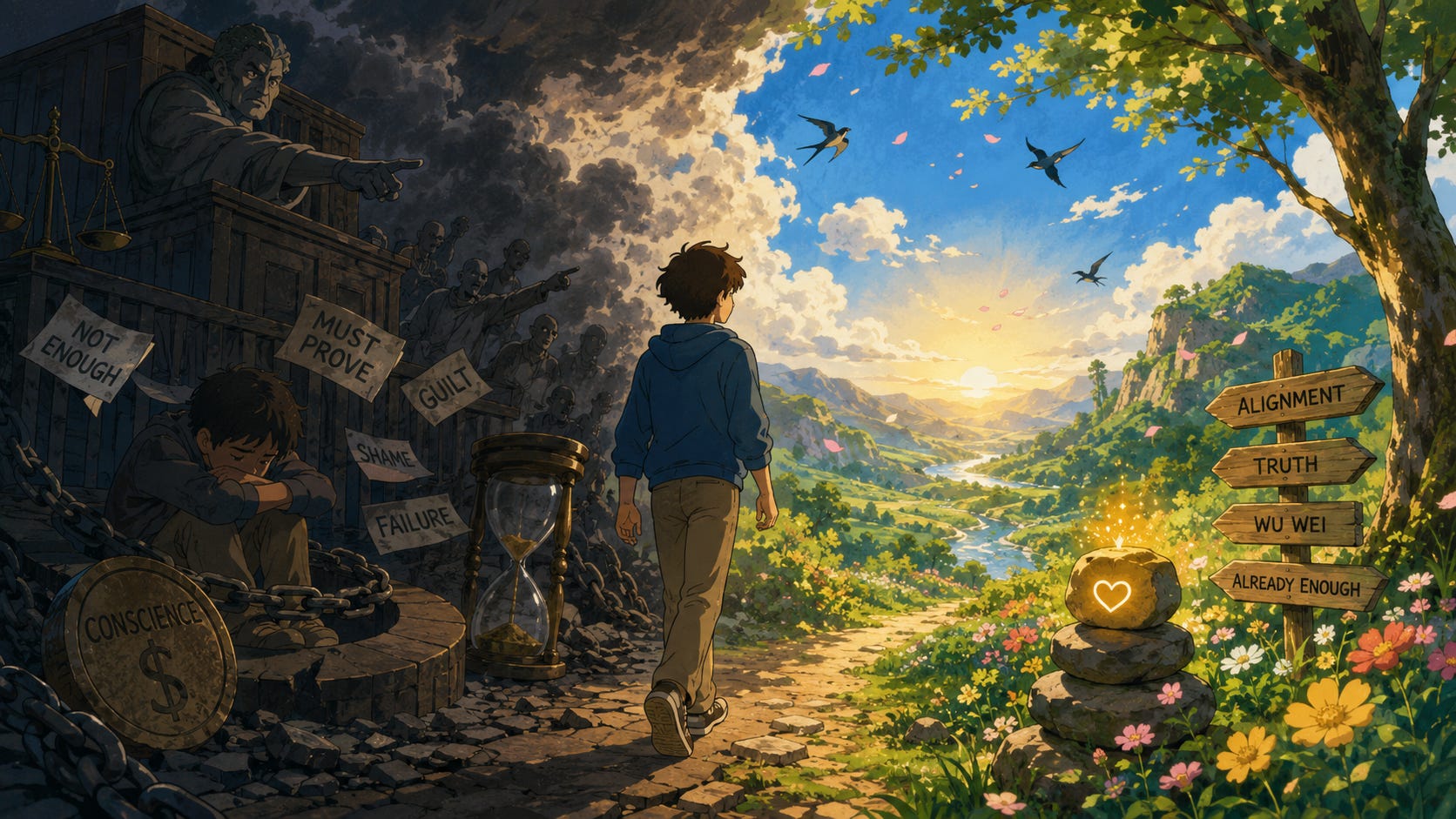
Have you ever caught yourself trying to prove that you are good enough to belong here? Have you ever noticed how quickly your mind can turn life into a courtroom, where every action becomes evidence, every mistake becomes an accusation. Every moral effort becomes a desperate attempt to win back a value that was never truly lost?
Many of us live more this way than we realise. We may seem thoughtful, sincere, and deeply committed to doing what is right, yet underneath that worthy intention, there can be a hidden bargain at work: “If I behave well enough, perhaps I can deserve my own existence.” That is a painful burden to carry because it turns life into performance, conscience into currency, and our humanity into something that seems conditional.
In this journal post, ‘Conscience Cannot Pay’, we will explore a subtle but powerful misunderstanding, the belief that guilt proves goodness, that moral effort proves worth, and that our Inner Child can somehow earn back what Shen already knows is whole. We will look at why this confusion happens, why it seems persuasive, what broader perspective Taoist teaching offers, and how wu wei returns us to a steadier way of living. Most importantly, we will guide ourselves back to the belief beneath the emotion, because unless we question that belief, we remain trapped on the ‘Carousel of Despair’, trying harder and harder to prove what never needed proof.
When Conscience Becomes Currency
Our Inner Child uses ‘Emotional Logic’, not ‘Shen Logic’. That distinction matters more than it may first seem, because ‘Emotional Logic’ is often clever, quick, innocent, and completely convinced of itself. It creates equations that seem to make sense in the moment. “If I deny responsibility, I cannot be punished.” Then later, when the emptiness of that position becomes obvious, it creates a second equation. “If I feel guilty, if I become highly moral, if I keep proving that I care, then I can earn back my conscience, my worth, my place.” Do we see the tragedy hidden in that reasoning? The first belief tries to escape pain by disconnecting from responsibility. The second tries to escape emptiness by performing goodness. Both are strategies of survival, and both assume the same false premise, that our worth can be lost, suspended, or restored through behaviour.
This is where the misunderstanding of conscience quietly takes hold. Conscience is no longer seen as the natural expression of alignment. Instead, it becomes a kind of spiritual receipt. We start treating guilt as evidence, moral tension as proof, and relentless self-monitoring as virtue. Our Inner Child nags, criticises, badgers, and reproaches, insisting that if we do not keep proving ourselves, something terrible will be exposed. We may not say it out loud, but the belief underneath can sound like this: “If I stop trying to be good, I may discover I was never worthy at all.” That is not the truth. That is fear dressed in respectable clothes.
In our previous teaching, we explored the profound recognition that our emotions are not the truth itself, but signals that reveal the beliefs creating them. We are reminded to ask, “What belief am I holding that creates this emotion?” and then trace it back with the ‘Golden Thread Process’ until we reach the original misunderstanding. When we apply that here, guilt stops being a badge of humanity and becomes a signal asking for deeper enquiry. What do we believe if guilt seems necessary? Usually something like this: “Without guilt, I would be dangerous.” “Without proving, I would be empty.” “Without moral effort, I would be nothing.” These beliefs are not signs of maturity. They are signs that our Inner Child has mistaken tension for integrity.
A wider perspective helps us here. Some would argue that guilt keeps us honest, that moral discomfort is necessary because without it, we might become careless, selfish, or harmful. There is some surface truth in that concern. Of course, reflection matters. Of course, accountability matters. But accountability is not the same as self-condemnation, and conscience is not the same as chronic inner punishment. A truly aligned person does not need to create endless red-light emotions to remain ethical. When actions arise from Shen, integrity is not manufactured through fear; it flows through authenticity. That is the difference between forced morality and wu wei. One is tight, anxious, and performative. The other is clear, steady, and unforced.
The Cost of Trying to Earn Humanity
Once we believe that conscience proves our humanity, we begin building an entire identity around earning what can never be bought. We become the ones who must always be thoughtful, always self-questioning, always striving to get it right. On the surface, this may look admirable. Others may even praise it. But inwardly, something becomes exhausting. Life starts to seem like an endless audition. We cannot rest, because rest seems careless. We cannot simply be, because being seems too passive. We cannot trust our worth, because our Inner Child has already decided worth must be maintained through constant effort.
Yet the very attempt to earn worth reveals the false belief beneath it. As one of our teachings states so beautifully, “Trying to deserve something implies that we do not already deserve it. The word itself betrays the belief: ‘I must earn what should already be mine.’” That is the hidden cost. The more we try to deserve our humanity, the more we reinforce the lie that it was ever in doubt. The more we labour to be worthy, the more we quietly tell ourselves that worth is unstable. This is why striving for worth never resolves the issue. It deepens it. We may gain temporary relief, perhaps a moment of pride, a sense of being back on the right side of ourselves, but the relief fades because the original belief remains untouched.
Our Inner Child does not understand this. It thinks more proof will solve the pain. So, it pesters us toward perfection, pressures us to monitor every motive, and chastises us when we fall short. It says, “Be better, then you will be safe.” “Try harder, then you will be real.” “Keep proving, then you will be allowed to stay.” But Shen does not speak that language. It does not barter or demand a fee for existence. Shen reflects the truth that we are already here, already part of the Tao, already human, already of value.
This is why our Taoist view changes everything. In our Tao Te Ching translation, the opening teaching reminds us that, “From the unknown comes all of creation, Tao is the mother of everything.” If Tao is the mother of everything, then what exactly have we been imagining ourselves separated from? If our existence arises from that source, then worth is not a later reward for correct behaviour. It is part of our origin. Behaviour matters, yes! Integrity matters, yes! But neither creates our essence. They express it. This is an enormous shift. It means our task is not to earn Shen, but to align with what was already true before our Inner Child built its anxious equations.
Another teaching deepens this further. We once wrote that, “This greatness within you is not a distant goal to be reached someday. It is a presence that exists here and now.” That line does not promote grandiosity; it dismantles the myth of deficiency. It reminds us that our worth is not a project. We do not graduate into humanity. We do not pass an ethical exam and receive permission to belong. We are already in the room. Already in this life. Already of this Tao. That does not remove responsibility; it puts it in the right place. We act responsibly, not to become real, but because reality is already ours.
What Shen Expresses Without Strain
So, what is conscience when we no longer treat it as currency? It is an expression. It is the natural movement of alignment. It is what arises when we stop performing morality and start living in truth. That does not mean we become passive or vague. It means we no longer need guilt to stand in for integrity. We no longer need emotional heaviness to convince ourselves we care. We do not have to create suffering to appear sincere. That is the “aha” moment hidden inside this teaching. Many of us have confused pain with proof. We assumed that if something hurts internally, it must be meaningful. But our Inner Child can create enormous emotion around a false belief. Intensity is not the same as truth.
Our I Ching translation offers a beautiful doorway here through Hexagram 17, Following. It reminds us, “In aligning with my inner truth, I find my true path and inspire others to follow with integrity.” Notice what is absent from that teaching. There is no command to prove. No instruction to perform guilt. No praise of inner struggle as evidence of value. The emphasis is on alignment with inner truth. That is profoundly different. Inner truth does not harangue us into goodness. It steadies us. It clarifies us. It calls us back to authenticity.
This also changes how we understand other people. When we are lost in proving, we often expect the world to cooperate with our inner drama. We think others should recognise our efforts, reward our sincerity, or align with our moral standards. But expecting others to align with us so we can remain steady is like blaming the weather for not matching our preferences. Another person’s behaviour may inform our choices, but it cannot create or remove our worth. We create our own emotional responses through interpretation and belief. So, if we become resentful because someone did not notice our effort, that resentment is not proof that they wronged our value; it is a signal asking, “What did we believe their recognition would give us?” Very often, the answer is uncomfortable. We believed they would confirm our worth. And that belief must be questioned.
When we stop using others as proof, a gentler strength emerges. We can let people be where they are, while remaining accountable for our own alignment. We do not need them to validate our conscience. We do not need them to admire our goodness. We do not need them to agree with our path to walk it. Wu wei teaches us to move without forcing, to respond without over-constructing, and to allow truth to become action naturally. This is not weak. It is mature. It is what happens when our Inner Child is no longer driving the carriage with panic and strategy.
Small Steps Out of the Courtroom
What, then, are we invited to do when we notice ourselves trying to earn worth through conscience? First, we pause before the old performance begins. We notice the red-light emotion without treating it as the final truth. Then we ask the deeper question: “What do I believe this emotion is proving?” That wording matters. It takes us beyond the emotion into the hidden argument beneath it. Perhaps we discover, “I believe guilt proves I am good.” Or, “I believe self-criticism proves I care.” Or even, “I believe that unless I struggle internally, I cannot trust myself.” Once seen, those beliefs lose some of their magic. We can examine them honestly rather than obey them out of fear.
Then comes the second step, one that our Inner Child often resists. We replace performance with alignment. Instead of asking, “How can I prove I am worthy?” we ask, “What would an already worthy person choose here?” That question shifts everything. It moves us from courtroom to compass. A worthy person may apologise, but not grovel. A worthy person may correct a mistake, but not collapse into shame. A worthy person may care deeply, but not make guilt the measure of sincerity. This is the movement from ‘Emotional Logic’ into ‘Shen Logic’. Not emotional suppression, not cold detachment, but spiritual clarity.
We can also remind ourselves of another teaching we have already come to trust: “I am never surprised by what I already know.” Beneath the noise, we do know. We know when we are forcing. We know when we are performing. We know when conscience has turned into theatre. The task is not to invent wisdom, but to stop overruling it with panic. And this is why our next steps must remain small, consistent, and manageable. No dramatic vows. No harsh self-correction. No Criticism, Comparing and being Judgemental (CCJ). Just one belief questioned at a time. One emotional equation dismantled at a time. One honest action taken from alignment, not pressure.
As we close ‘Conscience Cannot Pay’, let us return to the central truth with warmth and firmness. We cannot buy back our humanity with guilt. We cannot earn Shen through performance. We cannot prove our worth by becoming morally exhausted. Our conscience was never designed to be a payment system. It is an expression of alignment, a natural movement of truth when we stop confusing strain with sincerity. So, if our Inner Child begins nagging again, insisting that we must prove, perform, or punish ourselves into goodness, let us guide it gently but clearly. Let us say, “We do not have to earn what Tao already gave. We do not have to prove what Shen already knows. We are here, and that is enough to begin from.”
That is not complacency. That is the beginning of real responsibility. From there, we can act with integrity because we are aligned, not because we are afraid. We can choose wisely because wisdom is clearer than panic. We can take one small step today, then another tomorrow, without expectations, drama, or CCJ. Let ‘Conscience Cannot Pay’ stay with us as a quiet correction and a profound comfort. We are not becoming human. We are remembering that we never stopped being.

Have you unknowingly paid the entrance fee for happiness? Have you taught your Inner Child that peace must be earned through pleasing, striving, fixing, or emotional labour? Do calm moments sometimes seem unfamiliar, almost suspicious, as though life cannot be trusted unless we are working hard to manage it?
In this journal post, we explore “Peace Without Payment”, the quiet but powerful belief that happiness only comes after pain. We will look at how our Inner Child can create a hidden contract with struggle, how ‘Emotional Logic’ turns familiar discomfort into false safety, and how Shen guides us back to the truth that peace is not a reward for suffering; it is our natural state when we return to alignment with the Tao.
The Hidden Contract
Many of us did not choose to struggle consciously. We learned it early, often in homes where another person’s sadness, anger, silence, or disappointment seemed to fill the room like weather. As children, we may have believed, “If I can make them happy, I will be safe.” Over time, this became an emotional formula: pain, pleasure, temporary relief, then a brief taste of happiness.
So, happiness became a chore. Our Inner Child was not trying to sabotage us. It was trying to create certainty. It was noticed that when someone else seemed calmer, we created relief. Then it made an innocent but flawed conclusion: “My peace depends on managing their emotions.” This is ‘Emotional Logic’, not ‘Shen Logic’. ‘Emotional Logic’ says, “If I am anxious, danger must be present.” ‘Shen Logic’ asks, “What belief am I choosing that created this red-light emotion?”
This is where the hidden contract begins. Our Inner Child promises, “One day, when I have suffered enough, fixed enough, pleased enough, and proved enough, I will finally be happy.” But beneath that promise lies a far deeper, often hidden belief: “At least this pain is familiar.” This is where many of us unknowingly enter the ‘Carousel of Despair’. The cycle becomes painfully predictable; emotional discomfort arises, our Inner Child reacts with urgency, we begin fixing, pleasing, overthinking, rescuing, or overworking, we temporarily create relief, and then mistake that brief emotional exhale for happiness. Soon enough, the cycle begins again.
Pain → pleasing → temporary relief → repeat, the ‘Carousel of Despair’.
What makes this cycle so difficult to break is not simply the discomfort itself, but the certainty it creates. Our Inner Child often values certainty over success, familiarity over freedom, and predictability over authentic peace. Why? Because certainty appears safer than the unknown. Even painful certainty can seem more attractive than unfamiliar happiness because at least our Inner Child believes it understands the rules of suffering.
If chaos was normal in childhood, calm may seem suspicious. If emotional labour created temporary approval, rest may seem irresponsible. If suffering became linked to worthiness, peace may seem undeserved. This is why many people unconsciously sabotage opportunities, healthy relationships, career growth, financial stability, or emotional peace. It is not because they do not want these things. It is because genuine peace asks them to step into unfamiliar emotional territory where their old survival strategies no longer work.
Our Inner Child would often rather repeat a painful story it knows than step into a peaceful chapter it cannot control. This is the great illusion of the ‘Carousel of Despair’, it keeps us moving, exhausting ourselves, and creating the appearance of progress while quietly circling the same emotional lesson. We may tell ourselves we are being responsible, productive, loyal, or caring. But sometimes we are simply recreating familiar suffering because uncertainty seems far more threatening than disappointment; we already know how to survive.
This is why stepping off the ‘Carousel of Despair’ can initially create discomfort. Peace may seem unfamiliar. Stillness may seem unnatural. Success may even create anxiety because our Inner Child begins badgering us with old questions: “What if this disappears? What if this calm does not last? What if we stop trying and everything falls apart?” But the Tao asks us a far more liberating question: “What if peace was never something you had to earn?” That question changes everything.
Because the moment we recognise that certainty is not the same as safety, and struggle is not the same as purpose, we begin loosening the hidden contract that has kept us emotionally overworked for years. And that is where the Tao gently invites us into something our Inner Child may initially resist, but our Shen immediately recognises: peace through alignment, not exhaustion.
In our Tao Te Ching translation, Verse 48 reminds us: “Those who seek security and certainty, work hard to gain something every day. Those who follow the way of the Tao let go of something every day.” This is the doorway. The Tao does not ask us to add more effort to our emotional life. It invites us to let go of the belief that effort is the price of peace.
When Peace Seems Unsafe
There is the strange truth: ‘familiar pain can seem safer than unfamiliar peace’. Our Inner Child may pester, criticise, and badger us when life becomes calm because calm does not match the old emotional map. It may say, “Something is wrong. We should be worrying. We should be fixing. We should be preparing.” This is why some of us create problems just as life begins to settle. We are not broken. We are repeating a strategy. If struggle was once linked to survival, then ease may seem like carelessness. If pleasing once created temporary relief, then authenticity may seem dangerous. If emotional labour once gave us a sense of control, then wu wei may seem too simple to trust.
But wu wei is not doing nothing. It is doing what is aligned with life, without forcing, grasping, or bargaining with life. It is the river moving around the stone, not because it is weak, but because it understands flow.
The counterargument from our Inner Child may be strong: “But if I stop trying so hard, everything will fall apart.” We answer gently, “No, everything built on fear may loosen, but what is true will remain.” That is the difference between control and alignment. Control demands guarantees. Alignment trusts our ability to meet life honestly.
Following The Golden Thread
When a red-light emotion arises, we do not attack it, suppress it, or treat it as truth. We use the ‘Golden Thread Process’ to trace it back to the belief beneath it. We ask, “What must I believe to create this emotion?” Perhaps we discover, “I believe I must keep others happy to be safe.” Or, “I believe rest must be earned.” Or, “I believe peace without struggle means I am being lazy, selfish, or careless.” Now we have found the doorway out of the ’Maze of Confusion’. Not by blaming the past, or blaming others. And certainly not by blaming ourselves. We bring truth, honesty and integrity to the belief. This is ‘The Power of Three’: truth, honesty and integrity.
In our previous teaching, we said: “We cannot place our emotions in another’s body. Others cannot make us feel love, validated, or rejected, and they cannot take those emotions away.” This is a profound turning point. It means our peace is not being held hostage by someone else’s mood, choices, approval, or sadness. We create our emotions from our interpretations and beliefs. So, when our Inner Child complains, “They made me feel rejected,” Shen guides us deeper: “What did I believe their action meant about me?” This is not cold or unkind. It is freedom.
Returning To Peace
“Peace Without Payment” asks us to stop paying emotional invoices we never owed in the first place. We do not owe suffering before joy. We do not owe exhaustion before rest. We do not owe pleasing before love. We do not owe pain before peace.
So, we begin again, gently. We speak to our Inner Child with steady compassion: “I understand why you learned this. You were trying to keep us safe. But we no longer need to earn peace through pain. We can choose alignment now.”
And then we practise. Not dramatically. Not perfectly. We take small, consistent, manageable steps without expectations or Criticism, Comparing, or being Judgemental (CCJ). We pause before pleasing. We question the belief beneath the red-light emotion. We notice when we are working for happiness rather than allowing peace to arise from Shen.
The ‘Carousel of Despair’ slows each time we choose truth over habit. Pain, pleasing, relief, repeat, begins to dissolve. In its place, we discover something quieter and stronger: peace that does not need permission. Let this be our affirmation: “We do not need to suffer to deserve peace. We guide our Inner Child with truth, honesty and integrity. We trust Shen, practise wu wei, and return to the Tao one gentle step at a time.”
So, let us carry “Peace Without Payment” into the ordinary moments of today. Let us stop doubting ourselves because an old emotion seems loud. Let us remember that Shen is calm, clear, and stabilising. Let us choose the next honest step, then the next, and allow the Tao to meet us there, not after we have suffered enough, but now, exactly where we are.
And here is your gentle challenge for today. Choose one small action that seems slightly unfamiliar, something your Inner Child would normally avoid because it may create a red-light emotion. Perhaps it is saying “no” without guilt, asking for help, resting without first earning it, speaking honestly, applying for the opportunity you keep delaying, or allowing yourself to enjoy a peaceful moment without waiting for something to go wrong.
Notice what happens. Your Inner Child may criticise, complain, badger, or create a sense of emotional urgency. It may tell you to retreat to the familiar patterns of the ‘Carousel of Despair’ because certainty can seem safer than growth. Do not argue with it. Acknowledge the emotion and ask yourself, “What belief is creating this reaction?”
Then pause. Take one slow breath. Drop your shoulders. Unclench your jaw. Relax your body. And take one small step anyway. Not recklessly, but with truth, honesty and integrity. This is how we build trust with ourselves. This is how we teach our Inner Child that unfamiliar does not mean unsafe. This is how we move from survival patterns into authentic alignment with the Tao.
Remember, your life will not transform because of one giant breakthrough. It changes when you consistently choose small courageous moments over familiar emotional patterns, without expectations and without Criticism, Comparing and being Judgmental (CCJ). So, today, be peaceful with the unfamiliar. Let calm be enough. Let ease enter where struggle once lived. And trust that every small step you take in alignment is quietly guiding you out of the ‘Maze of Confusion’ and into the beautiful flow of “Peace Without Payment.”
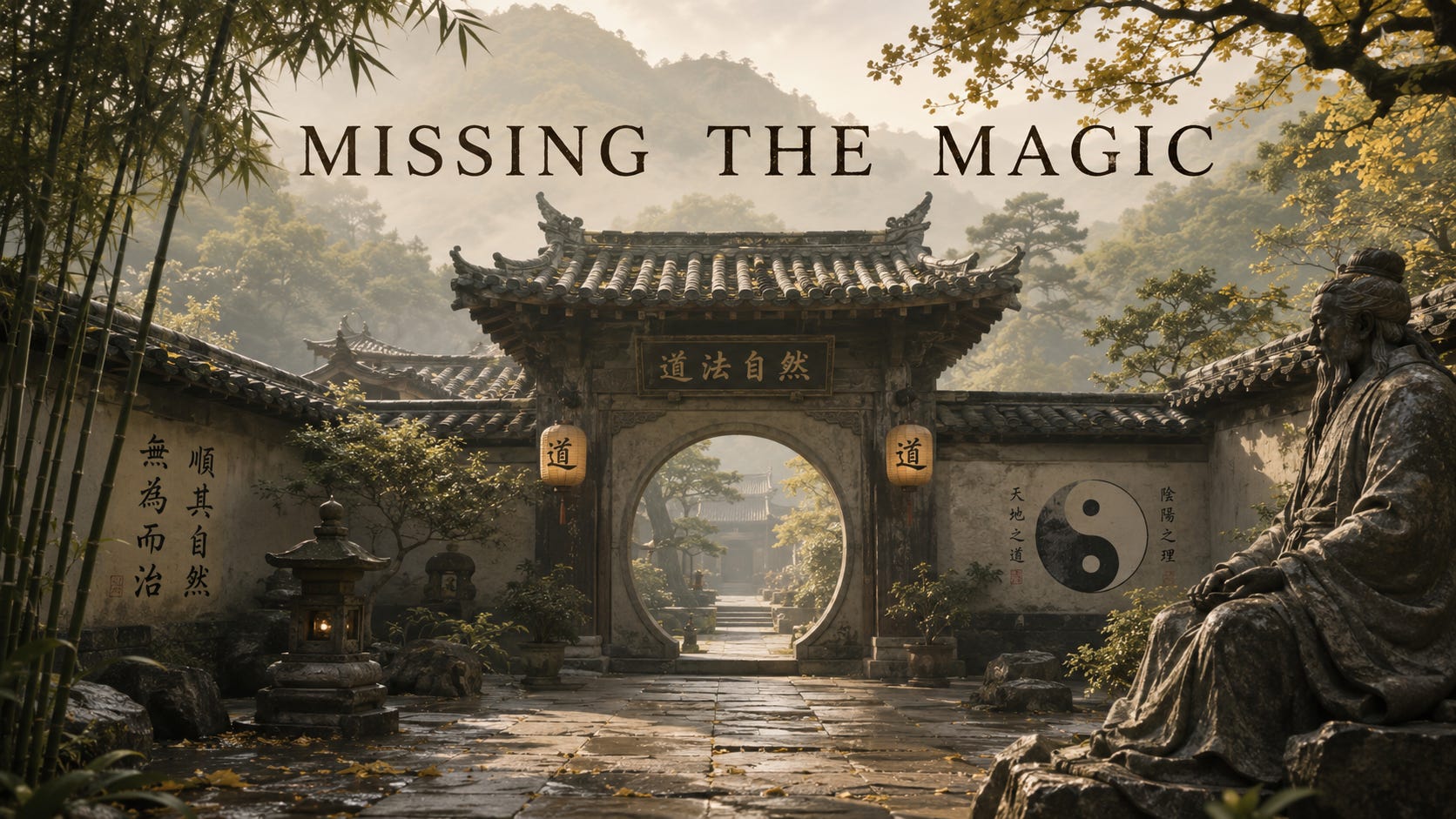
Have you ever stayed loyal to an old, painful identity because you secretly believed it might one day reward you? Have you ever thought, “If I stop waiting, what if the apology finally comes?” or “If I stop hoping for them to change, what if that is the moment the magic happens?” Have you ever been confused about letting go of a false belief, only to lose the possibility of happiness itself?
In this journal post, we explore “Missing The Magic”, a subtle and powerful fear within our Inner Child: the belief that if we change, grow, or release an old story, we may miss the ending we have spent years waiting for. This is not laziness. This is not a weakness. This is our Inner Child clinging to an emotional contract that says, “If I keep waiting, proving, pleasing, and protecting, one day life will give me what I was missing.”
But here is the profound doorway: when a belief changes, we do not disappear. Our personality does not vanish. Our humour, warmth, creativity, preferences, and uniqueness remain. What changes is identity. We stop identifying with pain as who we are. We stop calling the old story our truth. We stop mistaking waiting for faith. Shen does not ask us to become someone else; Shen guides us back to the authentic self that existed before the story became a cage.
Waiting For Magic
Our Inner Child often believes hope is safety. It says, “Do not let go yet. What if they finally understand? What if the relationship becomes what we need? What if success arrives tomorrow? What if validation comes just after we stop chasing it?” This is the hidden fear of “Missing The Magic”. We imagine that letting go of the old identity means stepping away from the very thing we have waited for.
But changing a belief does not remove us from life. It simply changes the lens through which we meet life. If the magic happens, we will still be here to witness it. Only now do we not need it to complete us, rescue us, or prove our worth. This is a vital distinction. We are not closing the door to love, success, apology, joy, or change. We are closing the door to emotional dependency on a particular ending.
Our Inner Child may pester, complain, and badger us because it believes that if we stop waiting, we will lose the chance to be chosen by the old story. But waiting is not the same as openness. Waiting often freezes us. Openness allows us to move. Waiting says, “My life begins when that happens.” Openness says, “Life is already happening, and I will meet it with truth, honesty and integrity.” This is where ‘Emotional Logic’ becomes convincing. It says, “If I give up this belief, I give up my hope.” But ‘Shen Logic’ says, “When I release a false belief, I create space for real possibility.”
Survival In Disguise
There is another remarkable insight here: much of what our Inner Child calls survival is often an unmet emotional need wearing the costume of danger. We may say, “I need this person to approve of me,” “I need this job to work,” “I need my family to understand,” or “I need this outcome to be safe.” Yet we have survived many unmet expectations, disappointments, delays, and closed doors. This does not mean those experiences were easy. It means they were not the same as physical survival.
This distinction matters because our Inner Child often wraps emotional needs in the language of survival so they cannot be questioned. If something is labelled survival, it becomes urgent, unquestionable, and absolute. It seems dangerous to pause. It seems disloyal to examine the belief. It seems safer to stay in the ‘Carousel of Despair’, repeating the same protective actions while never asking whether the danger is real.
But we can ask with compassion: “Am I truly unsafe, or am I trying to get an emotional need met through an external condition?” This question does not dismiss our needs. It clarifies them. We may need care, connection, respect, understanding, rest, encouragement, or a sense of belonging. These are human needs. But when our Inner Child insists that only one person, one outcome, or one magical ending can meet them, we enter the ‘Maze of Confusion’.
So, we begin to reclaim ourselves. We say, “I can want this without making it my survival. I can hope without making hope my identity. I can care without handing over my peace.” This is wu wei. We remain engaged with life, but we stop forcing life to become the proof of our worth.
Responsible, Not Wrong
A beautiful turning point comes when we realise that our Inner Child was not lazy, careless, or irresponsible. It was doing a job. It was trying to protect us with the understanding it had at the time. Perhaps it did not achieve what it set out to achieve. Perhaps it did not get the approval, safety, attention, or love it wanted. But we are here. We continued. We adapted. We endured. That means something.
This is not an invitation to glorify old patterns. It is an invitation to stop using Criticism, Comparing and being Judgemental (CCJ) against ourselves. We do not need to say, “I wasted years.” We can say, “I was responsibly protecting myself with limited awareness, and now I am ready to learn a wiser way.”
In our previous teaching, we said, “I am learning to cope authentically.” This simple shift matters because it changes identity from failure into development. It reminds us that mistakes are not proof of unworthiness; they are opportunities to refine our beliefs, actions, and alignment. This is ‘The Power of Three’: truth, honesty and integrity. Truth says, “This pattern no longer serves us.” Honesty says, “We used it because we believed it protected us.” Integrity says, “Now we choose a new step that reflects Shen.”
Our I Ching translation, Hexagram 49, Ko, ‘Revolution’, Moulting, offers a powerful teaching for this moment: “Progress cannot occur until we let go of outdated defences and fears.” It describes transformation as moulting, the shedding of old skins, habits, and beliefs so that we may meet life with fresh eyes. This is exactly what happens when we stop identifying with pain. We are not losing ourselves. We are shedding what was never our true nature.
Life Keeps Moving
Inherited family stories often present life as fixed. They may say, “This is who we are,” “People like us struggle,” “Success is unsafe,” “Love must be earned,” or “Nothing ever really changes.” These stories can become emotional furniture inside us. We stop questioning them because they have always been there. But life is not a set pattern. Life is dynamic. The Tao is movement, rhythm, transformation, and flow. A pattern is rigid. Shen is alive. A family story may describe where we came from, but it does not have to decide where we go.
Our Tao Te Ching translation reminds us through Verse 15 that the wise are adaptable, able to “sit with it” until the right time arrives, and that “The journey is you; you are the journey.” This is a beautiful correction to the fantasy that life begins only when the old story finally gives us what we wanted. We are not waiting at the edge of life. We are already on the journey.
So, what are we still waiting for before we allow peace? Are we waiting for someone to admit they were wrong? Are we waiting to become successful enough to rest? Are we waiting for our family story to change before we live differently? Are we waiting for magic while neglecting the ordinary miracle of today?
Let us return to “Missing The Magic” with clear eyes. The true magic is not the fantasy rescue ending. The true magic is the moment we realise we can change our beliefs and remain whole. We can let go of the old identity and still keep our personality. We can stop waiting and remain open. We can stop depending on one outcome and still welcome blessings when they arrive.
Today, choose one belief you have been afraid to release because your Inner Child says, “What if we miss it?” Pause. Breathe. Drop your shoulders. Ask, “If I no longer identified with this belief, who would I be free to become?” Then take one small, consistent, manageable step without expectations and without Criticism, Comparing, and being Judgemental (CCJ). Do not doubt yourself because an old story seems familiar. Do not mistake waiting for loyalty. Do not confuse survival with an unmet emotional need. You are here, which means you have already carried yourself further than you realise.
So, let “Missing The Magic” become the doorway into a deeper truth. We are not here to repeat inherited stories. We are here to live consciously, guided by Shen, aligned with the Tao, and willing to let life move. The magic is not behind us, hidden inside an old identity. It is here, in the next honest breath, the next clear belief, the next gentle act of wu wei and living in your flow.
Moments of Inspiration…
Whole, Not Perfect
Have you ever noticed how perfection keeps moving? Just when you think you have reached it, your Inner Child raises the standard again, whispering, “Not enough yet.” This is why perfection is not truth; it is perception, shaped by fear, comparison, and old emotional rules.
Taoism offers us a kinder doorway. The Tao does not demand flawless flowers, straight rivers, or cloudless skies. It allows each thing to be fully itself. Our Shen does not need polishing into acceptability; it asks only to be expressed with truth, honesty, and integrity.
When we chase perfection, we often believe we are improving ourselves. Yet beneath the surface, we may be trying to avoid CCJ, rejection, or shame. As our teachings remind us, “Your best efforts will never be perfect, but that does not mean you have failed.”
So, today, let us practise wu wei, stop forcing ourselves into an impossible shape, and return to alignment. We can grow without attacking ourselves. We can learn without CCJ. We can guide our Inner Child with warmth, not pressure.
Perfection asks us to perform. Shen invites us to be real and flow.
Affirm: “We release the illusion of perfection and return to the peace of authenticity. We are whole, worthy, and guided by Shen, one honest step at a time.”
This week, notice where perfection is quietly stealing your peace. Pause, breathe, and choose one small act of authenticity instead.
In the Next ‘Inner Circle’ (Paid) Journal…
The Control Illusion
The False Cause
The Inner Picture
Moments of Inspiration
In the Next Free Journal…
Guilt Guards Joy
When Life ‘Feels’ Relentless
Rightness Without Truth
Moments of Inspiration
Journal #F081 18/05/2026
Contact: info@wuweiwisdom.com
Website: www.wuweiwisdom.com
YouTube: www.youtube.com/user/WuWeiWisdom
Facebook Community: www.facebook.com/groups/wuweiwisdomcommunity/