
Empty Courtroom
This week, are you the juge, jury or defendant? Learning from others and is our worth and value by design? Finally flowing in the unknown.

“I release the illusion of being on trial, for my worth was never up for debate. Today, I walk away from the witness stand and into the quiet power of my Shen, where truth needs no defence and peace flows freely.”

Have you ever imagined standing in a courtroom of your own mind, trying to defend choices you made decades ago? Have you ever caught yourself silently arguing, rehearsing a defence to convince someone of your worth, your innocence, your good intentions? It may not always take the form of a courtroom, but many of us live with an inner trial constantly in session. We sentence ourselves for things we did as children, for words we said under pressure, or for decisions we made when we simply didn’t know better.
This journal post will explore that powerful inner metaphor, the courtroom, created by our Inner Child. It will reveal how Taoist and Wu Wei Wisdom invite us to leave that imaginary space, to step into the truth of our adult Shen awareness, and to understand that the court never truly existed. If we are to reclaim alignment and flow, we must close the case not with a verdict, but with clarity.
The emotional weight of self-judgment often stems from misunderstandings and unresolved issues that were never ours to carry. The courtroom exists because we mistakenly believed we were on trial. The reality is far more liberating: there is no case; there never was. Yet what makes this courtroom metaphor even more powerful is our Inner Child’s tendency to search for the familiar. Even in the absence of wrongdoing, it clings to the illusion of the judge, the verdict, the cross-examination, not because they are honest, but because they resemble what once felt emotionally predictable.
So, while there may be no courtroom, no accusation, no punishment, our Inner Child can still find comfort in recreating that scene, as though familiarity offers safety. This is how outdated emotional logic persists: it prefers the known discomfort of imagined guilt over the uncertain spaciousness and unknown of innocence. But when we realign with our Shen, we see through the illusion. There is no judge; only the echo of an old belief asking to be questioned. There is no sentence; only the opportunity to walk free.
Beyond the Judge’s Bench
Our Inner Child often builds elaborate structures to make sense of emotional pain. One of the most common is this idea of an internal courtroom. In that imagined chamber, we play multiple roles: we are the accused, the defence, the prosecution, and the judge. The scene may replay during moments of self-doubt or guilt, or when we recall past events that still carry emotional weight. Perhaps we see ourselves standing before a stern judge, defending a decision we made as a child, or arguing that we were never to blame.
The tragedy is that this courtroom was built on no objective evidence. Our Inner Child, using emotional logic, formed beliefs such as “I must have done something wrong,” or “I’m at fault because I didn’t stop it,” or “If I explain it well enough, maybe they’ll finally understand.” But when we examine these beliefs through the calm clarity of Shen, we see how flawed and unfair they genuinely are.
The teachings of the Tao are subtle and profound. One line from the Tao Te Ching reminds us: “The Tao does not contend, yet no one under heaven can overcome it.” (Verse 22) There is power in calm truth. There is no need to argue or justify. In alignment, there is no need for defence.
So why do we keep returning to the stand? Because our Inner Child still believes the trial is necessary and familiar. It imagines that if the correct argument is made, if the right person agrees with us, we will be free. But that freedom doesn’t come from others. It comes from within, when we recognise the trial was never real.
No judge is coming. No jury has been summoned. And the prosecution, loud as it may be in our heads, has no case. We were children. We responded with the only tools available to us: innocence, instinct, and survival. That’s not guilt; that’s simply life unfolding.
The Weight of Emotional Logic
The courtroom persists because emotions, especially guilt and shame, seem convincing. Our Inner Child might badger us with questions like: “Why didn’t you stop it?” or “How could you have said that?” And because those questions come with powerful emotions, we believe they must be true.
But emotions are not evidence. They are effects, not causes. In Wu Wei Wisdom, we learn to ask not “What am I feeling?” but “What belief created this feeling?” Often, when we follow the ‘Golden Thread Process’, we find that belief ultimately stems from a child’s limited understanding. Beliefs like “I have to earn love,” or “If I’m good enough, no one will leave me,” or “I must be responsible for others’ emotions.” These are not truths; they are misunderstandings we absorbed in moments of confusion.
And yet we carried them. We built an identity around them. We shaped our lives as though they were law. That’s why the courtroom metaphor is so sticky: it mirrors the internalised blame we’ve never challenged. But when we examine the foundation, it begins to crumble.
That is the gift of Shen. When we are aligned with our Shen, we are not swayed by the noise of emotions or the accusations of the past. Shen does not react; Shen recognises. It sees clearly. It knows: “This belief is no longer true. I am no longer that child.”
The I Ching offers a striking insight in Hexagram 61, “Inner Truth”: “Truth within, calm without. Integrity in the core brings clarity to the world.” This is how the courtroom dissolves, not with a shout, but with a quiet knowing. We no longer argue; we observe. We no longer plead our innocence; we live it.
The beliefs that led to the trial in our minds were never facts. They were emotional attempts to explain the unexplainable. Now, as adults, we can see through them.
Living Without a Sword
There comes a moment in our journey when we realise that defending our truth is not the same as living it. Our Inner Child often believes we must prove ourselves in every conversation, explain ourselves endlessly, or correct those who misunderstand us. But this is the courtroom dynamic at play again.
In truth, Shen needs no defence. When we are aligned, we can calmly state our truth or say nothing at all. Silence, when rooted in clarity, becomes a more powerful message than any argument. We can remain still even in the face of misunderstanding because we no longer require validation.
One beautiful insight from a previous journal post captured this perfectly: “Truth doesn’t need a sword. It simply needs presence.” And in another, we wrote, “You’re not on trial. You are in transition.”
That transition is a return to authenticity. When we drop the sword, when we step off the witness stand, we are left not with weakness, but with power. Calm power. The power of knowing ourselves, not needing anyone else to agree.
If we engage in debates or confrontations with prickliness or defensiveness, we re-enter the courtroom. We become the prosecutor again, trying to convict others of misunderstanding us. But if we respond calmly and remain firm without aggression, we model clarity. The Tao flows more freely through us. We teach, not through words, but by being aligned.
We do not need to be warriors for truth. We need only walk in it.
Choosing a New Verdict
The decision to leave the courtroom is not made in one go. It’s a daily practice, a gentle return to truth. When old emotions rise, guilt, shame, and regret, we can pause. We can ask: “Is this belief still true?” And more importantly: “Who is speaking? Is this my Shen, or my Inner Child?”
If it is the Inner Child nagging, pressuring, and chastising, then we listen, reassure, and lead. We do not obey its fears. Instead, we gently say: “I see your confusion, but I choose differently now.”
This process requires kindness. Not passivity, but strength rooted in compassion. We do not silence our Inner Child; we guide it. We offer clarity where once there was confusion. We remind ourselves that our worth was never conditional.
The Tao does not push. It does not argue. It flows. In the same way, we align with truth by allowing, not forcing.
We live each day with the intention: “There is no trial. There is only truth.” We affirm: “I am not guilty. I am evolving.” These are not affirmations of denial; they are recognitions of reality.
Bit by bit, moment by moment, the courtroom fades. It may still echo at times. Old accusations may reappear. But we meet them now with a new understanding. We don’t fight them; we don’t attend.
Eventually, there comes a day when we realise: the court is empty. The chairs are dusty. The gavel lies unused. And outside, life is waiting.
No Verdict Required
We began this journal post exploring the pain of self-judgment, the familiar and imaginary courtroom our Inner Child constructs, and the powerful emotions that seem to hold us in place. Along the way, we’ve uncovered a quieter truth: ‘Empty Courtroom’ is not just a metaphor. It’s a possibility. It’s a choice we can make.
By recognising the beliefs behind our emotions, by allowing our Shen to lead instead of our Inner Child, we stop living life as a defence. We no longer need a verdict. We no longer seek permission to be who we are.
And perhaps most powerfully, we stop comparing ourselves with others, we stop criticising our path, and we stop judging our progress. No more CCJ: Comparison, Criticism, and being Judgmental. These are the tools of the courtroom. Our tools now are clarity, alignment, and truth.
Let us take one step today, however small. Let us catch one courtroom thought and gently release it. Let us walk forward, not to prove, but to live because the most powerful verdict we can reach is no verdict at all. Just alignment. Just truth. Just being.
And in this new way of being, there is no judge. No jury. No defence. Only the Tao, flowing through us. Only the calm wisdom of Shen guides our way. Only the gentle liberation of the ‘Empty Courtroom’.
This is the moment when we realise we were never truly on trial, only replaying echoes from the past that no longer serve us. The silence in that courtroom is not emptiness, but freedom. It is the spaciousness of truth without accusation, alignment without defence, and value that needs no validation. It is time to step away from the witness box, to stop cross-examining your worth, and to lead your Inner Child gently by the hand into the light of truth.
You are not on trial. You never were. It’s time to stop sentencing yourself and start living your life, not as the defendant in a courtroom of doubt, but as the creator of a destiny shaped by Shen, integrity, and deep trust.
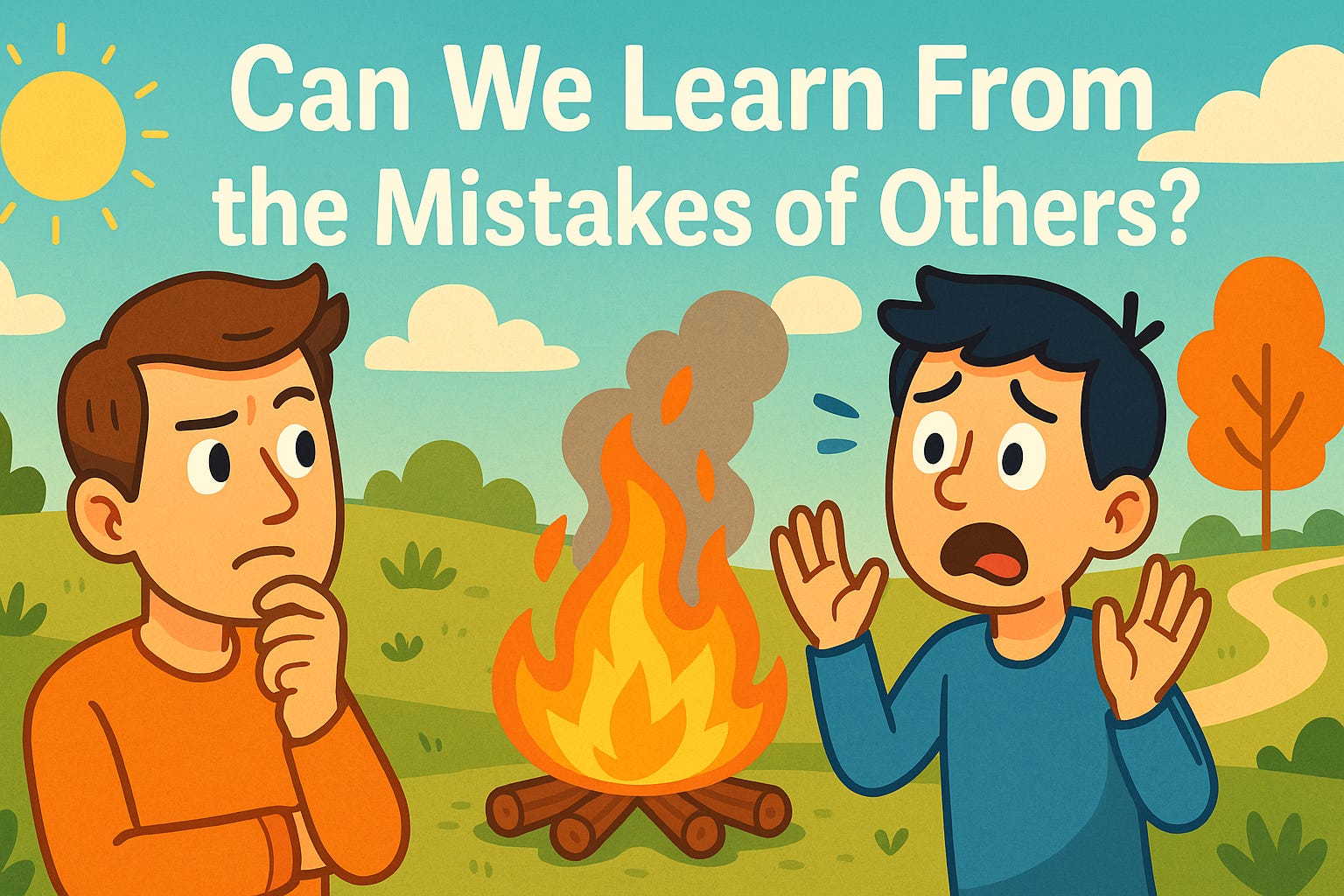
Have you ever watched someone repeat a mistake you’ve already made and wondered, “Why can’t they see it?” Or perhaps more painfully, have you ever observed someone else’s suffering and vowed to avoid the same fate, only to stumble into a similar trap yourself?
Why is it that we often find it challenging to learn from others’ mistakes, even when their lives stand as clear cautionary tales? Do we truly need to walk through fire ourselves to understand the burn? Or is there another, more graceful way? The truth is, many of us struggle to accept wisdom when it doesn’t arrive through personal pain. There’s a quiet arrogance we rarely acknowledge: the belief that we “know better”, or that “we are different”. This illusion, often birthed by our Inner Child’s need to be special or in control, convinces us that others’ missteps do not apply to us. So, we dismiss the lesson, judge the person, and unknowingly step into the same trap, repeating the very cycle we thought ourselves immune to.
Have you noticed how it’s often easier to spot misalignments in someone else’s life, their misguided beliefs, their harmful patterns, yet remain entirely blind to our own? It’s as though we’re looking through a stained-glass window from the outside in, convinced we see the truth, while being unaware of the distortions in our own lens. This is our Inner Child’s innocent logic at play; it filters life through the simplicity of “I’m right and they’re wrong,” leaving no space for curiosity or growth. It’s a shield that, ironically, traps us in stagnation. The tragedy lies not only in what we refuse to see but also in the opportunities we forfeit, the chance to evolve, to shift, to rise.
Here’s the counterpoint we rarely consider: perhaps the real wisdom isn’t in waiting for the pain to teach us, but in the humility to learn from the whispers instead of the shouts. Imagine standing by the edge of a river swollen with lessons, some from your own journey, others from observing those around you. You can wade in slowly, guided by observation, or be swept away by insisting you need the whole force to understand. One path follows the flow of wu wei, where you respond rather than react, trust rather than resist. The other path is our Inner Child’s demand for proof through pain and personal experiences. Both are valid, but only one truly honours the wisdom of Shen.
We must ask ourselves sincerely: “Why do I believe I need to learn the hard way? What does this say about the belief I hold regarding my worth or intelligence? Is it true that pain is the only teacher I will trust?” These questions, asked with compassion and curiosity, are doorways to transformation.
Let us remind ourselves of the more profound teaching echoed in ‘Awakening to Your Inner Greatness’: “Greatness is not a distant goal to be reached someday. It is a presence that exists here and now, a quiet force that encourages you to take the next step, face the unknown with courage, and trust that you are capable of more than you have ever imagined.” That next step can be the choice to learn without judgment, to grow without suffering, to be guided by insight rather than crisis.
Taoist wisdom, as always, provides a quiet yet powerful response. Not through commandments or guarantees, but with gentle clarity and an invitation to realign. In this journal post, we explore this ancient question through the lens of the Tao, the Shen, and our Inner Child. We ask: “Can true wisdom emerge through observation alone? And if so, why doesn’t it always?”
We’ll see how Shen, our divine spark, accesses what we might call ‘the Shen database,’ a non-judgmental awareness that allows us to learn through truth rather than trauma. But we’ll also examine how our Inner Child often resists that simplicity, demanding emotion before it accepts reality.
The Tao Te Ching presents this paradox in Chapter 73: “A person with outward courage dares to die; a person with inner courage dares to live.” In other words, true spiritual bravery is not about dramatic sacrifice. It is about quiet alignment. And that includes the courage to learn before life forces the lesson upon us. Let’s explore how that courage unfolds.
When Shen Observes, It Learns
Our Shen perceives life clearly, like still water reflecting the sky. It doesn’t argue. It doesn’t need to prove. It observes. And in its quiet observation, Shen can learn deeply from others, without requiring the personal detour into emotional chaos. Shen says, “I see the cause. I understand the effect. I choose the alignment.”
This is possible because Shen is not interested in blame or judgment. It does not say, “What a fool!” It says, “That choice created that outcome.” Full stop. No drama. Just truth. This is why we can sometimes witness the suffering of a stranger, or the breakdown of a relationship, or the consequences of someone else’s dishonesty, and feel a profound shift inside ourselves. Not fear. Not shame. But clarity.
That clarity is Shen learning. And it’s available to us at all times, if we are aligned. So why doesn’t this happen more often?
The Inner Child Demands Experience
Why is it that we often find it challenging to learn from others’ mistakes, even when their lives stand as clear cautionary tales? Do we truly need to walk through fire ourselves to understand the burn? Or is there another, more graceful way? The truth is, many of us struggle to accept wisdom when it doesn’t arrive through personal pain. There’s a quiet arrogance we rarely acknowledge: the belief that we “know better”, or that “we are different”. This illusion, often birthed by our Inner Child’s need to be special, to be right, or to be in control, convinces us that others’ missteps do not apply to us. So, we dismiss the lesson, judge the person, and unknowingly step into the same trap, repeating the very cycle we thought ourselves immune to.
This is not because we lack intelligence or insight, but because a part of our mind, our Inner Child, has been conditioned to believe that it is entitled to better outcomes. In its innocence and fear, our Inner Child often holds a mildly arrogant worldview: that life ‘owes’ it fairness, predictability, and perfection. This belief is not malicious; it is the product of immaturity. Our Inner Child, shaped by early emotional experiences, sees the world in absolutes: good or bad, right or wrong, fair or unfair. It believes that if it behaves correctly or proves its worth, things should work out precisely as it imagines. When they don’t, it reacts not with reflection but with confusion, outrage, or self-blame.
This mildly entitled stance isn’t always loud; sometimes it is woven subtly into our choices. It can sound like: “Why is this happening to me?” or “I don’t deserve this,” or even, “They just got lucky, I did everything right.” Underneath these thoughts lies a belief that perfection should be guaranteed if we follow a specific formula, and that suffering is somehow an error rather than part of the human journey.
When we release the Inner Child’s demand to be right, to be owed, or to be exempt, we make space for a more profound knowing: we are already worthy of growth, healing, and transformation. We do not need pain to prove it. We simply need to trust Shen’s whisper before it becomes a scream.
And so, our Inner Child dismisses examples, ignores red flags, and convinces us that “this time, it will be different,” until the consequences catch up with us. That’s why we can read books, hear advice, or even witness someone else’s downfall, and still repeat the same mistake. Not because we lack intelligence, but because we’ve let our Inner Child lead our learning. And the Inner Child does not learn through observation. It learns through emotional drama.
The Belief That Creates the Experience
One of the most essential Wu Wei Wisdom teachings is this: “We create our emotions through the beliefs we choose to accept.” That means the belief “I must suffer to learn” will, sooner or later, produce the experience of suffering.
The Tao does not punish us for this belief. It honours it. If we believe that wisdom must be earned through hardship, the Tao will allow hardship to teach us, not out of cruelty, but out of alignment. However, this belief is not true. It is a limitation, because learning can also happen through reflection. Through stillness. Through observation. But only if we allow Shen to lead.
This is why learning from others is not a matter of intelligence; it’s a matter of alignment. Shen asks: “What is true?” The Inner Child asks: “What do I feel?” And that simple difference changes everything.
Why Some Lessons Must Be Lived
Still, there are moments when we face hardship. Even after warnings. Even after observing others. Why? Because sometimes, our beliefs are so deeply embedded and emotionally charged that only a direct experience will bring them into the light. This does not mean we have failed. It means the Tao is honouring our path of unfolding.
Shen does not judge. It simply says: “Now you know. Now you can choose.”
We must not Criticise, Compare, or be Judgemental (CCJ) ourselves for needing experience. The Tao does not shame us for learning the hard way. It flows with us, no matter the path we choose.
But now that we are becoming more aware, we can pause, observe, and reflect before taking the next step. We can ask, “Is this choice truly aligned, or am I proving something?” “Do I need this lesson, or am I creating it out of emotional habit?”
And if the answer is unclear, we wait. Stillness is also movement in the Tao. And patience is a sign of Shen, not weakness.
Choose Courage Without the Burn
So, can we learn from the mistakes of others?
Yes. But only when we allow Shen to lead the learning. Only when we observe without judgment, accept without emotion, and choose with clarity. We’ve seen how our Inner Child demands emotional engagement, often insisting on experiencing pain before accepting truth. This is not wrong, but it is limiting.
We’ve also discovered that Shen, in its calm neutrality, can access profound wisdom through observation alone, not by avoiding life, but by flowing with its natural rhythms. We’ve understood that Yi Tao, Qi Tao apply here too: our intention to learn through Shen will set the direction of our energy. If our purpose is truth, the Tao will align us with clarity. If our purpose is validation, the Tao will align us with experience.
And most importantly, we’ve seen that true courage is not in chasing hardship, but in aligning with truth before the storm arrives. As the Tao Te Ching reminds us: “A man with outward courage dares to die; a man with inner courage dares to live.” (Chapter 73)
Living with Shen is the courage to live clearly. Quietly. Peacefully. It is choosing not to light the fire to prove it burns. So, now pause. Reflect. Look at the patterns around you, not with judgment, but with Shen clarity.
Ask, “What truth is life showing me?” And then choose. Not because you’ve suffered enough. But because you’ve seen enough. And because now, you are ready to let your Shen lead the way. Calmly. Clearly. Lovingly. And always, without CCJ.
That is learning the Taoist way.
The Illusion of Unworthiness
Have you ever caught yourself thinking, “I don’t deserve love,” or “Forgiveness isn’t meant for someone like me”? These phrases don’t just pass through the mind; they linger, burrowing into the corners of our spirit. They echo through our relationships, sabotage our decisions, and cut us off from life’s flow.
But where did this belief originate? Was there ever a moment in our lives when someone suggested, subtly or directly, that we were flawed beyond redemption? Perhaps it came not as words but through silence, withdrawal, judgment, or the eyes that looked through us rather than at us. Over time, we internalised these glances and comments and turned them into beliefs. But were they ever truly correct?
In this journal post, ‘Deserving by Design’, we will gently explore this belief. We will investigate its origins, why it endures, and most importantly, whether it aligns with our Shen, our spiritual essence. This teaching is not about guilt or blame but about clarity, alignment, and returning to the flow of the Tao. As we examine what lies beneath the shame or guilt, we reveal something far greater: our natural birthright to accept and love.
The Origin Story: A Belief with a Voice
Most of us don’t conclude, “I am undeserving,” through logical reasoning. This belief wasn’t born from Shen's insight; it was shaped by emotional reasoning, the logic of our Inner Child. Our Inner Child nags with the belief: “If I am flawed, I must earn love. If I make mistakes, I lose value.” But mistakes are never the actual cause of shame. Instead, it is the belief that we have to prove we are good enough after making them that traps us.
Taoist wisdom encourages us to reflect not on what we feel, but on what we believe caused us to feel this way. As written in Verse 59 of the Tao Te Ching: “When rooted deeply, the foundation is firm. When aligned with the Tao, nothing is lost. Everything returns to balance.”
Shame is not the cause; it is the signal. We must follow the ‘Golden Thread Process’ from the red-light emotion to the belief it uncovers. Often, we discover an outdated Inner Child belief rooted in a misunderstanding or injustice. Our Inner Child remembers, not with clarity, but with emotion. It stores experiences as emotional charges, such as the belief that “if I was rejected, it was because I was unlovable.” It then repeats that story again and again, even when life changes.
The Self-Forgiveness We Withhold
Many believe that self-acceptance means excusing behaviour. However, Taoism teaches that alignment is not about avoiding responsibility; it is about confronting it with compassion.
Acceptance, in Taoist terms, is the gentle letting go of control. It is a return to truth. If our Inner Child believes we are unforgivable, we must ask: “What is the emotional benefit of holding on to guilt?”
For many, guilt acts as a shield. It mistakenly believes it stops us from being vulnerable again. It says, “If I punish myself, no one else can hurt me.” This is the paradoxical belief of our Inner Child, that self-inflicted pain somehow prevents greater pain. It chooses guilt, not because it is truthful, but because it seems safer than uncertainty, rejection, or judgment by others.
Our Inner Child believes, “If I accept the blame, if I carry the guilt, then others cannot surprise or shame me; I’ve already beaten them to it.” It is as though by doing the worst to ourselves first, we make whatever others might do feel less devastating. But this emotional logic is deeply flawed. Rather than offering protection, it creates isolation. It distances us not just from others, but from our Shen, the part of us that knows we are already enough.
It disconnects us from the natural rhythm of life, trapping us in a cycle of self-recrimination and hypervigilance. We become both judge and prisoner, hoping to avoid punishment by inflicting it upon ourselves, yet never questioning the validity of the original charge. In truth, guilt is rarely about accountability; it is often a misguided tactic for control, an attempt by our Inner Child to future-proof against criticism by pre-emptively collapsing under its own weight.
The I Ching reminds us in Hexagram 40: “Forgiveness is the release of tension, a return to movement, like water flowing once more after a blockage has cleared.” This is the path back to wu wei, the effortless effort. When we accept ourselves, not with justification but with understanding, we move freely again. We are not stuck. We are not broken. We are simply choosing a new course.
The False Currency of Worthiness
Many of us behave as if worthiness is a form of currency, something to be earned through perfection, service, or atonement. But Taoism instructs the opposite: worthiness is innate, because Shen cannot be diminished.
In ‘Awakening to Your Inner Greatness’ journal post, we’re reminded: “To awaken this inner greatness is to recognise that you are more than your circumstances, more than your past, more than any self-imposed limitations... Your Shen is vast, resilient, and filled with brilliance that can illuminate even the darkest corners of your life.”
When we believe we are unworthy, we are essentially denying our Shen. We are saying, “Because I made a mistake, my eternal essence is diminished.” But the Shen cannot be tarnished by worldly actions. It is the sky, not the weather.
Ask yourself: “If worthiness were not something to be earned, how would I live differently?” Would I stop trying so hard to prove something? Would I finally relax, let go, and flow with life? This belief, that ‘I must earn love’, is the very obstacle blocking us from receiving it.
Emotional Logic vs. Shen Truth
Our Inner Child is not malicious. It is frightened. It is shaped by early emotional logic, which perceives the world in terms of safety and danger. So, when someone rejected us, the Inner Child assumed: “I must be unworthy.” When we were scolded, we thought: “I must be bad.” It then developed a belief: “If I can just be perfect, I will be loved again.”
But this is not the language of Shen. Shen speaks in truth, not emotion. Shen says, “You are already enough. You are not your behaviours or beliefs. You are the sky, not the passing weather.”
Taoism guides us in bridging this divide. When we live from our Shen, we are no longer reactive. We respond with maturity. We take accountability without shame. We make mistakes without losing worth.
As written in the journal post, ‘The Wisdom of Emotional Intelligence’, we must ask: “What belief have I accepted that created this emotion?” Our Inner Child nags to be heard. But we must guide, not obey it.
Wu Wei and the Release of Resistance
In Taoist practice, wu wei is not about inaction. It is about effortless alignment with truth. When we believe we must suffer to earn love, we are resisting life. Releasing this resistance involves gently guiding our Inner Child. Not by fighting, but by leading: “I know you believe you are undeserving. But I choose not to believe that anymore. I choose truth, not emotional habit.”
In ‘Life Lessons’, we are reminded: “Wu Wei teaches us to recognise the dance of life’s rhythms, moving gracefully with each moment’s unfolding and relinquishing the need for control. In this harmonious flow, what we once misguidedly labelled flaws are unveiled as vital stepping stones.”
Our Inner Child is not our enemy. It does not seek to deceive us. Its purpose is to be in control and ‘feel’ safe. By recognising the belief behind its emotions, we can gently guide it towards truth and calm.
Creating Space for Worthiness
Gratitude can be a powerful daily practice to anchor in truth. Not a superficial list, but a genuine inquiry: “What do I appreciate about myself today?” Start small: a moment of patience, a decision to rest, a refusal to self-criticise. These are signs of alignment. These are green-light emotional moments.
As the journal post ‘The Wellspring Within’ teaches us: “Greatness is cultivated not through grand gestures but through the everyday choices to show up, persevere, and believe in the power of our Shen.” Gratitude shifts us from a state of deficiency to one of abundance. It tells our Inner Child: “There is already goodness here. You are not broken. You are growing.”
Returning to Truth
‘Deserving by Design’ is not a journey toward being good enough. It is a return to the truth that we always were. The belief “I don’t deserve acceptance and love” is a habitual belief, created in childhood, not a fact. And those beliefs can change.
As we start to question that belief, we loosen the grip of emotions like shame. As we choose self-compassion, we reclaim the space between our Inner Child’s voice and our Shen’s truth. We begin to move with the flow of wu wei, not striving, not resisting, but gently aligning.
So, let us not strive to deserve. Let us remember we already do. Let our actions reflect not desperation, but authenticity. Let us speak to our Inner Child not with judgment, but with guidance: “I see your fear. But I choose to trust. I choose love. I choose alignment.”
And finally, let us affirm: “I am already worthy of love, not because of what I do, but because of who I am. I choose truth over emotion, Shen over shame, alignment over control.”
In ‘Deserving by Design’, we do not try to change who we are. We remember. We realign. We soften. And we return, always, to the path of the Tao.
Moments of Inspiration…
Have you ever longed for a clear sign, a guarantee that everything will turn out just right? Do you catch yourself trying to map out every moment ahead, hoping to feel safe and certain finally?
We all have. There’s something so human about wanting to be “future-proofed.” And yet, deep within us, there is also a quiet knowing, a whisper that reminds us: ‘we have never known what comes next’. Uncertainty is not a mistake in the design; it is the design.
Uncertainty is our home. It is where we have always lived and where we will always live. The Tao reminds us that the more we release the illusion of control, the more gracefully we move with life’s natural rhythms. Every moment, however unclear, is rich with potential.
This truth is not meant to frighten us but to inspire us.
When we surrender to the mystery, we no longer see the unknown as a threat but as a vast landscape of possibility. In that space of not-knowing, our Shen spirit awakens. That’s when the most breathtaking moments of inspiration arise, unforced, unwritten, and wholly alive.
We must remind ourselves that nothing extraordinary ever emerged from certainty. It is in the dark soil of unknowing where seeds of wisdom are planted, and it is our trust, not our plans, that waters them.
Let us be like the Tao, flowing with what is, anchored in our truth, yet ever open to what may come. To live in harmony is not to secure every outcome but to embrace each twist of the path as part of our becoming.
When we stop needing the map and trust the journey, we discover we are already exactly where we are meant to be, in the arms of the unfolding moment.
Affirm: “I welcome the unknown with open arms, knowing I am safe in the flow of life. Inspiration finds me here, in the space between certainty and flow.”
This week, let’s walk forward with courage, not to control the path ahead, but to meet it fully with trust, clarity, and the quiet power of our Shen spirit. Let us be inspired, not by what we can predict, but by what we can become.
In the Next ‘Inner Circle’ (Paid) Journal…
An exclusive verse and commentary of the Tao Te Ching
From Withering to Flourishing
Sacred Messiness
Moments of Inspiration
In the Next free Journal…
The Prickly Truth
Yi Tao, Qi Tao
Shield of Silence
Moments of Inspiration
Journal #F055 17/11/2025
Contact: info@wuweiwisdom.com - Website: www.wuweiwisdom.com.
Hi Amy,
Thank you for your continued support as a paid subscriber. It means so much. I’m glad the message spoke to you. When something truly resonates, it's often your Shen spirit reminding you of a deeper truth you already hold within. Trust that inner knowing, and stay committed to resolving issues with honesty and self-respect. You're walking the wu wei path beautifully.
Kind Regards,
David
I relate!