
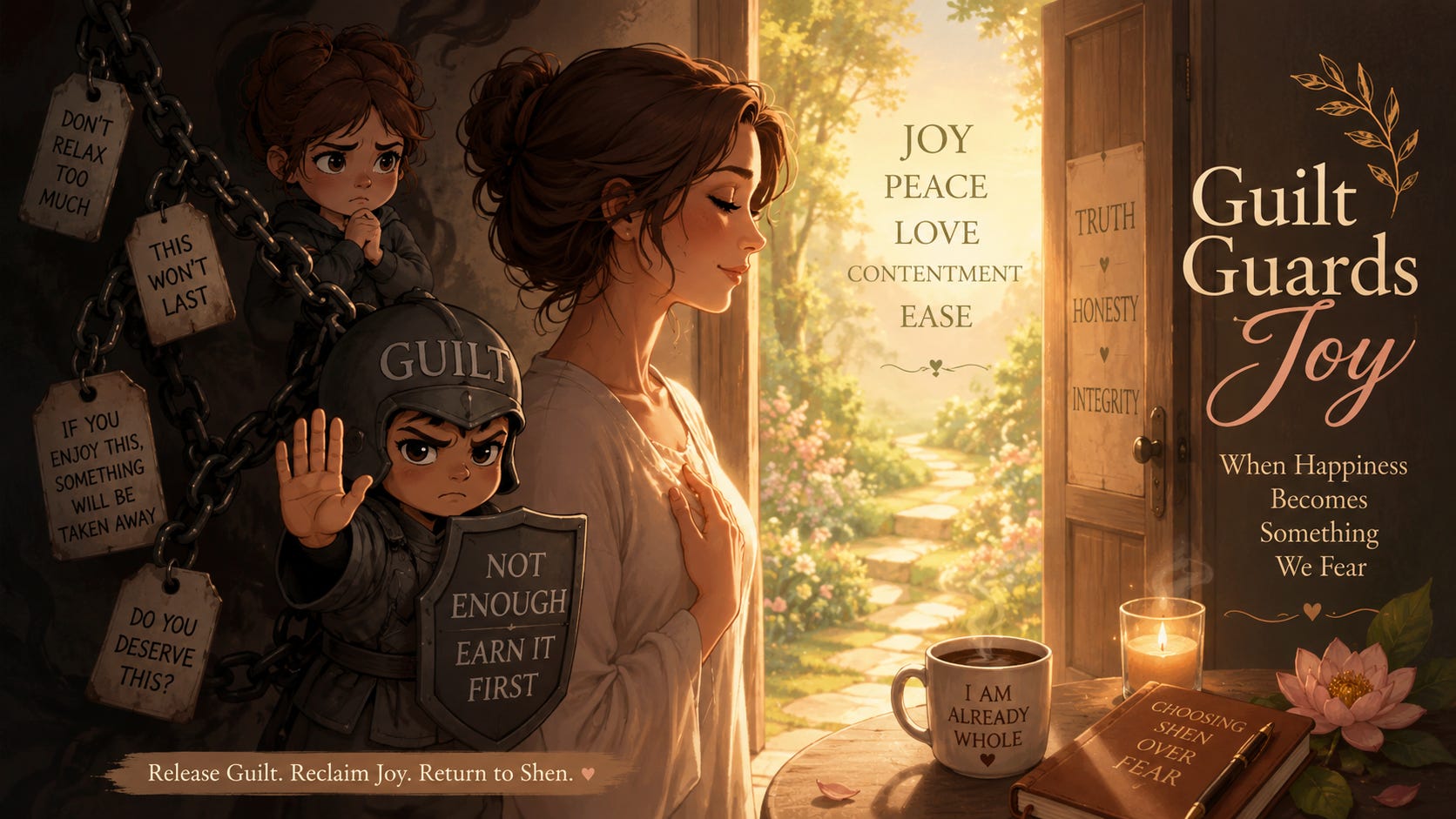
Guilt Guards Joy
This week, do you really want happiness? Drowning in red-light emotions and defending the old stories. Finally, are you thriving or just surviving?

“Perhaps peace has never been absent from our lives, only guarded by old beliefs that taught our Inner Child to fear joy more than struggle. As we gently loosen guilt’s grip and return to the quiet wisdom of Shen, we begin to discover that happiness is not something we must earn, but something that naturally flows when we live in truth, honesty, and harmony with the Tao.”
When Happiness Becomes Something We Fear
Have you ever noticed that happiness can sometimes seem more uncomfortable than struggle? Have you ever reached a peaceful moment, a loving connection, a small success, or a quiet day without drama, only to find your Inner Child beginning to pester you with warnings, predictions, and complaints? It may say, “Do not relax too much,” “This will not last,” or “If you enjoy this, something will be taken away.”
This is where we begin our teaching on ‘Guilt Guards Joy’, because for many of us, guilt is not simply an emotion we create after doing something wrong; it becomes a protective strategy, a way our Inner Child attempts to control happiness before happiness can disappoint us. We may believe we want joy, peace, love, contentment, and ease, yet when these green-light emotions begin to arise from Shen alignment, our Inner Child may quickly create a red-light emotion to pull us back into the familiar. Guilt then stands at the doorway of joy like a nervous guard, checking whether we are allowed to enter, asking whether we have earned it, whether others approve of it, whether it is safe to accept it, and whether we will be punished for enjoying it too much.
This is why this teaching matters so deeply. Many people are not struggling because they lack opportunities for happiness; they are struggling because their beliefs make happiness seem unsafe. We can be surrounded by kindness and still create suspicion. We can receive love and still create doubt. We can achieve something meaningful and still create guilt. Not because another person put those emotions into us, because they cannot, but because our interpretation created them.
This is one of the great turning points in Wu Wei Wisdom: others cannot make us feel loved, validated, rejected, guilty, or happy, nor can they take these emotional experiences away. Our emotions are created through our beliefs, interpretations, thoughts, and choices. So, when guilt appears around happiness, the most important question is not, “Why is life doing this to me?” The deeper question is, “What do I believe about happiness that makes guilt seem necessary?”
The Inner Child’s Control Contract
Our Inner Child reasons through ‘Emotional Logic’, not ‘Shen Logic’. ‘Emotional Logic’ says, “If I feel guilty, I must have done something wrong.” It says, “If I am happy while others struggle, I must be selfish.” It says, “If I let go of control, something bad will happen.” These statements seem convincing because they arrive wrapped in emotional intensity, but intensity is not truth. It is simply the volume of an unexamined belief. Shen, by contrast, does not harangue, pressure, or reproach. Shen is clear, stabilising, honest, and aligned with ‘The Power of Three’: truth, honesty and integrity. Shen does not demand that we suffer to prove love. Shen does not ask us to reject joy to appear humble. Shen does not confuse guilt with goodness. Shen understands that happiness is not a trophy awarded after perfect behaviour; happiness, peace, and contentment can be natural expressions of alignment with the Tao.
The control contract begins when our Inner Child comes to believe, often very early in life, that emotional safety depends on managing outcomes. We may have learned that if we were good enough, quiet enough, helpful enough, pleasing enough, or self-sacrificing enough, we could prevent upset around us. From there, a hidden belief forms: “I am responsible for how others feel.” This belief seems noble, but it is not true. We cannot put our emotions into another person’s body, and they cannot put theirs into ours. We can be kind, respectful, and accountable, but we cannot create another person’s emotional world for them. When we believe we can, we enter the ‘Maze of Confusion’, where love becomes control, care becomes obligation, and guilt becomes the price we pay for belonging.
In our previous teaching, we explored this clearly: “Guilt is not a safety net; it is an anchor. It tells the Inner Child, ‘Stay small and you’ll stay safe.’ But safety without freedom is a cage.” This insight matters because guilt often pretends to protect us from becoming careless, arrogant, or selfish, yet chronic guilt does not create integrity. Integrity comes from awareness, responsibility, and aligned action. Guilt often keeps us in a loop of self-punishment, as though repeating our regrets will somehow prove our goodness. But the Tao does not ask us to repeat suffering as evidence of sincerity. The Tao asks us to return to balance, learn the lesson, and move on in flow.
When Guilt Pretends to Be Love
One of the strongest counterarguments to this teaching is that guilt keeps us caring. Some may say, “If I stop feeling guilty, I might stop being thoughtful.” But let us look closely. Does guilt truly make us loving, or does it make us afraid? Does guilt create generosity, or does it create obligation? Does guilt help us respond from Shen, or does it keep our Inner Child anxiously scanning for disapproval? This is the “aha” moment: love does not need guilt to be genuine. In fact, guilt often contaminates love because it adds a hidden invoice. We give, but secretly expect relief. We help, but secretly hope to be seen as good. We overextend, but secretly resent that no one notices the cost. Then our Inner Child complains, “After everything we did, why are we still not appreciated?” This is not love flowing freely; this is emotional bargaining.
The Taoist path invites us to recognise the difference between responsibility and emotional debt. Responsibility says, “I will act with truth, honesty, and integrity.” Emotional debt says, “I must keep punishing myself for the past by denying my right to peace and joy.” Responsibility involves learning from mistakes and making repairs where appropriate. Emotional debt endlessly rehearses guilt, as though suffering itself is a form of virtue. When we confuse the two, we become trapped on the ‘Carousel of Despair,’ circling the same red-light emotion without ever reaching the deeper belief beneath it. We say, “I feel guilty,” but rarely pause to ask, “What belief is creating this guilt?” We say, “I feel bad for being happy,” but do not question, “Why do I believe my happiness harms someone else?”
This is where Taoist self-enquiry of the ‘Golden Thread Process’ gently changes the direction of our lives. Instead of remaining lost in emotional reaction, we begin tracing the feeling back to its source. We stop treating guilt as proof of the truth and start seeing it as a signpost to an old belief that no longer aligns with our Shen or our present reality.
Our Tao Te Ching version offers a gentle but powerful correction in Verse 40: “Returning is the movement of the Tao. Yielding is the way of the Tao.” This is not a call to collapse or abandon ourselves. It is a call to return from force to flow, from emotional control to spiritual alignment, from guilt to clarity. Returning is not going backwards; it is coming back to what is true. When we return to Shen, we remember that joy does not need to be defended, justified, or apologised for. We remember that another person’s struggle does not require us to abandon our happiness. Compassion does not mean joining others in their suffering. Sometimes the kindest thing we can do is remain aligned, steady, and authentic, offering care without making our peace dependent on their emotional state.
The Golden Thread Beneath Guilt
The ‘Golden Thread Process’ is essential here because guilt often appears as the emotion, but the belief underneath is where transformation begins. So, when guilt arises, we do not criticise it, dramatise it, or obey it. We listen, then we investigate. We might ask, “What do I believe I have done wrong?” Then, “Is that belief true, or is our Inner Child trying to gain control?” Then, “Does this guilt come from Shen alignment, or from an unresolved issue?” This matters because not all emotions have the same source. Emotions such as peace, contentment, gratitude, and joy can arise from Shen and reflect alignment. Other emotions, such as guilt, shame, anxiety, jealousy, or resentment, are often created by our Inner Child’s beliefs and serve as signals of disharmony. They are not bad. They are not enemies. But they are not automatically wise.
For example, imagine we finally take time to rest. A red-light emotion appears, and our Inner Child begins to chastise us: “You are lazy. You should be doing more.” If we obey the emotion, we return to overworking. If we use the ‘Golden Thread Process’, we uncover the belief: “My worth depends on being useful.” Now we are no longer trapped inside the emotion; we are standing in awareness. From there, ‘Shen Logic’ can respond: “Rest is not laziness. Rest is alignment. My worth is not created by productivity.” This is how we step out of the ‘Maze of Confusion’. We stop arguing with the emotion and begin questioning the belief that created it.
The same applies to happiness. If joy appears and guilt follows, we can ask, “What does our Inner Child believe will happen if we allow this joy?” Perhaps the answer is, “We will lose it.” “Others will judge us.” Or “We do not deserve it yet.” These beliefs are not facts; they are old agreements. Old agreements can be reviewed, updated, and aligned. This is wu wei of not forcing ourselves to be happy, but gently removing the false beliefs that block happiness from flowing naturally.
Choosing Joy Without Apology
So, how do we live ‘Guilt Guards Joy’ in a practical way? We begin by recognising that guilt is often guarding a doorway that no longer needs guarding. We do not need to fight our Inner Child, because fighting creates more resistance. We guide our Inner Child with consistency, compassion, and firmness. We say, “We are not using guilt to stay safe anymore. We are choosing truth, honesty and integrity. We can care without carrying. We can love without controlling. We can be happy without apology.” This is not selfishness. This is spiritual maturity.
The Tao does not measure our worth by how much joy we refuse. Nature does not apologise for blooming because another branch is bare. The river does not stop flowing because stones interrupt its path. The sky does not dim itself to make the night more comfortable. In the same way, our Shen does not need to shrink so that others can avoid their own beliefs. We can be compassionate and still be joyful, be generous and still have boundaries. We can be accountable without punishing ourselves, and we can walk gently forward following the Tao.
As we close ‘Guilt Guards Joy’, let us return to the beginning. The pain point was never happiness itself; it was the belief that happiness must be controlled, earned, defended, delayed, or sacrificed. The solution is not to force joy, but to align with truth. Each time guilt appears, we pause and ask what belief created it. Each time our Inner Child pressures us to control, we return to ‘Shen Logic’. Each time we are tempted into Criticism, Comparing and being Judgemental (CCJ), we choose one small, consistent, manageable step instead: no expectations, no emotional punishment, no proving, no rushing.
Let this be our closing affirmation: “I allow joy to flow without guilt. I trust my Shen to guide me with truth, honesty and integrity. I do not need control to be safe, and I do not need self-punishment to be good. I take small, steady steps in wu wei, and I return again and again to the Tao within me.”
Never doubt yourself because doubt is often our Inner Child asking for certainty before it will allow movement. We do not need certainty to begin. We need alignment. We need honesty. We need the courage to take the next small step without CCJ. And as we practise this, patiently and gently, guilt no longer guards joy. Joy becomes what it was always meant to be: a natural expression of Shen, flowing through a life lived in authenticity, balance, and the quiet wisdom of the Tao.
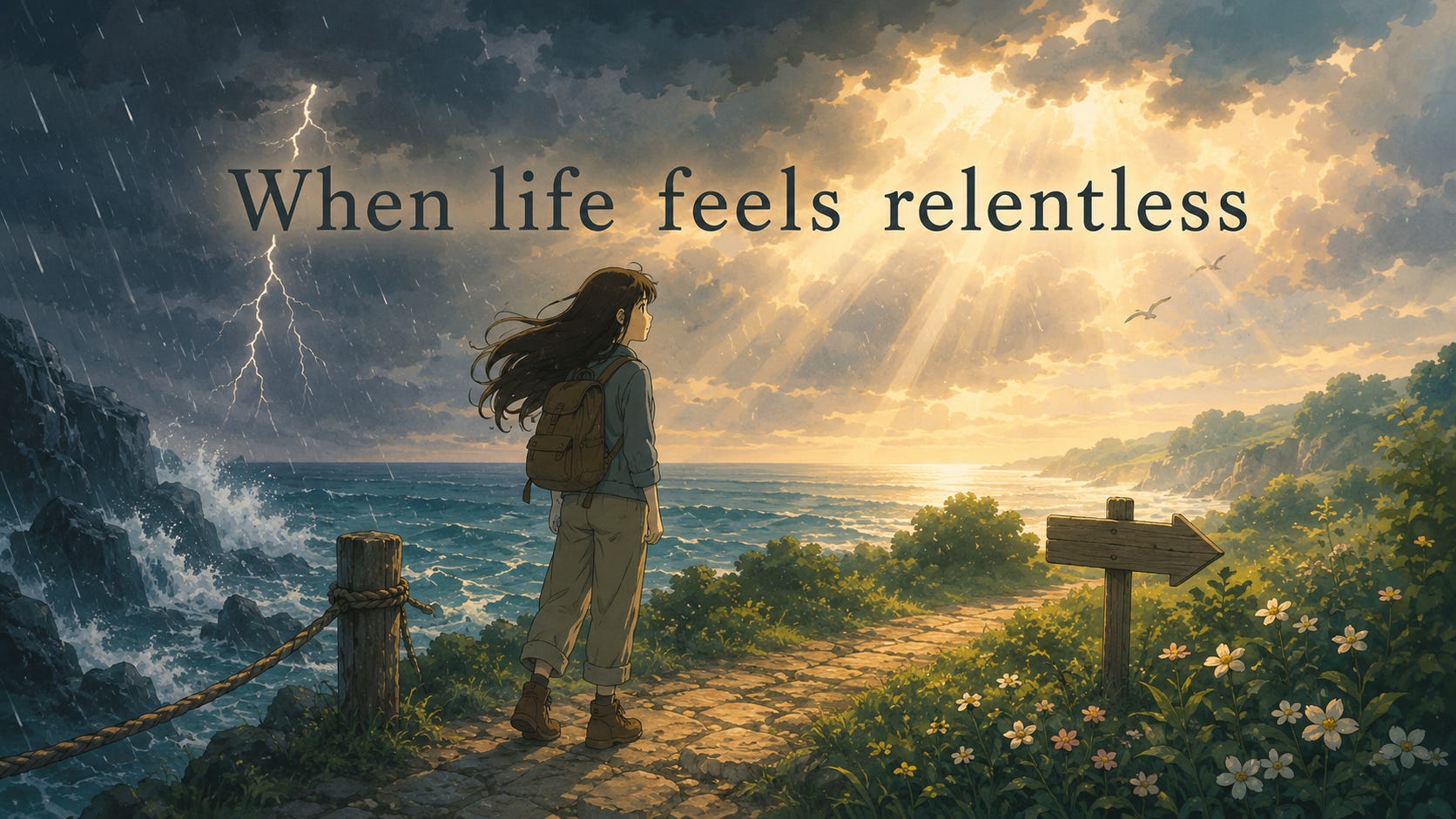
Have you ever reached the place where life no longer seems like one challenge, but a whole emotional circus of problems arriving at once? Have you ever tried to breathe, only to discover that your Inner Child has already gathered every unresolved issue, every difficult person, every uncertain outcome, and every practical complication into one giant story called “I cannot cope”? Do you sometimes look at your life from inside the situation, rather than from the higher clarity of Shen, and then wonder why everything seems so confusing, unfair, and impossible to untangle?
This is the teaching of ‘When Life ‘Feels’ Relentless’. We are not exploring difficulty as an abstract idea. We are looking at those seasons when our emotional system seems crowded, when another quickly replaces one issue, and when our Inner Child begins to nag, complain, pester, and criticise until we can no longer see the difference between what is real, what is urgent, what is imagined, and what is simply an old belief trying to stay in control.
In this journal post, we will explore how we become drawn into the victim role, not because we are weak, but because our Inner Child uses ‘Emotional Logic’ to turn many separate situations into one overwhelming identity. We will look at why red-light emotion can seem so convincing, why sympathy and attention may become emotional traps, and how the Taoist path of wu wei guides us to step back, observe the storm, and return to alignment. Most importantly, we will learn how to move from being inside the storm to becoming its steady observer.
When The Storm Becomes Identity
When life seems relentless, our Inner Child often stops seeing events as separate. A difficult conversation, a practical problem, a person behaving unfairly, financial pressure, a family issue, a health worry, a work challenge, or a painful memory can all become emotionally glued together. The mind no longer says, “There are several issues here.” It says, “My life is impossible!” That single sentence is where clarity begins to disappear.
This is the entrance to the ‘Maze of Confusion’. Our Inner Child creates red-light emotions from the belief that too much is happening and we are powerless. It then uses the emotion as evidence. The more overwhelmed we become, the more our Inner Child insists, “See, this proves we cannot cope.” But the emotion does not prove the belief is true. It only reveals the belief we are holding.
This is a vital distinction. We create our own emotions through our interpretations and beliefs. Others cannot put rejection, love, validation, shame, or fear into our bodies. They may behave in ways we do not like. They may disappoint us, challenge us, ignore us, or behave without integrity. But what we create emotionally comes from the meaning we give to their behaviour. This is not to blame. This is freedom.
Our Shen does not deny that life can be complicated. Shen refuses to turn complication into identity. Shen says, “This is one situation. This is one belief. This is the next step.” Our Inner Child says, “Everything is happening to me, and I am trapped.” That is the difference between ‘Shen Logic’ and ‘Emotional Logic’.
Our Tao Te Ching translation reminds us in Verse 59: “Whether serving the Cosmos or showing the way, keep it simple and follow your truth, honesty, and integrity.” This is not a small teaching. It is the doorway out of emotional overwhelm. When life becomes complicated, the Tao does not ask us to add more thinking, more panic, or more control. It asks us to return to simplicity, to ‘The Power of Three’: truth, honesty and integrity.
The Emotional Circus
The victim role often enters quietly. It does not usually announce itself as victimhood. It arrives disguised as exhaustion, injustice, helplessness, or the belief that everything outside us must change before we can regain peace. Our Inner Child begins to harangue us with emotional arguments: “This is too much. No one understands. No one is helping. Nothing ever changes. Why is this always happening to us?”
These statements can seem honest because they are emotionally intense. But emotional intensity is not the truth. It is simply energy attached to a belief. The victim role becomes attractive because it gives our Inner Child a temporary explanation for pain: “It is not my responsibility, because life is doing this to me.” Yet this explanation keeps us trapped on the ‘Carousel of Despair’, circling the same emotional scenery, hoping the outside world will finally rearrange itself and offer us permission to be calm.
So, we must ask a braver question. Not “Why is this happening to me?” but “What belief am I using to turn this situation into helplessness?” This is where the ‘Golden Thread Process’ becomes so powerful. We trace the red-light emotion back to the belief beneath it. If we create fear, what do we believe is threatening us? If we create resentment, what do we believe we are owed? If we create shame, what do we believe is wrong with us? If we create numbness, what truth are we avoiding because it seems too uncomfortable to face?
This does not mean we excuse other people’s behaviour. It means we stop allowing their behaviour to dictate our emotional life. We can take practical action, create boundaries, seek support, ask for advice, make decisions, and protect our well-being without turning ourselves into powerless characters in someone else’s story.
In our previous teaching, we wrote: “We are the architects of our emotions, the shapers of our realities, and the keepers of our spirit’s integrity.” This sentence matters here because it returns authority to us. Not control over everything, but authority over meaning. Not control over others, but responsibility for the beliefs we choose to live by.
Observing The Storm
There is a profound difference between being in the storm and observing the storm. When we are in the storm, every sound seems urgent, every thought demands action, every emotion claims to be the truth. Our Inner Child pressures us to react quickly because it believes speed equals safety. It says, “Do something now. Fix everything now. Make them understand now. Get certainty now.”
But wu wei teaches a different path. Wu wei is not passivity. It is effortless effort, aligned action without emotional force. It asks us to pause long enough to separate the storm from the sky. The storm is the situation. The sky is our Shen. The storm may move, rage, change, and pass through, but the sky is not destroyed by weather. This is the “aha” moment: we do not need to solve the whole storm to become clear. We only need to stop becoming it.
A practical way to do this is to name each issue separately, not as a long list of disasters, but as individual pieces of reality. This is a practical issue. This is a communication issue. This is a boundary issue. This is someone else’s behaviour. This is my interpretation. This is my red-light emotion. This is the belief beneath it. This is the next aligned step.
As soon as we separate the pieces, the monster becomes a map. What seemed like one enormous emotional creature is revealed as several smaller parts. Some parts need action. Some parts need patience. Some parts need advice. Some parts need boundaries. Some parts need nothing except for us to stop feeding them with fear.
Our Inner Child may resist this. It may chastise us, “You are minimising this. You do not understand. You must stay upset to prove this matters.” But Shen answers calmly, “We can take this seriously without becoming consumed by it. We can act with clarity without creating chaos. We can care without collapsing.”
This is how we step out of the emotional circus. We stop performing panic for our Inner Child. We stop using emotional intensity as proof of importance. We stop confusing being overwhelmed with being responsible. True responsibility is quieter. It is steadier. It asks, “What is mine to do, and what is not mine to carry?”
Returning To One Step
When life seems relentless, our Inner Child usually wants a complete solution. It wants the whole future guaranteed, every person behaving properly, every risk removed, every unresolved issue settled, every uncertainty answered. But the Tao does not work like that. The Tao reveals the path through movement, not through total control.
This is why the next small step is so sacred. It brings us out of fantasy and into reality. One email. One boundary. One breath. One honest conversation. One document organised. One moment of rest before replying. One belief was questioned. One refusal to use Criticism, Comparing and being Judgemental (CCJ) against ourselves. One decision not to climb back onto the ‘Carousel of Despair’ just because it is familiar.
Small steps may disappoint our Inner Child because they do not look dramatic enough. Our Inner Child wants the grand rescue, the perfect answer, the emotional guarantee. But Shen knows that life is rebuilt through steady alignment. The river does not carve stone through one dramatic performance. It continues, patiently, naturally, consistently.
So, when we return to ‘When Life ‘Feels’ Relentless’, we are not saying life will never be difficult. We are saying difficulty does not have to become our identity. We are saying that red-light emotion is not a command; it is a message. We are saying that our Inner Child may use ‘Emotional Logic’ to avoid accountability, gain sympathy, or protect old beliefs from scrutiny. Still, Shen will always guide us back to clarity, simplicity, and truth.
Let us end by returning to ‘The Power of Three’: truth, honesty and integrity. Truth asks, “What is actually happening?” Honesty asks, “What belief am I using to create this emotion?” Integrity asks, “What small, aligned step can I take now?” These three questions can lead us out of the ‘Maze of Confusion’ and back into flow.
Never doubt yourself because life is complicated. Complexity does not mean incapability. A stormy season does not mean a broken path. We are not here to force life into perfect order before we trust ourselves. We are here to practise trust while life is still moving, still changing, still unfolding.
So, take the next small, consistent, manageable step without expectations, without CCJ, and without demanding that the whole mountain move today. Let the Tao guide the pace. Let Shen guide the meaning. Let wu wei guide the action. And when our Inner Child begins to pester, complain, and build the emotional circus again, we can gently say, “We are not going back into the storm. We are observing it now. We are choosing one clear step.”
This is the quiet wisdom of ‘When Life ‘Feels’ Relentless’. We do not need to escape life to find peace. We need to stop abandoning our Shen inside the noise. We step back. We breathe. We observe. We align. And from that steadier place, the way forward begins to reveal itself, one honest step at a time.
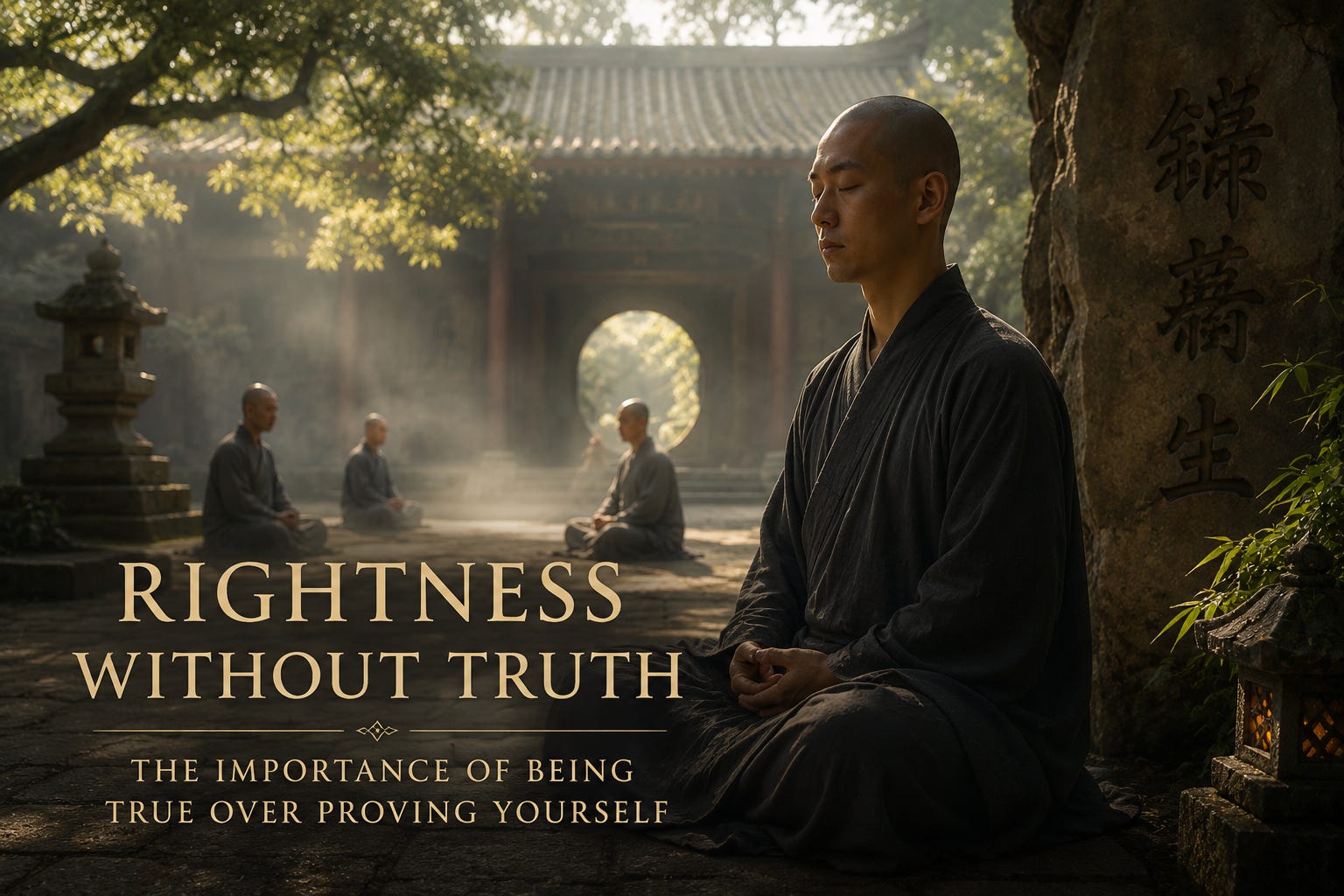
Have you ever been so certain you were right that you could no longer hear what was true? Have you ever defended your position with such force that the conversation stopped being about understanding and became about winning? Have you ever replayed an argument long after it ended, polishing your evidence, strengthening your case, and silently proving to yourself that you were innocent, misunderstood, mistreated, or morally superior?
At first glance, the need to be right may seem like stubbornness, pride, or a strong personality. Yet through the lens of Taoist and Wu Wei Wisdom teachings, we often discover something far more vulnerable beneath it. Our Inner Child rarely needs to be right because it loves truth. It needs to be right because being wrong seems emotionally dangerous. For many of us, being wrong became associated with Criticism, Comparing and being Judgemental (CCJ). Perhaps mistakes were met with criticism, embarrassment, rejection, or impossible standards. Our Inner Child may have innocently concluded, “If I am wrong, I will be judged,” “If I make mistakes, I lose love,” or “If someone else is right, I become less valuable.”
So, rather than risk those old emotional experiences, our Inner Child may argue, justify, interrupt, blame, over-explain, or retreat into victimhood. It may even create red-light emotions such as anger, defensiveness, shame, or anxiety to distract us from the deeper fear of inadequacy. Ironically, these behaviours often create the very criticism and disconnection our Inner Child is trying to avoid.
Shen sees this differently. Shen understands that being wrong is not rejection; it is information. Correction is not condemnation; it is growth. When we stop treating mistakes as threats to our worth, we become more open, curious, and free to choose truth over defensiveness. Being wrong may mean admitting that we created a red-light emotion from a belief that was never true. Being wrong may mean accepting that our version of events was shaped by fear, unfairness, old resentment, or the familiar story of being misunderstood. Being wrong may mean we must stop blaming someone else and begin asking the deeper question: “What belief am I protecting?”
This journal post explores the hidden cost of “Rightness Without Truth”. We will look at how our Inner Child uses ‘Emotional Logic’ to defend old beliefs, how victim language can become a shield against accountability, how familiarity keeps the old story alive, and how wu wei guides us back to openness, humility, and flow.
When Being Right Seems Safe
Our Inner Child loves certainty because certainty seems like safety and familiarity. If our Inner Child can decide, “I am right, and they are wrong,” then the world becomes simple. There is no need to examine hidden beliefs, no need to question our emotional reaction, no need to wonder whether we may have misunderstood the situation. The story becomes cleaner, more dramatic, and more convincing. But life is rarely that simple.
A disagreement about communication may really be about our belief that silence means rejection. A conflict over respect may stem from our belief that disagreement means we are being dismissed. A painful argument may seem to prove someone does not care, when the deeper truth is that our Inner Child has created fear from the belief, “If they do not agree with me, I am unsafe.” This is why needing to be right can become so exhausting. We are not only defending an opinion. We are defending an identity. We are defending the belief system our Inner Child has used to explain life, people, love, rejection, worth, fairness and control. So, when someone challenges us, it may seem as if they are attacking the whole structure of who we believe ourselves to be.
This is ‘Emotional Logic’. It says, “If I am wrong, I am unsafe.” “If I admit another perspective, I lose power.” “If I stop defending myself, I will be blamed.” But ‘Shen Logic’ sees differently. ‘Shen Logic’ asks, “Can I be open and still be safe? Can I be wrong and still be worthy? Can I listen without losing myself?” That is the beginning of maturity.
The Victim’s Version of Being Right
There is an obvious kind of needing to be right, the argumentative kind, where we interrupt, defend, explain and try to win. But there is also a quieter version, and it can be far more difficult to recognise. This is when our Inner Child becomes attached to being right about suffering. It may say, “You don’t understand what I have been through.” It may say, “This is why I cannot change.” “My beliefs are too deep.” Or “Anyone would react this way if they had my life.”
There may be truth in the story. Painful things may have happened. People may have behaved unfairly. There may be unresolved issues that deserve care and attention. But the hidden danger appears when explanation becomes justification. Context is helpful. Excuses keep us trapped. Our Inner Child can become very loyal to the identity and story of being hurt because that identity offers something powerful: protection from accountability. If we are always the injured one, we do not need to ask where we are manipulating, avoiding, exaggerating, withdrawing, blaming or refusing to grow. If we remain the victim, someone else remains responsible for our emotional life.
This is where the ‘Carousel of Despair’ begins turning. We keep telling the same story, creating the same red-light emotion, demanding the same recognition, and wondering why peace never arrives. Yet peace cannot arrive while we are still insisting that someone else must change before we can return to alignment. In our previous teaching, we said, “Emotions are not evidence. They are the consequences of what we believe.” This sentence is a doorway. It does not deny emotion. It honours emotion by guiding us back to the belief that gave rise to it.
The Familiar Argument
Our Inner Child does not always choose the truth. It often chooses the familiar. This is why the need to be right can become a deeply repeated emotional habit. We may know the old argument does not work. We may know the same defence creates distance. We may know that the same victim story leaves us powerless. Yet our Inner Child still returns to it because it knows the route. Familiar pain can seem safer than unfamiliar growth.
When misunderstanding becomes familiar, genuine understanding can seem unsettling. After living beside sadness for so long, joy may appear fragile or untrustworthy. A mind accustomed to blame may look upon accountability as though it were punishment rather than freedom. And when we have relied on others to confirm our worth, the quiet steadiness of self-trust can seem almost too simple to believe. This is why painful beliefs are often defended with such fierce loyalty. Not because they bring harmony, but because they are known pathways within the emotional system. Our Inner Child quietly says, “At least I understand this pain. At least I know the rules here.” So, the familiar suffering becomes like a small, dimly lit room, cramped and limiting, yet strangely comforting because we have lived inside it for so long.
Our I Ching translation, Hexagram 15, ‘Modesty’, offers a beautiful correction: “Modesty does not dwell in blind faith or stubborn disbelief but rather in the simplicity of a mind willing to explore and grow.” This is not a weakness. This is spiritual strength. Modesty asks us to loosen our grip on certainty and become available to truth. The need to be right closes the door. Modesty opens it.
From Winning to Understanding
The Sage, the inner voice of Shen, does not need to win because the Sage is not trying to prove worth. Shen does not need to dominate because Shen is already whole. When Shen guides us, we can listen without collapsing, disagree without attacking, apologise without shame, and change our minds without losing dignity. In our previous teaching, we explored this clearly: “When you no longer need to be right, you become real. And in your authenticity, our Inner Child will begin to follow, not out of fear, but because your steadiness becomes irresistible.”
This is a profound shift. Instead of asking, “How do I prove I am right?” we ask, “What truth is trying to reveal itself here?” Instead of asking, “How do I make them understand my pain?” we ask, “What belief created this pain in me?” Instead of asking, “Who is to blame?” we ask, “Where is my next aligned step?” This is the ‘Golden Thread Process’. We begin with the red-light emotion, but we do not stop there. We gently follow it to the thought, then to the belief, and finally to the early misunderstanding our Inner Child has been protecting. We do this without Criticism, Comparing and being Judgemental (CCJ), because harshness only makes our Inner Child more defensive. Truth does not need cruelty. Truth needs courage.
And here is the quiet miracle: when we stop needing to be right, we become easier to love, not because we are pleasing others, but because we are no longer using every conversation as a courtroom. We are no longer placing others on trial to prove our worth. We are no longer asking our red-light emotion to testify on behalf of an old belief. We become curious. Curiosity is softer than certainty, but far stronger.
Returning to Truth
“Rightness Without Truth” is exhausting because it asks us to defend what may no longer serve us. It keeps us trapped in the ‘Maze of Confusion’, building explanations, excuses and justifications around beliefs that would dissolve if we examined them honestly.
So, today, let us practise differently. When our Inner Child pesters us to defend, we pause. When it complains, “This is unfair,” we listen, but we do not hand over the steering wheel. When it nags, “You must prove you are right,” we ask, “What am I afraid will happen if I am not?” Then we return to ‘The Power of Three’: truth, honesty and integrity. Truth asks, “What is real?” Honesty asks, “What am I believing?” Integrity asks, “How will I now live from what I know?”
This is wu wei; we do not force ourselves to become open. We stop forcing ourselves to stay closed. We stop fighting to protect an old identity. We allow the Tao to move us through the small doorway of humility. Take small, consistent, manageable steps without expectations or Criticism, Comparing, or being Judgemental (CCJ). Admit one place where we may be defending familiarity instead of truth. Rewrite one victim statement into an accountable belief statement. Pause once before proving a point. Ask once, “What else might be true?”
Never doubt yourself. Your Shen is not threatened by being wrong. Your Shen knows that truth is not a weapon, but a path. It knows that openness does not diminish us; it returns us to flow. Affirm: “I release the need to be right when it blocks truth. I guide my Inner Child with patience, courage and clarity. I choose humility, curiosity and alignment with the Tao. I am safe to learn, safe to grow, and safe to live from Shen.”
This is how we move beyond “Rightness Without Truth”. Not by losing ourselves, but by finding the truth we were once too defensive to see.
Moments of Inspiration…
Thriving, Not Surviving
There comes a moment when we must gently ask ourselves: are we truly living, or are we simply managing to get through each day? Survival has its place. Sometimes, it is the bridge that carries us across difficult seasons. But we were never meant to build a permanent home there.
Our Inner Child may believe survival is safer because it is familiar. It keeps expectations low, avoids risk, and prepares for disappointment before life has even unfolded. Yet Shen knows something deeper. Shen remembers that we are not here merely to endure; we are here to grow, create, connect, and align with the natural flow of the Tao.
Thriving does not mean life becomes perfect. It means we stop measuring our worth by how much we can tolerate. It means we begin choosing thoughts, beliefs, and actions that support expansion rather than emotional protection. We pause and ask, “What would I choose today if I trusted myself a little more?” That one question can open a doorway.
Through wu wei, we do not force ourselves into a new life. We take one honest step, then another. We stop using Criticism, Comparing and being Judgemental (CCJ) as motivation and begin walking with truth, kindness, and quiet courage.
Affirm: “I am ready to move beyond survival. I trust my Shen, honour my growth, and take small steady steps into a life of alignment, purpose, and flow.”
This week, choose one small action that supports your thriving, and let it remind you that your life is not only something to survive, but something sacred to live.
In the Next ‘Inner Circle’ (Paid) Journal…
Truth Seeds Love
The Sleeping Spell
Moments of Inspiration
In the Next Free Journal…
(Familiar) Pain
Belonging Without Bargaining
Hope Delays Peace
Moments of Inspiration
Journal #F082 25/05/2026
Contact: info@wuweiwisdom.com
Website: www.wuweiwisdom.com
YouTube: www.youtube.com/user/WuWeiWisdom
Facebook Community: www.facebook.com/groups/wuweiwisdomcommunity/