
No Rescue Needed
This week, hoping for someone to step in and fix things, the effortless flow of honesty and protecting who you would like to be. Finally, worth is not found in your bank balance.

‘“Today, we choose to stop waiting for the world to rescue us and gently return to the quiet wisdom already waiting within our Shen. With every belief we question through truth, honesty, and integrity, we discover that the peace we have been searching for has never been lost, only patiently waiting for us to remember it.”

Have you ever noticed how quickly your Inner Child agrees with a teaching when life is calm, yet the moment uncertainty, rejection, delay, or frustration appears, the whole emotional landscape changes?
One moment we are clear and reflective, speaking about accountability, alignment, and wisdom; the next, our Inner Child is pressuring, reproaching, and demanding that reality bend to its emotional preferences. Have you ever caught yourself saying that you understand that you create your emotions, yet still waiting for another person to apologise, reassure you, explain themselves, or behave differently before you allow yourself to return to peace? These are not signs of failure. They are powerful opportunities for awareness. They reveal the hidden emotional equation beneath many of our reactions, the belief that peace can only arrive once life becomes emotionally comfortable.
In this journal post, we will explore one of the most subtle yet profound Taoist doorways within emotional growth, our Inner Child’s longing to be rescued from its own emotional creations. We will examine how our Inner Child uses what we call ‘Emotional Logic’ to pressure reality into restoring certainty, validation, reassurance, or fairness. We will also uncover why emotional urgency can be so exhausting, why resentment often masks emotional dependency, and why aligning with the Tao asks us to stop waiting for life to repair our emotional state before we return to Shen clarity. Through the teachings of wu wei and the wisdom of our Tao Te Ching translation, we will gently explore how true emotional maturity emerges when we stop asking the world to remove our discomfort and begin guiding our Inner Child through it with compassion, truth, honesty and integrity, the ‘Power of Three’.
The Hidden Desire to Be Rescued
One of the most difficult truths for our Inner Child to accept is that no one else can climb into our emotional system and repair what we are creating through our beliefs. This can seem confronting at first because our Inner Child has spent years developing a different strategy. It has learned to use emotional intensity as leverage. It reasons that if it becomes upset, angry, anxious, dramatic, or emotionally overwhelmed enough, then somebody will finally provide the reassurance, certainty, validation, or control it believes it needs. This is not because our Inner Child is malicious. It is immature. It still interprets life through ‘Emotional Logic’ rather than ‘Shen Logic’.
When life does not go according to plan, our Inner Child begins badgering us with emotional arguments. “This should not be happening.” “They need to fix this.” “I need answers right now.” “I cannot relax until this changes.” These emotional equations seem persuasive because they arrive wrapped in urgency. Yet urgency is not the same as truth. Urgency often becomes the emotional costume worn by fear, insecurity, and the desire to regain control over uncertainty.
In our previous teaching, “Anchored in Truth,” we explored the insight that “Emotions are messengers, not masters. They are signs, not destinations.” This teaching opens a profound doorway by reminding us that emotions themselves are not the problem. The issue arises when we begin to treat emotional discomfort as evidence that reality must change immediately. Our Inner Child creates the emotional storm, then insists the storm proves that something is wrong externally.
This is why resentment becomes so exhausting. Resentment often appears to be about another person, yet beneath it lies a belief that someone else should remove our discomfort for us. Our Inner Child becomes trapped in what we call the ‘Carousel of Despair’, replaying emotional arguments in a cycle, hoping the repetition itself will somehow force reality to feel emotionally safer. The more our Inner Child pressures life, the more emotionally fragile it becomes, as its stability now depends on external compliance.
‘“The moment we stop asking life to rescue us, we begin discovering the strength that was quietly waiting beneath the panic.”’
The Tao Te Ching gently steers us away from this emotional dependency. In Verse 59 of our Tao Te Ching translation, we are reminded: “When rooted deeply, foundation is firm. When aligned with the Tao, nothing is lost. Everything returns to balance.” There is immense wisdom within these lines. Emotional balance does not emerge from controlling every outcome. It arises through alignment with truth. Shen does not demand guarantees before choosing peace. Shen trusts its ability to navigate uncertainty without abandoning itself.
When Rage Becomes Emotional Protest
Many people misunderstand anger. They assume anger itself is the problem. Yet anger often serves as an emotional protest from our Inner Child when reality refuses to meet its expectations. Beneath rage is usually a childlike equation insisting: “If I cannot get certainty, fairness, validation, or reassurance, then I will create enough emotional intensity to force attention onto my unresolved issues.”
This is why emotional outbursts can sometimes seem strangely addictive. Our Inner Child believes emotional escalation creates power. It reasons that calmness means vulnerability while emotional intensity creates protection. Yet the opposite is often true. Emotional escalation weakens our connection to Shen because it narrows perception into emotional survival mode. Our Inner Child becomes consumed by emotional noise, unable to hear the deeper wisdom already present beneath the reaction.
In our previous teaching, “Before Belief Speaks,” we explored how our Inner Child absorbs early emotional equations long before it develops mature reasoning. If our Inner Child learned that strong emotions gained attention, control, or temporary reassurance, then emotional escalation can become a deeply familiar strategy. Familiarity then disguises itself as safety. This is what we call ‘The Pit of Familiarity.’ The emotional reaction may be painful, yet because it is familiar, our Inner Child continues returning to it.
This explains why emotional growth can initially seem uncomfortable. Shen alignment asks us to stop feeding the familiar emotional strategy. Instead of reacting impulsively, we pause, breathe and guide. We question the belief beneath the emotion using the ‘Golden Thread Process’. We ask ourselves: “What belief is my Inner Child defending right now?” Often the answer reveals itself gently. “I believe I cannot cope unless this changes.” “I believe uncertainty means danger.” “I believe other people should remove my discomfort.”
Notice how different this is from endlessly analysing emotions. Taoist wisdom is not about becoming emotionally obsessed with ourselves. It is about recognising the emotional equation beneath the reaction and realigning with Shen’s truth.
Our I Ching translation beautifully reflects this understanding by teaching that life is not fixed but constantly moving through cycles of change and transformation. Emotional discomfort often arises because our Inner Child wants life to be frozen in certainty. Yet the Tao flows through movement, unpredictability, and openness. Trying to emotionally future-proof ourselves against every possible discomfort only deepens emotional fragility.
Guiding our Inner Child Back to Shen
One of the most beautiful shifts within emotional maturity occurs when we stop arguing with our Inner Child and begin guiding it instead. Many people unknowingly enter emotional warfare with themselves. They criticise themselves for reacting. They judge themselves for struggling. They become trapped in Criticism, Comparing and being Judgemental (CCJ), believing harshness creates improvement. Yet our Inner Child interprets this as rejection.
In our previous teaching, “Accepting Yourself,” we explored how our Inner Child reacts when it feels emotionally abandoned. This is why self-rejection never creates alignment. Our Inner Child becomes louder, reactive, and more desperate for emotional certainty. Shen’s guidance sounds very different. Shen calmly says, “I understand why you are upset, but we do not need to create panic to be safe.” Shen reminds our Inner Child that uncertainty is part of life, not proof of danger. Shen does not rush to rescue the reaction emotionally. It lovingly redirects it.
This distinction is essential. Many people mistake emotional guidance for emotional suppression. They worry that if they stop emotionally indulging every reaction, they are somehow invalidating themselves. Yet true alignment involves listening compassionately while remaining rooted in truth. We acknowledge the emotion without handing over leadership to it.
‘“Peace begins the moment we stop negotiating with emotional panic and start trusting our Shen to lead the conversation.”’
Wu wei becomes deeply important here. Wu wei is often misunderstood as passivity, yet our teachings consistently remind us that wu wei means effortless effort, alignment with natural flow rather than emotional force. When we stop emotionally wrestling with reality, tremendous energy returns to us. We no longer spend hours mentally rehearsing injustice, demanding certainty, or emotionally bargaining with life. We become available to wisdom again.
This doorway also reveals why conscience matters so deeply within Taoist teachings. Beneath emotional urgency, most people quietly know when they are trying to force reality to conform to comforting our Inner Child. Shen recognises the difference between authentic action and emotional pressure. Our conscience gently reveals when we are acting from truth versus emotional desperation.
The Freedom Beyond Emotional Permission
One of the deepest emotional traps occurs when our Inner Child believes it needs permission from the external world to relax. “I can only feel okay once they reply.” “I can only relax once this problem disappears.” “I can only feel secure if I receive reassurance.” This creates a life of emotional dependence in which peace is permanently postponed.
Yet Taoism invites us into a radically different understanding. External events do not grant peace. Peace emerges through alignment with Shen truth regardless of changing circumstances. This does not mean we stop caring about life. It means we stop outsourcing our emotional stability to conditions beyond our control.
Our Tao Te Ching translation beautifully expresses this in Verse 1: “Recognising the opposites and extremes, it means discovering wu wei.” Our Inner Child lives in extremes, certainty or panic, validation or rejection, control or fear. Shen gently returns us to balance. Shen understands that uncertainty does not erase our value. Delays do not diminish our worth. Other people’s behaviour cannot remove our connection to ourselves unless we choose to hand that power away.
This becomes one of the most liberating ‘Life Lessons’ we can learn. Emotional maturity is not the absence of difficult emotions. It is the growing ability to recognise when our Inner Child is trying to recruit reality into fixing what only inner alignment can resolve. In our previous teaching, “Already Whole,” we explored how our Inner Child constantly seeks proof of worth through external conditions. Yet Shen does not require proof to recognise value. Shen already understands our worth because Shen exists beyond emotional performance. When we reconnect with this understanding, the emotional noise gradually softens. We stop demanding that life constantly reassure us that we matter.
This does not happen overnight. Our Inner Child often returns to old, familiar strategies because emotional habits have been repeated for many years. That is why small, consistent, manageable steps matter so deeply. Each moment of awareness weakens the old emotional equation. Each pause interrupts the familiar cycle. Each act of self-guidance strengthens our connection to Shen.
So, if we notice ourselves emotionally pressuring life today, perhaps we can pause gently and ask: “What am I hoping somebody else will emotionally fix for me?” Then perhaps we can go deeper still: “What belief am I protecting beneath this emotion?” These questions are not punishments. They are doorways back into alignment.
The beauty of ‘No Rescue Needed’ is not that we become emotionally detached from life, quite the opposite. We become more authentic, more grounded, and more available to genuine connection when we stop demanding that others regulate our emotional state for us. We stop asking the world to remove every discomfort before we allow ourselves to return to peace.
This is where Taoist wisdom becomes deeply practical. We begin trusting that we can navigate uncertainty without collapsing into emotional panic. We stop measuring our emotional safety through external reassurance. We guide our Inner Child with patience rather than fear. We step away from the exhausting pull of the ‘Maze of Confusion’ and return to the quiet clarity of Shen.
As we continue walking this path, we slowly discover something extraordinary. The peace we spent years chasing was never hidden inside perfect circumstances. It was waiting beneath the emotional noise all along. Shen was never absent. It was being drowned out by the urgency of our Inner Child’s demands.
So, let us continue forward gently with the wisdom of ‘No Rescue Needed’. Let us stop doubting our ability to face uncertainty with grace. Let us trust that emotional discomfort does not define reality. And let us remember that every small moment of accountability, awareness, and alignment becomes another quiet step away from the ‘Carousel of Despair’ and back into the effortless flow of wu wei, where our Shen has patiently waited for us the entire time.
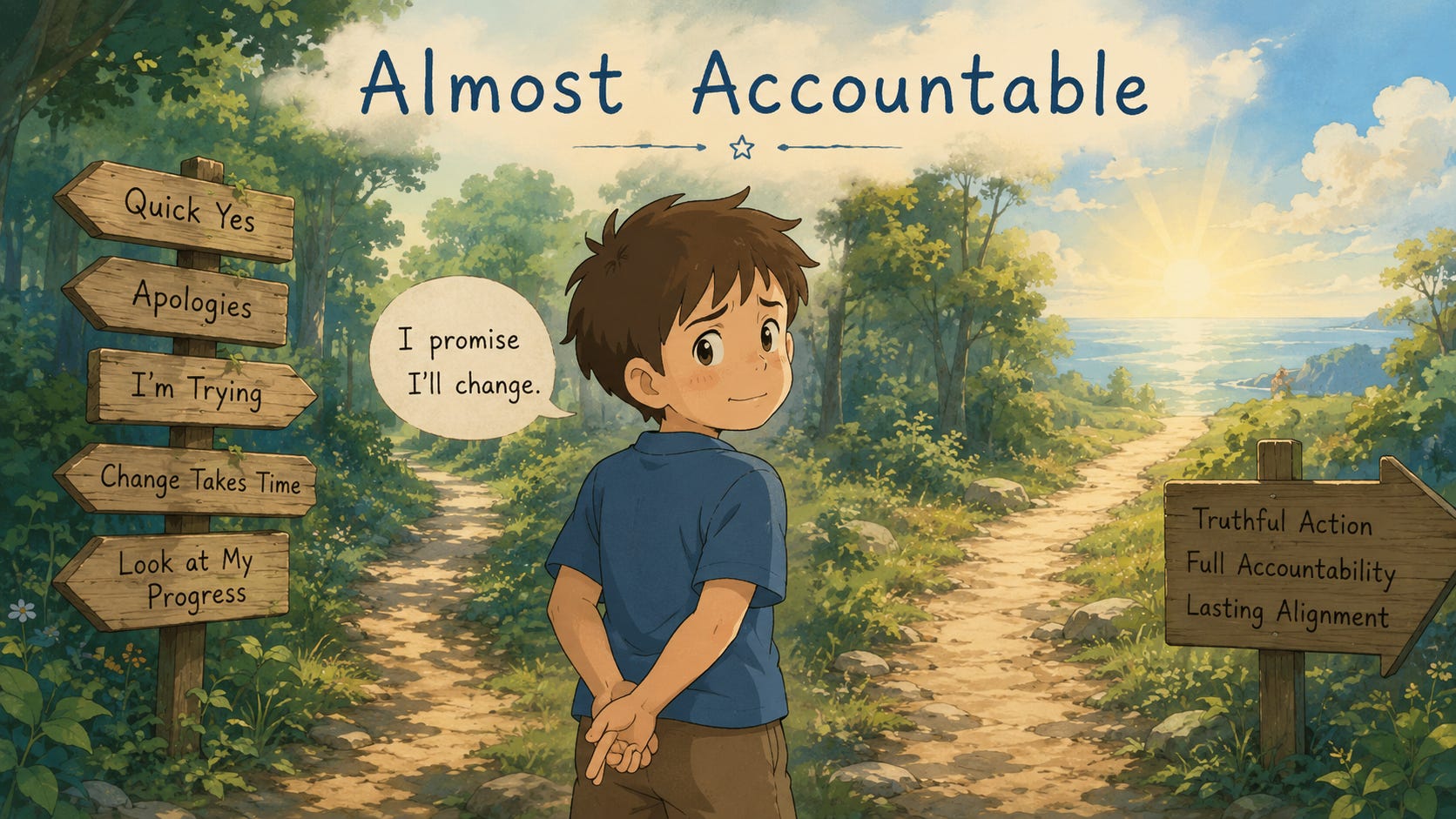
Have you ever caught yourself saying, “I’m trying my best,” while quietly avoiding the one truthful action you already know you need to take? Have you ever noticed how easy it is to speak the language of growth while still protecting the familiar emotional pattern beneath it?
Our Inner Child can become remarkably skilled at appearing accountable without fully stepping into accountability. It learns to soften criticism before it arrives, offering explanations, partial progress, emotional sincerity, or promises of future effort, all while quietly postponing the uncomfortable change that truth, honesty and integrity are asking of us right now.
This teaching opens a subtle yet powerful doorway into human behaviour because many people are not openly resisting change. Instead, they create what seems like movement while remaining emotionally loyal to familiarity. Our Inner Child says, “I’m working at it,” “Change takes time,” “It’s not easy,” or “Look how much progress I’ve already made.” Sometimes these statements are honest reflections. Yet at other times they become emotional protection strategies, carefully arranged within what we call the grey area, where accountability becomes blurred enough to avoid full responsibility while still appearing cooperative and sincere.
In this journal post, we will explore how our Inner Child uses ‘Emotional Logic’ to protect familiar identity patterns, avoid criticism, and maintain emotional comfort while seeming committed to change. We will examine the hidden manipulation beneath partial commitment, the emotional equations driving avoidance, and the deeper Taoist teaching that genuine transformation begins when we stop performing progress and start choosing alignment. Through the wisdom of wu wei and our Taoist teachings, we will uncover why true accountability is often quieter, simpler, and more exact than our Inner Child would prefer.
The Progress Shield
One of the most fascinating defence mechanisms of our Inner Child is what we may call the ‘Progress Shield’. This occurs when our Inner Child highlights improvement in one area to avoid being challenged in another. It creates a subtle emotional equation: “Because I am improving somewhere, I should not be questioned elsewhere.” Our Inner Child is not necessarily trying to deceive maliciously. It is attempting to protect itself from shame, criticism, rejection, and the emotional discomfort of confronting the deeper issue directly.
For example, someone may become more reflective, calmer, more emotionally expressive, or more communicative, yet continue to avoid taking truthful action where it matters most. They may seem committed, follow through, tell the truth, or partially honour agreements. Then, if challenged, our Inner Child quickly reaches for emotional protection: “But look how hard I’m trying.” “Look how much progress I’ve made.” “You’re ignoring the improvements.”
This creates a confusing emotional atmosphere because there often has been some growth. That is what makes the grey area so persuasive. Our Inner Child cleverly mixes sincerity with avoidance, truth with distortion, effort with emotional protection. This is why many relationships, friendships, and personal journeys become trapped within what we call the ‘Maze of Confusion’. There seems to be enough progress to delay full accountability, yet not enough truth to create genuine trust.
In our previous teaching, “Before Belief Speaks,” we explored how our Inner Child absorbs early emotional equations and survival strategies long before mature reasoning develops. If our Inner Child learned that appearing cooperative reduced criticism or emotional pressure, then partial accountability can become a familiar emotional strategy. Familiarity then disguises itself as safety, creating what we call ‘The Pit of Familiarity.’ The known pattern may limit growth, but it still seems emotionally safer than complete honesty and the uncertainty of change.
Our Tao Te Ching translation reminds us in Verse 40: “Returning is the motion of the Tao. Yielding is the way of the Tao.” Returning means revisiting the root belief beneath the behaviour. Yielding means allowing truth to soften our emotional defences rather than strengthening them. This teaching becomes deeply important because genuine accountability requires us to stop protecting the identity built around avoidance.
“Our Inner Child often progresses when it is frightened of transformation.”
Quick Yes, Slow Change
One of the clearest signs of this emotional pattern is what we may call the ‘quick yes’. Our Inner Child quickly agrees, apologises, promises, or quickly reassures because agreement immediately reduces tension and emotional discomfort. In the moment, our Inner Child seems sincere because it genuinely wants the pressure to stop. Yet later, when the emotional intensity fades, the familiar behaviour quietly returns.
This creates a painful contradiction within relationships and within ourselves. Words become separated from aligned action. Agreements become temporary emotional management tools rather than reflections of integrity. Then, when the agreement is broken or only partially honoured, our Inner Child moves into explanation mode. “I’m still learning.” “I need more time.” “I’m doing better than before.”
Again, there may be truth inside these statements. Real growth does take time. Emotional patterns do not vanish overnight. Yet the deeper issue is whether our Inner Child is using these half-truths to create alignment or to postpone it. This distinction matters enormously.
In our previous teaching, “Anchored in Truth,” we explored the insight that emotions can become persuasive distractions from deeper accountability. Our Inner Child often creates emotional sincerity to avoid exact honesty. It reasons that emotional expression itself should count as transformation. Yet Shen recognises the difference between emotional intention and aligned behaviour.
This is why accountability can seem uncomfortable at first. Accountability removes the grey area. It asks us to speak plainly. “I did not keep my agreement.” “I avoided the truth.” “I chose familiarity over alignment.” These statements do not attack the self. They clarify reality. Shen thrives in clarity because Shen is rooted in truth, honesty and integrity, the ‘Power of Three’.
Our Inner Child, however, often associates direct accountability with emotional danger. If it fully admits the truth, it worries that it will be criticised, abandoned, or exposed as flawed. So, it negotiates emotionally. It offers partial truths, visible effort, reflective language, or selective improvement as emotional bargaining tools. This creates what we may call ‘Almost Accountability’. Yet almost accountable is still avoidance.
The Familiarity Contract
There is an even deeper layer beneath these behaviours. Our Inner Child often protects a familiar identity, even when that identity causes suffering. This is where many students experience an important breakthrough. The issue is rarely laziness alone. Our Inner Child fears losing emotional familiarity.
Familiarity creates a hidden contract. The contract quietly says: “I will improve enough to reduce pressure, but not enough to lose the familiar version of myself.” This is why some people remain trapped in repeated emotional cycles for years while sounding highly self-aware. Awareness alone does not dissolve emotional loyalty to familiarity.
The familiar identity may involve avoiding conflict, seeking approval, manipulating perception, appearing spiritual, being emotionally dependent, or maintaining control through vagueness. Even painful patterns can seem emotionally safer because they are known territory. Our Inner Child would rather manage familiar discomfort than risk the uncertainty of complete change.
This insight aligns beautifully with our I Ching translation and the Taoist understanding of change itself. The I Ching consistently teaches that life flows through transformation and movement. Yet our Inner Child often tries to freeze identity into predictable emotional patterns because certainty seems safer than openness.
One of the greatest misunderstandings about growth is believing that effort alone creates transformation. Effort, reflection, and awareness matter. Yet transformation deepens when conscience and aligned action begin working together consistently. Otherwise, our Inner Child may become more sophisticated at explaining its avoidance.
‘“When effort becomes a shield against truth, progress quietly turns into performance.”’
This is why ‘The Shen Test’ becomes so valuable. We may gently ask ourselves: “Am I using effort language to avoid exact accountability?” “Am I hoping visible progress in one area excuses avoidance in another?” “Would I still choose this truth if nobody praised my effort or softened the consequences?” These questions are not meant to create shame. They invite alignment. They help us recognise where emotional protection may still be controlling behaviour beneath the appearance of sincerity.
The Courage of Exact Honesty
True accountability is often far quieter than our Inner Child expects. It does not need dramatic promises or emotional performances. It simply tells the truth. It clearly recognises the behaviour and repeatedly chooses alignment through small, consistent actions.
This is why wu wei becomes such an important teaching here. Wu wei, effortless effort, guides us away from emotional forcing and toward natural alignment and flow with truth. Our Inner Child often believes change must involve dramatic emotional struggle. Yet Shen understands that genuine transformation emerges through exactness, consistency, and honesty in small moments.
Our Tao Te Ching translation beautifully reflects this in Verse 63: “Manage the small before it becomes great. Bring harmony to what is still simple.” There is profound wisdom within this teaching. Avoidance grows when we keep postponing small truthful actions. The longer our Inner Child protects the grey area, the more emotionally exhausting life becomes. Relationships lose trust. Internal conflict deepens. The ‘Carousel of Despair’ keeps spinning because clarity is continuously delayed.
In our previous teaching, “Accepting Yourself,” we explored how our Inner Child fears rejection and emotional abandonment. This fear often sits beneath avoidance. Our Inner Child believes complete honesty may expose inadequacy or imperfection. Yet Shen already understands that imperfection is part of being human. Shen does not require perfection before choosing integrity.
There is immense freedom in this understanding. We no longer need to protect ourselves through ‘Almost Accountable’. We no longer need to make progress while quietly avoiding the deeper issue. We stop managing perception and start practising alignment. This may begin very simply. Instead of saying, “I’m trying,” perhaps we say, “I understand where I avoided responsibility.” Instead of saying, “It’s complicated,” perhaps we say, “Part of me still wants familiarity.” Instead of hiding the explanation, we gently acknowledge the exact behaviour needing attention.
The beauty of this path is that truth gradually softens the emotional system. The more exact our honesty becomes, the less energy we waste protecting emotional defences. We stop rehearsing explanations. We stop negotiating with conscience. We no longer need to appear improved while secretly resisting transformation.
So, if we recognise ourselves somewhere within ‘Almost Accountable’, let us approach that recognition with compassion rather than criticism. Our Inner Child created these strategies to avoid emotional discomfort and preserve familiarity. Yet we are no longer required to remain emotionally loyal to old patterns. We can guide our Inner Child toward something steadier.
Let us continue taking small, manageable steps rooted in the ‘Power of Three’: truth, honesty and integrity. Let us practise exact accountability without harshness and alignment without performance. Let us stop doubting our ability to grow beyond the familiar emotional identity that once seemed necessary for safety.
And perhaps most importantly, let us remember that genuine transformation rarely announces itself dramatically. It quietly appears in the moments when we stop hiding behind effort and begin consistently choosing truth, one honest step at a time.
Have you ever noticed how exhausting it becomes to protect a version of yourself that no longer aligns with your truth? Have you ever agreed with full sincerity, only to quietly drift away from it once discomfort, uncertainty, or emotional pressure appeared? Perhaps you explained it away with stress, confusion, timing, childhood experiences, or the familiar phrase, “I didn’t mean to.”
Most of us have done this in small and subtle ways, yet few of us pause long enough to explore what is truly happening beneath the surface. In this journal post, we will examine how our Inner Child can use justification to preserve emotional identity, how familiar emotional patterns quietly become a form of self-protection, and why truth, honesty and integrity restore us to alignment with Shen. We will also explore why conscience is not punishment, but guidance, and how wu wei invites us to stop negotiating with truth through emotional storytelling. This teaching is not about becoming perfect or harsh with ourselves. It is about recognising how emotional justification can slowly pull us away from authenticity while convincing us we are still protecting ourselves.
When our Inner Child creates a story, it usually does so with one purpose in mind: emotional safety. Yet emotional safety and truth are not always the same thing. Our Inner Child often believes that if it can explain the behaviour well enough, then the discomfort of accountability can be softened or avoided altogether. This is where ‘Emotional Logic’ becomes persuasive. It says, “If I created anxiety, then avoidance must be wise.” “If I created guilt, then I deserve comfort before responsibility.” “If my intentions were good, then my choices should not matter so much.” These emotional equations seem convincing because they are familiar. They have often been rehearsed for years, quietly reinforced through repetition until they begin to seem like reality itself.
Yet Shen sees something deeper. Shen does not condemn us for making mistakes, becoming inconsistent, or struggling with agreements. Shen asks us to become honest about what we are choosing and why. This is where ‘The Shen Test’ becomes profoundly important. The question is not whether our explanation sounds reasonable. The question is whether it aligns with truth. Many people unknowingly spend years preserving a self-image instead of nurturing authentic alignment. The emotional system becomes consumed with protecting identity rather than restoring clarity. Over time, this creates emotional exhaustion because maintaining a story requires an endless amount of emotional energy. The story must constantly be defended, justified, reshaped, and emotionally reinforced.
‘The longer we defend the story, the further we drift from the simplicity of truth.’
One of the most liberating insights in Taoist teaching is recognising that our worth was never dependent upon our behaviour in the first place. In our previous teaching, ‘Already Whole’, we explored how Shen remains untouched by external validation or emotional performance. This matters deeply because many people confuse accountability with unworthiness. Our Inner Child may believe, “If I fully admit my choice, then I must be bad.” So, instead of calmly acknowledging the truth, it creates emotional protection through defensiveness, self-pity, blame, confusion, or rationalisation. The issue is rarely the behaviour alone. The deeper issue is that the Inner Child still believes worth can be lost.
This creates what we call a ‘Dual Belief System’. One belief says, “I am worthy and valuable.” The other says, “If people see my mistakes clearly, I will lose love, approval, or belonging.” These two beliefs quietly compete within the emotional system, creating red-light emotion and internal conflict. The more we try to preserve emotional protection, the more disconnected we become from authenticity. This is why many people remain trapped inside repetitive cycles. They are not unintelligent. They are emotionally protecting an identity that no longer serves them.
Our Tao Te Ching translation offers a beautiful insight in Verse 63: “Act without struggle. Teach without forcing. Taste the flavourless. Greatness grows from small beginnings.” This verse reminds us that alignment is rarely dramatic. Returning to truth does not require emotional collapse, public punishment, or endless self-analysis. It asks for small, sincere corrections made consistently over time. One honest conversation, an agreement honoured, or a moment of truth without emotional performance. This is wu wei in motion, effortless effort rooted in authenticity rather than force.
The difficulty is that our Inner Child often prefers ‘The Pit of Familiarity’. Familiar discomfort can seem emotionally safer than unfamiliar accountability. Even guilt may seem comforting because guilt allows us to remain emotionally focused on ourselves without necessarily changing the underlying pattern. This is an important doorway for deeper understanding. Sometimes people are not protecting the behaviour itself; they are protecting the emotional identity connected to it. If they let go of the story, they no longer know who they are within that emotional pattern.
Many people unknowingly live inside emotional bookkeeping. The Inner Child keeps a quiet record of perceived unfairness, unresolved issues, disappointments, sacrifices, and emotional pain. Then, whenever accountability appears, the Inner Child immediately begins calculating emotional compensation. “After everything I’ve been through, surely this should be understandable.” “Given how difficult life has been, I deserve some leniency.” Yet this silent negotiation keeps us emotionally tied to the past because it is continually used to explain the present. Wu wei guides us towards another way of living. Nature does not carry emotional debt into tomorrow. The river does not justify yesterday’s direction before continuing its flow. The seasons do not cling to old identities before allowing transformation. In the same way, Shen gently invites us to stop negotiating with truth through old emotional calculations.
‘Conscience becomes painful only when we argue with what we already know.’
Conscience itself is often misunderstood. Many people associate conscience with guilt, morality, shame, or punishment. Yet conscience is something far more compassionate. Conscience is Shen recognising misalignment. It is the quiet awareness that something within us no longer aligns with truth, honesty and integrity. Our Inner Child, however, may immediately reinterpret that discomfort through ‘Emotional Logic’. Instead of allowing conscience to guide us gently back towards alignment, it creates emotional noise to distract us from the truth already waiting beneath the surface. This is why some people become highly emotional when challenged about honesty or accountability. The emotional intensity is not necessarily proof of innocence. Often, it is evidence that the Inner Child fears exposure.
In our previous teaching, ‘Anchored in Truth’, we explored the idea that emotions are messengers, not masters. This distinction becomes incredibly important here. A red-light emotion does not automatically prove that we are under attack, being treated unfairly, or being rejected. It may simply be highlighting a belief that requires examination. The feeling is real, but the conclusion attached to it may not be. Once we understand this, we begin stepping away from emotional reaction and towards conscious response.
There is also a quieter form of dishonesty that sincere people often overlook. Sometimes we become honest with others while remaining dishonest with ourselves. We admit the behaviour externally, yet internally continue preserving the emotional justification beneath it. We apologise while secretly rehearsing the same defence. We acknowledge the action while emotionally protecting the identity that created it.
This is why true transformation requires more than behavioural correction. It asks us to explore the hidden emotional rewards beneath the pattern. Perhaps inconsistency protects us from vulnerability. Perhaps confusion delays commitment. Perhaps avoiding agreements helps us avoid the possibility of failure. Once these hidden emotional bargains become visible, authentic change begins naturally because the belief underneath the behaviour is no longer demanding protection.
The ‘Golden Thread Process’ helps us move deeper into this understanding. Instead of reacting only to the behaviour or emotion, we gently trace the thread back to the underlying belief. We ask ourselves, “What must I believe for this pattern to continue making emotional sense?” This question changes everything because it moves us beyond surface-level reactions and into genuine self-awareness. We may discover beliefs such as “If I disappoint people, I will lose value.” “If I fully commit, I may fail.” Or even, “If I stay emotionally overwhelmed, I do not have to take full responsibility.” These beliefs are not evidence of brokenness. They are opportunities for awareness, maturity, and alignment.
One of the quiet tragedies of modern life is how easily people begin mistaking emotional performance for authenticity. Some become highly skilled at explaining themselves while slowly losing connection with truth itself. The story becomes polished. The language becomes sophisticated. Yet underneath it all, Shen continues waiting patiently for simplicity. Taoist wisdom consistently returns us to simplicity because simplicity dissolves emotional confusion. A clean truth restores more peace than a thousand emotional explanations.
Our I Ching translation reminds us, “Returning to clarity brings good fortune. Wandering endlessly through confusion exhausts the spirit.” This teaching beautifully captures the emotional exhaustion of maintaining narratives that no longer align with reality. The emotional system becomes overwhelmed trying to preserve contradictions. Shen, however, remains steady beneath the noise, quietly inviting us back towards authenticity.
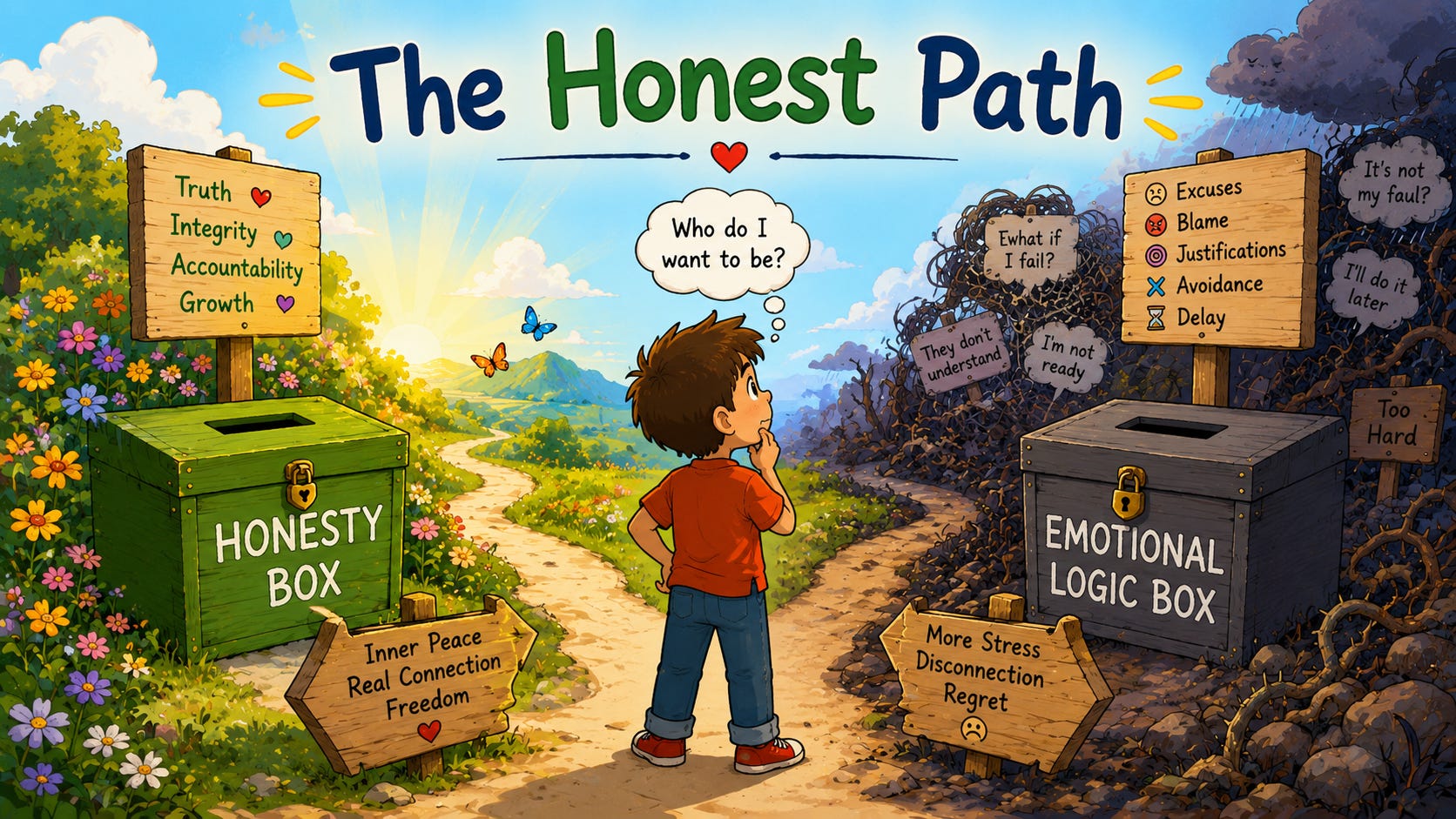
As we continue walking ‘The Honest Path’, we begin realising that truth is not nearly as frightening as our Inner Child once imagined. What becomes exhausting is maintaining performance, protecting identity, and carrying out the endless emotional calculations required to avoid simple honesty. Shen never asks us to become flawless human beings. Shen invites us to become authentic, willing to stand beside our choices with humility, compassion, and clarity. Every small agreement honoured strengthens trust within ourselves. Every honest correction weakens the old emotional pattern. Every moment of authenticity restores a little more inner harmony.
So, perhaps the invitation of ‘The Honest Path’ is simpler than we once believed. We do not need dramatic reinvention, emotional perfection, or to punish ourselves for being human. We need the willingness to stop hiding behind emotional protection and gently return to truth, honesty and integrity. Small, manageable steps taken consistently, without Criticism, Comparing, and being Judgemental (CCJ), slowly transform the emotional system.
Over time, we stop seeking emotional permission to live authentically because authenticity itself becomes natural. The performance softens. The stories quieten. The emotional bargaining fades. In that simplicity, we rediscover something our Shen has quietly known all along: peace does not arise from controlling how others see us. Peace emerges when we no longer need to hide from what we already know within ourselves.
If this path sometimes seems challenging, remember that genuine transformation has never asked us to be perfect, only willing. Every honest step, however small, is a step away from emotional performance and a step towards truth. If we stumble, if our Inner Child reaches once more for familiar explanations or old stories, let us simply acknowledge it with compassion, stand up again, and continue.
Just as we once learned to ride a bicycle by falling, adjusting, and trying again, we also learn to live in alignment one truthful choice at a time. There is no race, no final examination, and no need to criticise ourselves for being human. There is only this moment, this next choice, and another opportunity to return to the quiet wisdom of Shen. Trust the process, your courage, and trust that every small act of truth, honesty and integrity is the ‘Power of Three’ that gently reshapes your life until one day you realise you are no longer trying to become your authentic self; you are simply living as the person you have always been.
Moments of Inspiration…
Beyond the Price
Have you ever measured your worth by your bank balance, achievements, relationships, appearance, or another person’s approval? When these things change, does your Inner Child immediately whisper that your value has changed too?
Worth is not a material commodity. It cannot be bought, sold, borrowed, increased, or taken away. Money may rise and fall. Roles may begin and end. People may praise us one day and misunderstand us the next. Yet beneath these changing circumstances, our Shen spirit remains whole.
As we shared in an earlier teaching, “Shen lives at the heart of each of us, representing our essential worth, value, and profound spiritual essence.” This is the truth we are invited to remember.
Our Inner Child may still try to calculate worth through comparison: “They have more, so I must be less.” But this is ‘Emotional Logic’, not reality. Another person’s success does not diminish us. A financial setback does not define us. Rejection cannot remove what was never given by others.
The wu wei of living in alignment invites us to stop proving and start remembering. We do not need to chase worth. We allow ourselves to return to it.
This week, let us notice where we have confused our innate spiritual value with material value. Revisit our previous journal teachings on Shen, self-acceptance, and innate worth, allowing our inner wisdom to deepen our authentic connection through reflection.
Affirm: “My worth is eternal, untouched by circumstance, opinion, possession, or change. I stand gently and confidently in the truth of who I am and always will be.”
Let us carry this knowing into every conversation, choice, and challenge. We are not becoming worthy. We are remembering that we always were.
In the Next ‘Inner Circle’ (Paid) Journal…
Misunderstanding Worth
The Performance of Selflessness
The Dark Room
Moments of Inspiration
In the Next Free Journal…
Softening Certainty
The Sacred Stop
Guilt Without Crime
Moments of Inspiration
Journal #F091 20/07/2026
Contact: info@wuweiwisdom.com
Website: www.wuweiwisdom.com
YouTube: www.youtube.com/user/WuWeiWisdom
Facebook Community: www.facebook.com/groups/wuweiwisdomcommunity/