

“We choose to rest in the quiet truth that our worth was never something we had to prove; as we listen beyond our Inner Child’s doubts, we allow Shen to guide us towards the peace, self-trust, and effortless flow of wu wei that have always lived within us. Let us journey deeper into this story together, with curiosity and an open heart, and discover what becomes possible when we stop asking the world to confirm our value and begin remembering what was already ours.”

Why do we try so hard to prove the worth that has always been ours? In this journal post, we explore how self-doubt turns innate value into an argument, how our Inner Child uses ‘Emotional Logic’ to seek reassurance, and how Shen guides us back to truth, honesty and integrity.
Have you ever noticed how exhausting it becomes to keep proving something that should never have needed proving? Have you tried to be more useful, patient, impressive, agreeable, or more successful, hoping that someone, somewhere, would finally confirm what we secretly doubt in ourselves? Do you lose your sense of worth when another person questions, overlooks, criticises, or fails to see you as you want to be seen?
This teaching matters because the need to prove our worth can quietly become one of the most draining emotional habitual choices of a lifetime. We may call it ambition, love, loyalty, kindness, or responsibility, yet beneath the surface there may be a smaller, more painful equation: “If they approve of me, then I can believe in myself.” That equation leads us into the ‘Maze of Confusion,’ because it places our truth in another person’s opinion and then asks us to chase it back.
In this journal post, ‘Proving The Obvious’, we will explore why proving our worth is nonsense, not in a dismissive way, but in a deeply freeing way. We will look at the difference between a fact and an opinion, between Shen truth and our Inner Child’s emotional argument, between healthy accountability and the ‘Manipulation Game’ of trying to make other people acknowledge what is already true. We will also return to wu wei, as the natural way of living from worth without forcing, defending, or bargaining for validation. The doorway is simple, but it is powerful: we do not prove what we know to be true. We attempt to prove what we doubt. So, the real question is not, “How do we prove our worth?” The deeper question is, “Why are we doubting what Shen already knows?”
The Blue Eyes Doorway
Imagine a person with blue eyes standing in daylight. Someone looks them directly in the eyes and says, “I believe your eyes are brown.” What would be required in that moment? Would the person need to panic, collect evidence, ask ten strangers to confirm the colour, take photographs, argue through the night, or change the opinion of the one who misunderstood? Of course not. The person with blue eyes may recognise, “That is your opinion.” The eyes remain blue. The fact has not moved. The other person’s view only gains power when we place their opinion above our own knowing.
This is the beautiful equation of worth. If our worth is innate, then another person’s inability to see it does not remove it. Their criticism, rejection, silence, misunderstanding, or indifference may reveal their perceptions, preferences, beliefs, unresolved issues, or limits, but it does not alter the truth of our being. Our Inner Child, however, often responds as though someone else’s opinion has authority over our existence. It pesters us with thoughts such as, “What if they are right?” “What if we are not enough?” or “How can we make them see?” At that point, we are no longer living from Shen. We have entered a private court case inside the mind, where our Inner Child tries to defend a truth that never needed defending.
The moment we start proving our worth, we have usually accepted the first false premise: that our worth is uncertain. This is where self-doubt begins to separate us from Shen, because Shen stands in ‘The Power of Three’: truth, honesty and integrity. Shen does not need applause to exist. Shen does not need agreement to shine. Shen does not ask the world for permission to be valuable. When we doubt ourselves, we step away from that clear inner pathway and begin following our Inner Child into emotional bargaining. We try to manage the room, the relationship, impression, outcome, and the other person’s view of us. This is not alignment. It is a subtle form of self-abandonment dressed as effort.
‘The truth does not become stronger because others agree with it; it becomes easier for us to trust.’
The Manipulation Game
The manipulation game begins when we expend energy trying to get others to reinforce what is already true. This does not mean we are bad, false, or consciously controlling. It means our Inner Child has created an emotional strategy. It believes that if enough people admire, choose, praise, include, desire, respect, or reassure us, then the inner doubt will finally be quiet. Yet reassurance only soothes doubt for a moment when the root belief remains untouched. One compliment may lift us, one criticism may crush us, and this tells us something important. The problem was never the outside opinion. The problem was the authority we gave it.
Our Inner Child uses ‘Emotional Logic’, and that often turns life into evidence. A delayed reply becomes proof of rejection. A disagreement becomes proof of danger. A mistake becomes proof of inadequacy. Someone else’s mood becomes proof that we have done something wrong. This is how red-light emotion becomes persuasive. The emotion is real because we created it, but the belief beneath it may be deeply misaligned. If we create anxiety because someone doubts us, the anxiety is not evidence that we are unworthy. It may be evidence that we believe their judgement matters more than our truth. The ‘Golden Thread Process’ helps us follow that emotion back to the belief, so we can ask, “What did we just hand over, and why?”
This teaching carries a quiet conscience. When we attempt to prove our worth, we often know, somewhere beneath the noise, that we are moving away from honesty. We may smile when we want to speak clearly. We may over-explain when a simple truth would be enough. We may become overly helpful, not because help aligns, but because usefulness ‘feels’ safer than authenticity. We may say yes while resentment gathers in the background. Our emotional system registers the split. Shen asks for truth, honesty and integrity, while our Inner Child pressures us to perform for approval. This is the ‘Dual Belief System’ in action: one part knows our worth is real, while another part behaves as though worth must be earned from the outside.
In our previous teaching, we explored the line, “Emotions are consequences of what we believe, not proof of what is real or true.” This is essential here because the need to prove worth often arrives wrapped in intense emotion. The emotion may seem to say, “We must fix this now.” Shen asks us to slow down and examine the belief with courage. Did someone truly take our worth, or did we create fear because we believed they had the power to do so? Did another person make us ‘feel’ rejected, or did we interpret their behaviour through an old belief that says, “If I am not chosen, I am nothing.” This is not blame. It is freedom, because what we create through belief can be understood, questioned, and realigned.
The Tao of Unforced Worth
Our Tao Te Ching translation, Verse 48, offers a profound doorway into this teaching: “The pursuit of knowledge is a daily gain. The pursuit of Tao is a daily loss. The less you need to force, the more you arrive at non-action. Nothing is left undone.” This verse is beautifully suited to the habitual choice of proving. Our Inner Child wants daily gain: more reassurance, evidence, certainty, approval, and more emotional insurance. The Tao points toward daily loss, not loss of worth, but loss of the false burdens we added to it. We lose the need to convince, the need to perform innocence, the pressure to make everyone understand, and we lose the old belief that disagreement is danger. As these burdens fall away, nothing essential is lost, and something spacious begins to return.
Wu wei teaches us to act from alignment rather than force. In the context of worth, this means we still live responsibly, communicate honestly, repair mistakes, learn from feedback, and treat others with respect. Worth does not excuse poor behaviour, and Shen never uses spirituality to avoid accountability. Yet accountability is very different from proving one’s worth. Accountability says, “We can learn, adjust, apologise, and grow while remaining whole.” Worth-proving says, “If we make a mistake, we must earn back our right to belong.” One keeps us connected to conscience. The other traps us in ‘The Pit of Familiarity’, where old self-doubt seems strangely normal because we have practised it for so long.
This is where the blue eyes metaphor becomes practical. If someone says our blue eyes are brown, we may still choose to respond kindly. We may clarify, even laugh gently, but we do not need to collapse into doubt. In the same way, if someone misunderstands our worth, we can listen for useful feedback without letting their opinion become our identity. Their view may contain information about the relationship, the situation, or our behaviour, but it does not contain the final truth of our value. Our Shen already knows what our Inner Child keeps trying to outsource.
‘When we stop asking the world to certify our worth, we begin living as truth has already signed its name within us.’
Returning Through Shen
The practice begins in the small moments, especially the ordinary ones where our Inner Child nags us to prove, explain, justify, impress, or chase. A message goes unanswered, and we pause. A person misunderstands us, and we breathe. If criticism appears, we ask, “Is there something useful here, or am I turning an opinion into a verdict?” This is ‘The Shen Test’. We are not trying to become emotionless. Emotions are natural and normal. Peace, contentment, and joy may arise from Shen and reflect spiritual alignment. Fear, shame, anger, or jealousy may arise from our Inner Child’s beliefs and reveal disharmony or unresolved issues. The task is to identify the source, then choose our next step based on clarity.
So, we begin using language that returns power to the right place. Instead of saying, “They made me ‘feel’ worthless,” we might say, “I am creating a red-light emotion because I believe their opinion has authority over my worth.” This sentence may seem uncomfortable at first, because it removes the familiar emotional drama. Yet it also opens the door to freedom. If their opinion created our worth, we would be helpless. If our belief created the emotion, we can look deeper. We can ask when we first learned to make other people’s approval into a measuring stick. We can guide our Inner Child with patience and say, “We do not need to make them see our blue eyes for our eyes to remain blue.”
There will always be people who do not understand us. Some will misread our motives. Others may prefer a version of us that performs, pleases, or stays small. A few may even benefit from our self-doubt because it makes us easier to influence. This is why believing in our worth is not a soft idea; it is the spiritual strength of authenticity. When we stand in Shen, we become less available for emotional bargaining. We stop trying to manipulate outcomes by becoming who others want us to be, and stop using kindness as a transaction. We stop confusing being liked with being aligned. Slowly, the old ‘Manipulation Game’ loses its attraction because authenticity brings a steadier peace than approval ever could.
The conclusion of ‘Proving The Obvious’ is both simple and demanding. We are invited to stop treating innate worth as a debate. We are invited to notice the exact moment self-doubt asks us to leave truth, honesty and integrity and enter performance. We are invited to take small, consistent, manageable steps without expectations and without Criticism, Comparing and being Judgemental (CCJ). One honest sentence, a calmer pause, or refusal to over-explain. One moment of checking the belief beneath the emotion, a choice to let another person own their opinion without handing them our spiritual authority.
Let us carry this teaching into today with warmth and courage. We do not need to prove our worth any more than blue eyes need to prove their colour to someone committed to seeing brown. We can listen, learn, grow, apologise, and refine our behaviour while staying rooted in Shen. We can let our Inner Child complain and pester without giving it the steering wheel. Following ‘The Power of Three’: truth, honesty and integrity, to return to the Tao flow through wu wei. Never doubt yourself simply because another person cannot see you clearly. The miracle is that worth was never missing, only questioned. So, let ‘Proving The Obvious’ remind us to put down the evidence, step out of the emotional courtroom, and live from the quiet, shining fact of who we already are.
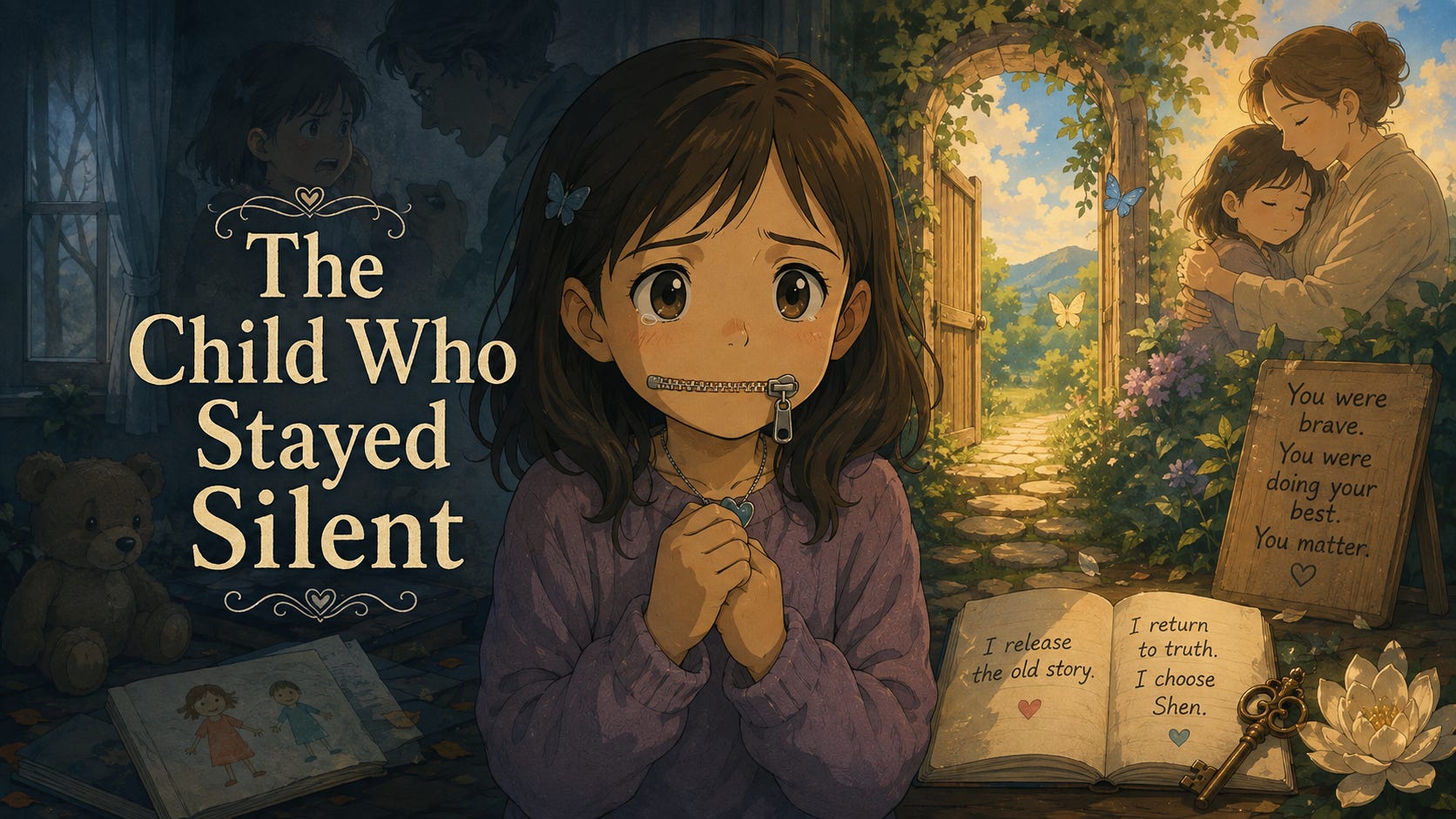
Have you ever replayed a moment from childhood and quietly wondered why you did not say anything? Why did you not tell your parents, speak up, ask for help, or somehow find the courage you imagine you should have possessed? Perhaps you have spent years carrying those memories as private evidence against yourself, believing they revealed weakness, inadequacy, or a flaw that nobody else could see. Yet what if the unresolved issue was never the silence itself, but the ‘vow’ our Inner Child created because of what that silence seemed to mean?
Through the gentle wisdom of Taoism and wu wei, this journal post explores how childhood conclusions can quietly shape our emotional lives and how, with truth, honesty and integrity, we may finally discover that the story we have been telling ourselves was never the whole story.
Some moments from childhood remain vivid in our memory, their details preserved with surprising clarity; others fade into the background until all that remains is the emotional residue they leave behind. We may struggle to recall exactly what was said, who stood nearby, or what the weather was like that day, yet we remember the tightening in our chest, the sinking feeling in our stomach, or the overwhelming wish that things had somehow been different. Often, we revisit these moments through the eyes of adulthood and ask questions that seem perfectly reasonable from where we stand now. Why didn’t we tell someone? Why didn’t we defend ourselves? Why didn’t we speak up?
The difficulty with these questions is that they quietly assume the child we once were possessed the understanding we have only gained through years of living. They expect emotional maturity from a mind still learning how the world worked. They assume access to perspective that did not exist at the time.
Between the ages of six and nine, our Inner Child is still developing its ability to understand complexity. Shen is present, offering its steady guidance, yet the child’s reasoning naturally relies upon ‘Emotional Logic’. Experiences are filtered through simplicity. The world becomes divided into safe and unsafe, good and bad, accepted and rejected. Faced with situations that exceed their emotional and cognitive capacity, children do what all human beings attempt to do when confronted with uncertainty. They search for meaning. They try to understand what is happening and, more importantly, what it means about them.
For some children, that meaning becomes shaped by experiences they never share with anyone else. They carry their fears quietly, perhaps because they worry about burdening those they love, because they fear not being believed, or perhaps because they cannot find the words to describe what they are experiencing. Silence becomes less a choice and more an expression of limited understanding. The burden remains within, and the child attempts to make sense of it alone. Without realising it, ‘vows’ begin to form.
The Burden of Innocent Conclusions
When adults reflect upon childhood experiences, we often underestimate the sincerity with which children interpret their world. A frightened child does not usually conclude that circumstances are unfair, that other people may be acting from their own unresolved issues, or that life sometimes presents challenges beyond anyone’s control. Those insights belong to perspective and maturity. The child reaches for explanations much closer to home.
Perhaps they decide that they are weak because they did not retaliate. Perhaps they conclude that they cannot cope because they struggled to manage the fear they were experiencing. Perhaps they decide they are not good enough because they could not prevent something painful from happening. In the innocent logic of childhood, these interpretations appear sensible. If something upsetting continues and I cannot stop it, then perhaps something is wrong with me.
As the years pass, these conclusions often become woven into identity. They settle beneath conscious awareness and influence how we interpret the ordinary experiences of adult life. We may wake with red-light emotions and assume they confirm the beliefs we have carried for decades. We may search for certainty because a younger part of us still believes that unpredictability exposes our inability to cope. We may seek reassurance from others because somewhere within us remains a child who carried burdens in silence and hoped someone stronger would eventually arrive to put everything right.
The unresolved issue is rarely the original experience alone. More often, it is the meaning we attached to that experience and the vows that emerged from it. Those vows may sound like, “I can’t cope,” “I’m weak,” or “I must never let this happen again.” They shape how our emotional system responds to life, encouraging vigilance and future-proofing in the hope of preventing history from repeating itself.
When viewed with compassion, we begin to recognise that our Inner Child was not trying to sabotage our future. It was attempting to protect us using the limited understanding available at the time.
Looking Again Through Shen’s Eyes
One of the greatest gifts we can offer ourselves is the willingness to look again. Not to rewrite history or deny the genuine discomfort we experienced, but to reconsider the conclusions we formed through the lens of innocence. This requires courage because many of us have spent years organising our identity around beliefs we have rarely questioned.
Imagine, for a moment, revisiting the child who remained silent. Rather than approaching them with criticism and hindsight, we observe what they actually did. We notice that despite fear and uncertainty, they continued showing up for life. They returned to environments that unsettled them. They navigated experiences they did not fully understand. They adapted to circumstances that stretched their emotional capacity and found ways, however imperfect, to continue.
The child who concluded they could not cope somehow managed to keep going. This does not diminish the difficulty of what they experienced, nor does it suggest that fear was absent. It simply acknowledges another truth that has often gone unnoticed. Resilience does not always arrive dressed in confidence. It frequently expresses itself through persistence, through the willingness to rise each morning and meet life despite uncertainty, through the quiet determination to continue even when we doubt our own strength.
Sometimes the stories we tell ourselves about our lives deserve to be revisited with honesty. The apparent weakness we have criticised for decades may have been adaptation in its earliest form. The frightened child who believed they lacked courage may have been demonstrating courage without possessing the language to recognise it.
Our Tao Te Ching translation reminds us, “Recognising the opposites and extremes, it means discovering wu wei.” Perhaps this teaching invites us into precisely that recognition. What if the conclusion, “I am weak,” represented one extreme interpretation born from fear? What if another understanding has always existed alongside it, patiently waiting to be acknowledged?
Becoming What Was Missing
There is something profoundly moving about recognising that the child who carried these vows often did so alone. Whether through uncertainty, loyalty, confusion, or an inability to express what they were experiencing, they remained silent, shouldering burdens they were never meant to carry alone. The younger self who longed for understanding may have concluded that nobody could truly help, so they kept carrying responsibilities that belonged to circumstances far larger than themselves.
As adults, we sometimes recreate that same environment internally. We pressure ourselves to be stronger, criticise our emotional responses, compare our struggles with others and wonder why everyone else seems to cope more easily. Through CCJ, we become yet another voice demanding perfection from a frightened child.
Reparenting offers another possibility. It invites us to become trustworthy enough to sit beside our Inner Child without interrogation or blame. Rather than demanding explanations, we approach with curiosity, wonder what frightened them, and ask what conclusions they reached about themselves. We listen long enough to understand why those conclusions once seemed necessary.
Through ‘The Power of Three’: truth, honesty and integrity, we begin to untangle the vows from the reality that gave rise to them. Truth acknowledges the experiences without exaggeration or dismissal. Honesty explores the meaning we attached to those experiences and the ways those meanings have shaped our lives. Integrity gently questions whether those childhood conclusions continue to reflect who we truly are.
Shen does not arrive to rescue our Inner Child from the past. Shen arrives as companionship, reminding the younger self that they no longer have to carry impossible responsibilities alone. The tug of war softens. The rope can finally be set down. Innocence and wisdom begin walking together, each contributing something valuable to the team.
The Lotus and the Light
The lotus blossom emerges from murky waters without becoming defined by them. It does not deny the mud from which it grows, nor does it pretend that difficult conditions never existed. Yet the mud is never the entirety of its story. Something within the lotus continues reaching towards the light, unfolding petal by petal according to its own nature and timing.
Perhaps our lives follow a similar rhythm. We may have spent years focusing upon the experiences that seemed to confirm our inadequacy while overlooking the quieter evidence of our resilience. The countless mornings we rose despite uncertainty, the relationships we nurtured despite fearing rejection, the responsibilities we carried while doubting our capacity, and the understanding we continued to seek all tell another story. They reveal that the child who believed they could not cope has, in fact, been demonstrating otherwise for all of their life.
The compassion we extend towards others often emerges from our own encounters with uncertainty and struggle. The wisdom we gradually develop arises not because life has been free from difficulty, but because we have continued engaging with it despite the vows that once urged us to retreat.
Shen has been moving gently beneath the surface of our experiences all along, guiding us back towards authenticity and reminding us that we are far more than the frightened conclusions formed in childhood.
Conclusion
As we reflect upon ‘The Child Who Stayed Silent’, perhaps we can soften the expectations we place upon the younger versions of ourselves. The child who remained silent was not an adult trapped in a smaller body. They were a child navigating circumstances beyond their understanding with limited emotional resources. Their interpretations were sincere, their vows understandable, and their desire for safety entirely human. Yet sincerity does not guarantee accuracy.
The child who concluded, “I cannot cope,” may have overlooked a lifetime of evidence demonstrating the opposite. The child who believed silence meant weakness may never have recognised the quiet resilience required to continue. Looking again does not erase the past. It allows us to reclaim authorship of the stories we continue telling ourselves.
There is no need to rush this unfolding. Small, manageable steps taken without expectations and without CCJ gently return us to alignment with the Tao. Each red-light emotion becomes an invitation to explore the beliefs beneath it. Each moment of awareness offers another opportunity to choose understanding over familiarity.
Perhaps the greatest gift we can offer our Inner Child is not rescue, but recognition. Recognition that they were doing the very best they could with the awareness available to them. That the vows formed in fear no longer have to govern the rest of our lives, and recognition that what once seemed like evidence of inadequacy may, viewed through the compassionate eyes of Shen, reveal itself to have been resilience all along.
As the lotus continues its patient unfolding, may we honour the child who stayed silent without allowing silence to define who we are. May we trust the gentle wisdom of wu wei, remembering that authenticity rarely arrives through force, and may we walk forward together, discovering that the story we feared most was never the whole truth.
Have you ever wondered who you were before you began explaining yourself? Before you believed you had to be impressive, useful, agreeable, successful, attractive, clever, quiet, strong, or needed? Before our Inner Child began building stories about what would make us safe, lovable, acceptable, or worthy?
This journal post explores the quiet place beneath our learned identity, the place where Shen was already present before comparison, approval, fear, and self-doubt arrived. We will look at how our Inner Child forms stories from early experiences, how those stories can seem like truth, and why our innate worth never increases, decreases, disappears, or depends on anyone’s opinion. Through Taoist wisdom and wu wei, we will begin returning to what was always there, not as a performance, but as a remembrance.
The First Story We Believed
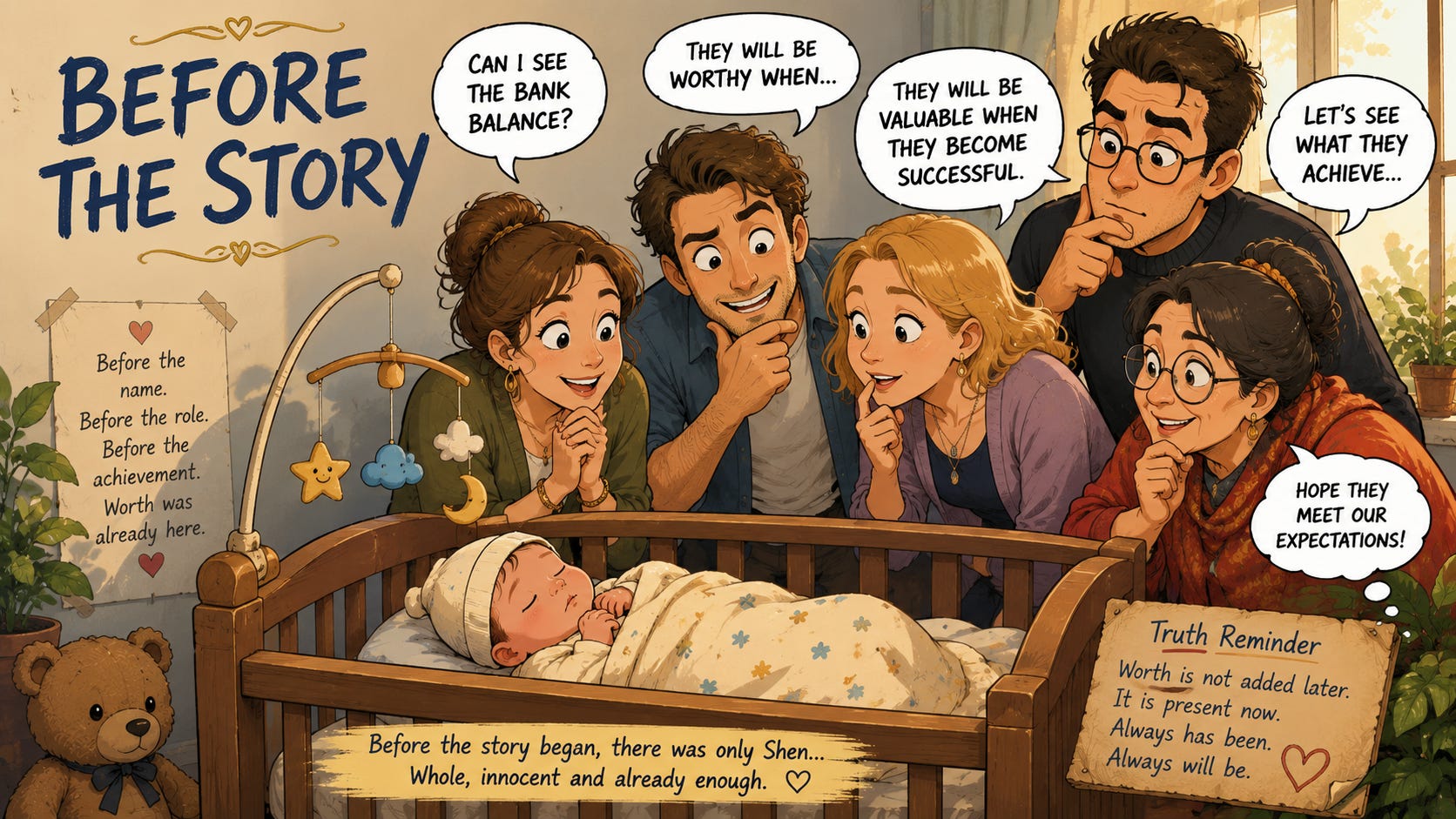
Every human life has a moment before the story begins. We do not remember it with words, because words had not yet become our way of understanding the world. We arrived without a résumé, a bank balance, exam results, status, reputation, or any ability to prove our value. Yet nobody with a loving and clear mind would hold a newborn baby and ask, “What have you achieved to deserve worth?” Nobody would look into that tiny face and say, “You will be valuable once people approve of you.” The question itself seems unkind because something within us already knows the answer. Worth is not added later, delivered by success, or waiting for applause. Worth is present before the first story is written.
This simple truth is easy to recognise in a newborn baby, yet strangely difficult to accept in ourselves. Somewhere along the path, our Inner Child begins collecting meanings. A parent praises us, and we create a story that approval means safety. A teacher criticises us, and we create a story in which mistakes threaten our worth. Someone withdraws, and our Inner Child may create the painful equation, “If they pull away, I must not matter.” We don’t choose these meanings with mature wisdom. They form through ‘Emotional Logic’, which can ‘feel’ logical even when built on a false belief. If the first assumption is false, the emotion that follows may be intense, convincing, and entirely misaligned.
In our previous teaching, we said, “Emotions are consequences of what we believe, not proof of what is real or true.” This is a vital doorway. A red-light emotion is not an enemy; it is a signal asking us to look beneath the surface. When our Inner Child nags, pressures, reproaches, or badgers us with old conclusions, it is usually defending a familiar story. This is why ‘Before The Story’ matters. We are not merely trying to replace one belief with another. We are asking what existed before the belief arrived.
The Worth That Never Moves
Worth is not a candle that grows brighter when life goes well and dims when life becomes difficult. Worth is more like the sun behind the clouds, constant even when hidden from view. We may distance ourselves from our worth through self-criticism, comparison, shame, approval-seeking, or perfectionism, but distance is not disappearance. The stories of our Inner Child can obscure worth, yet they cannot damage it. When those stories begin to dissolve, our worth is still there, untouched, pristine, and complete, like the quiet dignity of a newborn baby.
This understanding challenges one of the most common emotional equations: “If I do better, I will be worth more.” At first, that belief may seem motivating. It may encourage achievement, improvement, effort, and discipline. Yet when we examine it through ‘The Shen Test’, we begin to see the hidden cost. If achievement can increase worth, then failure can decrease it. If praise can prove worth, then criticism can threaten it. If love from others can give worth, then withdrawal can take it away. This places our sacred value in the hands of changing circumstances, and soon we are trapped on the ‘Carousel of Despair’, chasing proof for something that could never be measured.
Shen does not question worth; it questions alignment. It asks whether we are living with truth, honesty and integrity the ‘Power of Three’. Shen lovingly guides us toward authenticity, virtue, conscience, and mature choice. Our Inner Child often demands evidence because it mistakes worth for emotional permission. It says, “When they approve, we can relax.” Shen knows relaxation comes from returning to truth. It says, “We were whole before they had an opinion.”
‘Worth was present before the story arrived; it remains after the story dissolves.’
Before We Learned To Prove
Our Tao Te Ching translation, Verse 4, offers a beautiful lens for this teaching: “The Tao exists because it just ‘is’; Where it came from is a mystery. It has been this way before the first beginning, before the beginning of time.” This verse points us toward something deeper than self-improvement. The Tao does not become valuable by being useful. It does not justify itself. It does not perform existence. It simply ‘is’. In the same way, Shen does not need to argue its right to exist. It does not become more worthy when life approves of it.
This is where many of us misunderstand growth. We think the path is to improve the story until it finally becomes acceptable. We polish the identity, strengthen the image, gather achievements, manage reactions, seek approval, and try to become someone our Inner Child believes will never be rejected. Yet the Taoist path invites a quieter investigation. Who is trying to improve the story? Who is frightened that the story is not enough? What belief says we must become extraordinary before we can rest?
The ‘Golden Thread Process’ helps us follow each red-light emotion back to its belief. Anxiety may lead us to the belief, “I am unsafe unless I know what happens next.” Shame may lead us to the belief, “A mistake means I am bad.” Resentment may reveal, “Others should prove my value by treating me exactly as I expect.” These beliefs create a ‘Maze of Confusion’ in which we spend energy solving the wrong problem. We try to control people, outcomes, and appearances, even though the deeper invitation is to question the first assumption.
Returning Beneath The Story
Returning ‘Before The Story’ does not mean erasing memory or pretending our experiences did not shape us. It means we stop allowing old interpretations to govern the present without examination. Influence is real, but influence is not destiny. A belief may be old, loud, and familiar, and still be untrue. Our Inner Child may prefer ‘The Pit of Familiarity’ because familiar pain can seem safer than unknown freedom. Yet wu wei gently shows us another way. Effortless effort is the practice of loosening our grip on false stories so our natural Shen-guided alignment can reappear.
Virtue also belongs here. Rules can shape behaviour, but virtue reveals who we choose to be when nobody is measuring. A rule may say, “Do not lie.” Virtue says, “We honour truth because it is aligned with Shen.” A rule may say, “Be good so others approve.” Virtue says, “Goodness is not a performance; it is the natural expression of inner alignment.” This is the difference between fitting in and living authentically. Moral standards may vary across environments, but Shen-guided conscience arises from a deeper place. It is the seed of virtue within us, requiring nourishment through practice, reflection, humility, and choice.
So, as we close ‘Before The Story’, let us return to the newborn baby in our imagination. Let us remember that we would never demand proof of worth from that small, beautiful beginning. Then let us ask why we now demand it of ourselves. Our bank balance does not add value. Exams do not add worth. Mistakes do not remove worth. Approval does not insert worth into us, and rejection cannot take it away. What changes is not worth itself, but the story our Inner Child tells about it.
‘Before we learned who we were supposed to become, we already were.’
The invitation now is gentle and practical. Take small, consistent, manageable steps without expectations and without CCJ. When a red-light emotion arises, pause and ask, “What story is my Inner Child protecting?” Then ask, “What was true before that story began?” Never doubt yourself because a story has become loud. Loudness is not truth. Familiarity is not freedom. Return to Shen, the Tao, and return to truth, honesty, and integrity. Beneath every old belief, borrowed identity, and every attempt to prove, earn, or defend your value, your worth remains quietly waiting, whole, constant, and already enough.
Moments of Inspiration…
Becoming Our Parent
One of our greatest challenges is learning to parent ourselves with greater wisdom than we may have received. Not because we need to condemn the past, but because growing up gives us something our Inner Child never had: perspective, choice, and the quiet guidance of Shen.
Our Inner Child still carries early conclusions about love, safety, approval, and worth. When fear, anxiety, shame, or resentment appear, we can repeat the old parenting through criticism, impatience, or rejection, or we can become the steady presence we once needed.
As one of our earlier teachings reminds us, “We do not tell our Inner Child what it wants to hear. We reinforce what they need to hear, always with kindness.” This is loving authority. We listen without surrendering leadership. We understand without agreeing with every frightened belief.
Reparenting is not about blaming our parents or creating a perfect childhood in our imagination. It is about ending the inheritance of misunderstanding. Through wu wei, we take small, consistent steps. We pause before reacting. We question the belief beneath the emotion. We return to truth, honesty and integrity.
Perhaps maturity is not leaving childhood behind. Perhaps it is finally becoming trustworthy enough to walk back, take our Inner Child by the hand, and say, “We can learn another way now.”
Affirm: “We lovingly become the wise, patient guardians of our inner world, guiding our Inner Child with truth while allowing Shen to lead us gently home.”
This week, let us revisit our previous teachings on reparenting and ask one beautiful question: “How would we guide ourselves today if kindness and wisdom were sitting beside us?”
In the Next ‘Inner Circle’ (Paid) Journal…
Patterns That Reveal
The One Who Knows
The Classroom Within
Moments of Inspiration
In the Next Free Journal…
Nothing to Hide
The Worth Paradox
Standing at the Crossroads
Moments of Inspiration
Journal #F096 24/08/2026
Contact: info@wuweiwisdom.com
Website: www.wuweiwisdom.com
YouTube: www.youtube.com/user/WuWeiWisdom
Facebook Community: www.facebook.com/groups/wuweiwisdomcommunity/