
Regret Without Ruin
This week, learn from mistakes more gently, stop waiting for the perfect response, and step out of old patterns forever. Finally, adapt to reality in flow.

“Perhaps the mistake was never the moment itself, but the belief that we must carry it forever. As we gently release the burden of self-punishment and return to the quiet wisdom of our Shen, we discover that regret can become a doorway to understanding, compassion, and a deeper trust in life's unfolding journey.”

Have you ever recognised an old pattern too late and then created such intense regret that the mistake seemed to grow larger than life itself? Have you ever replayed a choice, a conversation, or a reaction until the original event almost disappeared beneath the weight of self-criticism? Perhaps you even believed that the pain was necessary, that if you punished yourself enough, stayed in regret long enough, or mentally replayed the situation enough times, you would somehow prove your sincerity and goodness.
Many people quietly carry this emotional burden for years. Outwardly, they may appear thoughtful, caring, and reflective, yet inwardly, they are trapped inside cycles of self-reproach that become emotionally exhausting. The smallest mistake may trigger overwhelming shame. A delayed realisation may create days of internal criticism. A misunderstood conversation may spiral into emotional punishment. Then the deeper question eventually emerges: “Why does this hurt so much?”
In ‘Regret Without Ruin’, we will explore why our Inner Child often transforms ordinary human mistakes into evidence of unworthiness, why familiar suffering can seem safer than emotional freedom, and how Taoist wisdom offers a gentler path through awareness, accountability, and alignment with Shen. We will look deeply at the hidden emotional “benefits” our Inner Child believes it gains through self-punishment, why emotional pain can become confused with morality and sincerity, and how wu wei gently guides us away from force, fear, and emotional struggle. Because the truth is this: mistakes are part of life. Emotional ruin need not be.
When Mistakes Become Emotional Identity
The mature Shen mind understands that mistakes are part of learning. We try, misunderstand, misjudge, react emotionally, overlook something, or fall back into an old pattern, and then life gives us new information. This is how growth naturally unfolds. Yet our Inner Child often sees mistakes very differently, reasoning through ‘Emotional Logic’ rather than ‘Shen Logic’.
To our Inner Child, a mistake may not simply seem unfortunate; it may seem dangerous. It may seem like proof that we are failing, not coping, or fundamentally flawed. A simple misunderstanding can become, “I always ruin things.” A delayed awareness becomes, “I should have known better.” A poor choice becomes, “This proves I am not good enough.” The event itself becomes secondary because our Inner Child attaches identity to the experience. This is why regret can linger so painfully. We are no longer simply reflecting on an action; we are unconsciously questioning our value as a person.
In our previous teaching, ‘Already Whole’, we explored how our Inner Child often links worthiness to performance, approval, or getting things “right.” When this belief system becomes deeply ingrained, mistakes no longer seem like information; they seem like threats to emotional safety and belonging. So, our Inner Child nags, criticises, reproaches, and badgers us in an attempt to avoid future rejection. It believes emotional punishment will somehow future-proof us against emotional pain.
Pain can become a teacher for a moment, like touching a hot stove and understanding boundaries. But prolonged emotional suffering usually points toward unresolved issues around worthiness, perfectionism, and self-judgment. Our Inner Child may create the belief: “If I punish myself enough, people will finally understand how sincere I am, how deeply I care, and then they will believe I am worthy, accepted, or good enough.”
This is one of the most misunderstood emotional patterns in human behaviour because self-punishment can masquerade as responsibility. Yet remaining emotionally trapped in regret rarely creates wisdom. Instead, it often keeps us spinning on the ‘Carousel of Despair’, moving endlessly between awareness and self-criticism without genuine alignment.
‘A mistake can become wisdom in a moment, but self-punishment turns it into identity.’
The Hidden Logic of Emotional Punishment
Here we begin to uncover something much deeper. Our Inner Child often believes emotional suffering proves goodness. If we suffer enough, perhaps we are caring enough. If we regret enough, perhaps we are moral enough. If we mentally attack ourselves enough, perhaps we can prove we are taking the mistake seriously. This is where emotional punishment is mistaken for sincerity.
Some people even fear that gentleness toward themselves would mean becoming careless, selfish, or irresponsible. They unconsciously believe harshness creates accountability. Yet if harshness alone were to bring about transformation, many of these emotional patterns would have disappeared years ago. Instead, emotional self-attack often creates exhaustion, shame, emotional collapse, and fear of trying again.
Our Inner Child also fears external criticism, rejection, comparison, and judgment. So, perversely, it chooses internal pain as the lesser of two evils. This is the deeper teaching within ‘The Pit of Familiarity’. Familiar suffering may be painful, but it seems predictable and controllable. The unknown path of gentleness, uncertainty, vulnerability, and self-acceptance feels emotionally risky because our Inner Child does not yet know what it may offer. Sometimes, the choice becomes this unconsciously: Known pain or unknown freedom. And for our Inner Child, known pain often seems safer because it is familiar.
This is why many people remain trapped in emotional cycles long after they consciously understand the teaching. The emotional system is still operating from old beliefs. Our Inner Child thinks: “If I stop criticising myself, I might repeat the mistake. If I stop replaying the regret, I may become irresponsible. If I let go of the suffering, perhaps I will stop caring.” Yet suffering and caring are not the same thing.
‘The Inner Child often chooses familiar suffering because uncertainty seems more frightening than emotional pain.’
This creates what we call the ‘Dual Belief System’. One part of us intellectually understands mistakes are normal ‘Life Lessons’. Another part emotionally treats mistakes as proof of failure and unworthiness. One part wants growth; another part clings to emotional punishment because it believes pain creates safety. The Taoist path gently interrupts this cycle.
Returning to Shen
Our Tao Te Ching translation offers profound guidance in Verse 45: “Your best efforts will never be perfect, but that does not mean you have failed.” There is tremendous softness and wisdom hidden inside this teaching. Taoism does not ask us to become emotionally hardened. It does not encourage us to build a “thicker skin” through suppression or force. Water does not become powerful through rigidity. It becomes powerful through flexibility, movement, and alignment. This is why wu wei becomes so important here.
Wu wei does not mean passivity. It means allowing growth to emerge through awareness rather than emotional violence. It means learning through alignment instead of punishment. It means recognising that Shen does not learn through shame. Shen connects through ‘The Power of Three’: truth, honesty and integrity.
In our previous teaching, ‘Anchored in Truth’, we explored the understanding that emotions are signals, not absolute truth. Some emotions originate from Shen and reflect peace, clarity, and alignment. Others are created through our Inner Child’s beliefs and signal disharmony or unresolved issues. This distinction changes everything because emotional intensity alone does not prove something is true. A red-light emotion may seem convincing, but we must ask: “What belief created this emotion?”
This is where the ‘Golden Thread Process’ becomes transformative. Instead of becoming trapped in regret, we gently trace the emotional reaction backwards. We ask: “What meaning did I attach to this mistake?” “What belief about myself became activated?” “What does this mistake say about me?”
Suddenly, the emotional reaction becomes clearer. Perhaps the real belief is: “I must always get things right to be accepted.” Or: “Mistakes mean I cannot trust myself.” Or: “If people truly saw my flaws, they would reject me.”
Now we are no longer fighting the emotion. We are uncovering the belief beneath it. Then we apply ‘The Shen Test’: “Would I teach this belief to a child I deeply loved?” The answer usually reveals tremendous clarity.
The Gentler Path of Alignment
One of the greatest misunderstandings around emotional growth is the belief that gentleness equals weakness. Yet genuine gentleness requires awareness, accountability, honesty, and courage. Emotional punishment is often reactive and familiar. Conscious reflection requires much deeper maturity. This is why Taoism continually returns us to softness and flow.
Our Inner Child often pressures us to rehearse mistakes repeatedly because it believes repetition prevents future pain. Yet endless rumination rarely creates clarity. More often, it creates emotional paralysis. We begin living cautiously, fearing mistakes so deeply that spontaneity, creativity, and authenticity slowly diminish. Life becomes emotionally managed rather than fully lived. But the Tao never asks us to become perfect before participating in life.
Our I Ching translation reminds us that life itself is change, movement, and transformation. Every experience contains information. Every challenge offers awareness. Every old pattern recognised becomes an opportunity for greater alignment. This means mistakes are not interruptions to the journey; they are part of the journey.
So, instead of asking: “How do I stop making mistakes forever?” Perhaps we ask: “How do I remain connected to Shen even when mistakes happen?” That is a very different question. Because when we remain connected to Shen, mistakes no longer define identity. They become information, reflection, and adjustment. We can apologise where needed, repair what is appropriate, strengthen our boundaries, deepen our awareness, and continue forward without collapsing into emotional self-attack.
‘Gentleness is not the absence of accountability; it is accountability without emotional destruction.’
This teaching also helps us understand something profound about emotional ownership. Other people cannot place rejection, worthiness, or validation into our bodies. They cannot make us feel those emotions, nor can they remove them. What we experience emotionally arises from our interpretations, beliefs, and emotional conditioning. This is deeply empowering because it returns authorship to us. Instead of saying: “They made me feel worthless.” We begin to see: “I created worthlessness because I interpreted the situation through an old misaligned belief.” This is not to blame. This is awareness. And awareness is where freedom begins.
Living Beyond Regret
As we begin to bring this teaching into everyday life, something subtle begins to change. We stop seeing ourselves as emotionally broken every time we make a mistake, or using pain as proof of sincerity. We stop confusing emotional intensity with truth. We begin recognising when our Inner Child is trying to protect us through familiar suffering. Then, slowly, we create a different relationship with ourselves. A calmer, more truthful relationship. A relationship based on alignment with Shen instead of punishment.
In ‘Regret Without Ruin’, we are reminded that growth does not require emotional violence. We can remain thoughtful, caring, accountable, and deeply sincere without mentally attacking ourselves every time we fall short of perfection. We can continue taking risks, trying new things, speaking honestly, and growing through life without demanding certainty before action.
So, when regret next appears, pause for a moment before entering the ‘Maze of Confusion’. Ask yourself gently: “What belief is this emotion trying to protect?” “What does my Inner Child fear this mistake means about me?” “Can I remain aligned with Shen while learning from this moment?” Then take one small, manageable step forward without expectations and without Criticism, Comparing and being Judgemental (CCJ). Because every moment of awareness already changes the direction of your life.
Never doubt yourself simply because our Inner Child becomes emotionally noisy. Keep walking gently, learning honestly, and allowing life to teach you through authenticity rather than fear. Over time, the familiar road of suffering slowly loses its grip, and a quieter, steadier path begins to emerge. That path is not perfection. It is flow.
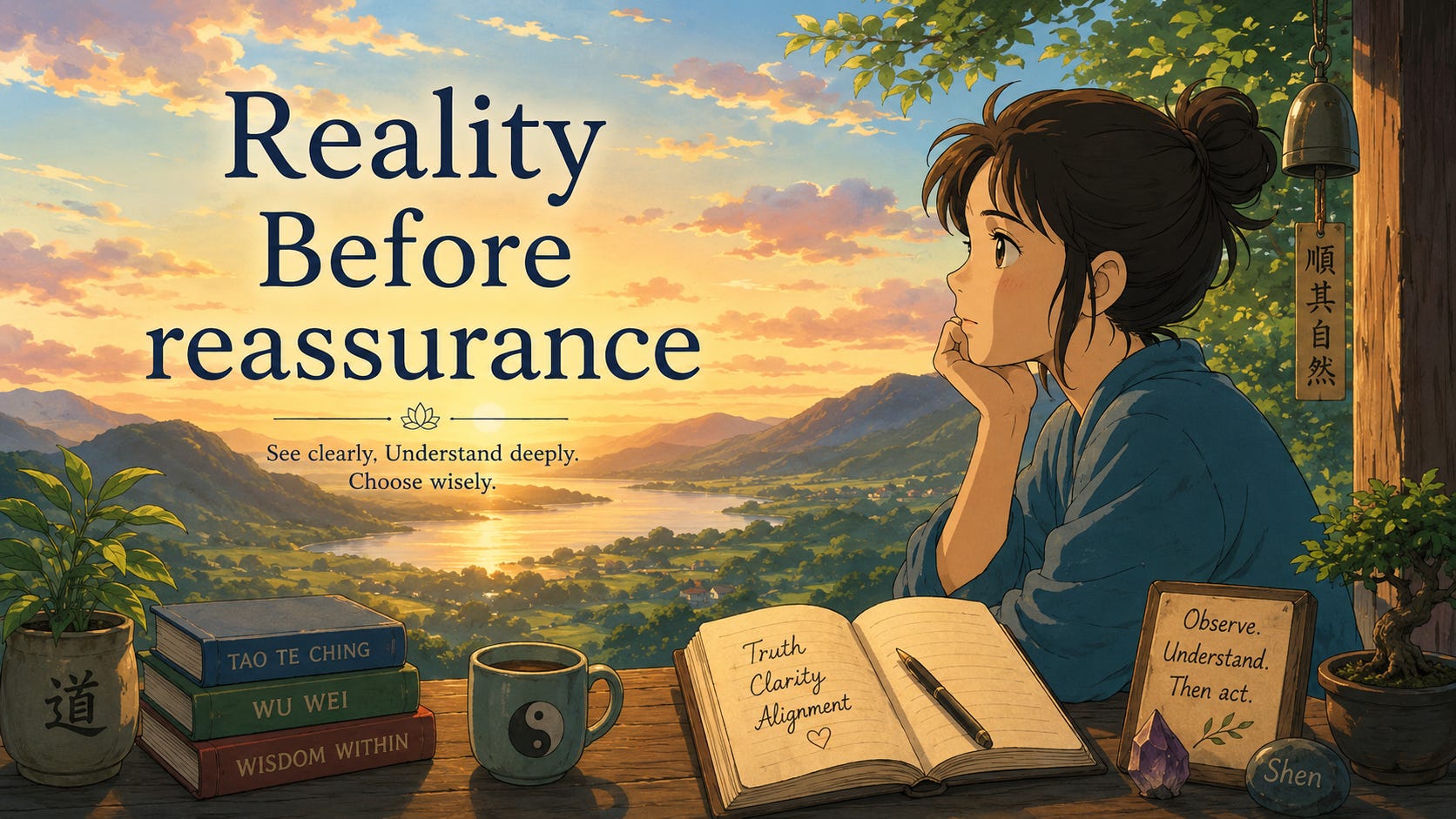
Have you ever paused in the middle of a reaction and quietly asked yourself, “What am I actually waiting for right now?” Are you waiting for clarity, or are you waiting for someone else to behave in a way that settles something within us? Do you notice how quickly our Inner Child begins to pressure, complain, and search when something does not go as expected, as though the answer must exist outside of us, hidden in another person’s response?
In ‘Reality Before Reassurance’, we explore a deeper, more refined doorway within our teachings, one that gently challenges a pattern many of us carry without realising: the belief that our emotional balance depends on external reassurance rather than on our own alignment with truth. This is not about removing connection or becoming distant; it is about understanding where we place authority over our emotional system and why that placement often keeps us on the ‘Carousel of Despair’ rather than stepping into steady, grounded clarity.
The Quiet Dependence on Reassurance
There is something subtle and almost invisible about the way reassurance operates in our lives. On the surface, it seems harmless, even healthy. We may say, “I just want to understand,” or “I need to know where I stand,” or “I would be okay if they explained themselves.” These statements may seem reasonable, yet beneath them, our Inner Child often constructs a condition far more rigid than it first appears. It quietly insists, “Only when they respond in the way I expect can I settle.” This is not a conscious demand; it is a learned pattern, shaped by early interpretations in which certainty seemed to equal safety. Our Inner Child, using ‘Emotional Logic’, treats discomfort as a signal that something must be corrected externally. It nags, reproaches, and badgers us with the idea that the solution lies in changing the situation, rather than understanding the belief we have attached to it.
The difficulty is not reassurance itself, but the role we assign to it. When reassurance becomes a requirement rather than a preference, we unknowingly give away our stability. We begin to measure our sense of calm against someone else’s behaviour, their tone, their timing, their willingness to respond in a way that matches our expectations. And because our Inner Child shapes those expectations, they are often precise, personal, and difficult for others to meet consistently. This is where the cycle begins. A red-light emotion is created; we seek reassurance; we receive temporary relief; yet the underlying belief remains untouched. The next time reality does not align with expectation, the same emotional pattern returns, sometimes stronger, sometimes more convincing, but always familiar in its structure.
‘Reassurance soothes the surface, but belief shapes the current beneath it.’
The Hidden Agreement with Reality
As we move deeper into ‘Reality Before Reassurance’, we begin to notice a hidden agreement operating quietly in the background of our experience. It is not something we consciously choose, yet it influences how we interpret almost every interaction. The agreement says, “Life should unfold in a way that supports my emotional comfort, and when it does not, something is wrong.” This belief positions reality as something that should adapt to us, rather than something we learn to understand and respond to with clarity. Our Inner Child reinforces this agreement through ‘Emotional Logic’, treating emotional discomfort as evidence that the situation needs to change. Yet ‘Shen Logic’ invites a different perspective, one rooted in truth, honesty and integrity. It asks us to consider whether the discomfort we create is not a signal of external failure but an invitation to examine the belief we hold.
A thoughtful counterargument often emerges at this point, and it deserves careful reflection. We may think, “But people should consider how their actions affect us. Isn’t it reasonable to expect understanding?” Yes, consideration and communication are valuable, and expressing our truth is part of living authentically. However, there is a meaningful distinction between sharing our perspective and depending on a specific response to regulate our emotional state. When we attach our stability to how others behave, we move away from alignment and into negotiation. We begin to treat peace as something that must be earned through external conditions, rather than something that arises from our connection to Shen. This does not mean we stop communicating; it means we refine our intention. We speak with clarity, but we do not place our emotional outcome in someone else’s hands.
Our Tao Te Ching translation offers a powerful reflection that supports this shift in understanding: “Without stepping outside, You can know the whole world.” This verse reminds us that the most important world we are learning to understand is not external, but internal. The patterns we observe in others often mirror the beliefs we have not yet questioned within ourselves. When we stop asking reality to confirm our expectations, we begin to see it more clearly, not as something that must change, but as something that reveals where we are still holding onto conditional thinking.
The Power of Familiarity and the Return to Old Patterns
One of the most insightful aspects of this teaching lies in understanding the ‘Power of Familiarity’. Our Inner Child does not always choose what is most aligned or fulfilling. Instead, it often chooses what is known. This can seem confusing at first. Why would we return to patterns that create discomfort, uncertainty, or frustration? The answer lies in predictability. Familiar patterns provide a sense of structure, even when they do not serve us. Our Inner Child knows how to behave within them. It knows how to interpret events, react emotionally, and seek reassurance when things do not go as expected. This predictability can seem like safety, even when the outcome is not what we truly want.
Imagine walking along a well-worn path that you have travelled many times before. You know where it leads, even if that destination is not particularly fulfilling. Beside it lies a new path, quieter, less defined, and uncertain. The new path may hold growth, clarity, and alignment, but it requires something our Inner Child resists: stepping into the unknown without immediate reassurance. So, it often guides us back to the familiar path, not because it is better, but because it is known. This is how patterns repeat, not through lack of awareness, but through attachment to predictability.
This is where wu wei becomes a guiding principle. Wu wei does not ask us to force change or reject our Inner Child. It invites us to move with awareness, allowing new responses to emerge naturally as we question the beliefs that sustain old patterns. Instead of reacting automatically, we pause. Instead of seeking reassurance, we observe the belief driving the need for it. This shift may seem small, but it alters the direction of our entire experience.
‘When we stop repeating the response, we begin to rewrite the pattern.’
The Shen Test and the Return to Alignment
As we continue this exploration, ‘The Shen Test’ offers a practical and grounding way to navigate moments of uncertainty. When our Inner Child begins to pressure us to seek reassurance or change a situation, we gently ask, “Is this response rooted in truth, honesty and integrity, or is it an attempt to remove discomfort by controlling the outcome?” This question is not critical; it is clarifying. It brings us back to the foundation of our teachings, the ‘Power of Three’: truth, honesty and integrity. From this place, we are no longer reacting out of urgency but responding from understanding.
Another counterargument may arise here, one that reflects a common concern. We might wonder, “If I stop seeking reassurance, will I become disconnected or indifferent?” This is a valid question, yet it is based on a misunderstanding. Alignment does not remove connection; it strengthens it. When we are no longer dependent on a specific response, we become more present, more open, and more able to listen without interpretation. We are not withdrawing; we are engaging from a place of clarity rather than need.
Our I Ching translation reminds us that life is a continuous process of change, inviting us to respond with awareness rather than resistance. Each moment offers an opportunity to observe, understand, and realign. When we approach life in this way, we are no longer caught in the ‘Maze of Confusion’ as we try to make sense of conflicting emotions and expectations. Instead, we recognise that our emotions are signals, guiding us toward the beliefs that require attention.
Walking Forward with Clarity
As we bring ‘Reality Before Reassurance’ into our daily experience, we begin to notice a subtle but powerful shift. We are no longer waiting for life to confirm our worth or settle our emotions. We are no longer searching for reassurance as the solution to every moment of uncertainty. Instead, we are turning inward with curiosity, asking what belief created the response we are experiencing. This does not happen all at once. It unfolds through small, consistent steps, each one grounded in awareness rather than urgency.
When a red-light emotion arises, we pause. We observe it without Criticism, Comparing and being Judgemental (CCJ). We trace it back through the ‘Golden Thread Process’, asking what belief sits beneath it. Then, we gently test that belief against our Shen. Does it align with truth, honesty and integrity, or does it reflect a pattern shaped by our Inner Child’s need for certainty? From this place, we choose a response that reflects alignment, not perfection, not control, but clarity.
In returning to ‘Reality Before Reassurance’, we are not removing the human desire for connection. We are refining it. We are learning to engage with others without placing our emotional balance in their hands. We are discovering that true stability does not come from external confirmation, but from our relationship with truth. And as we take each step, without expectation, without Criticism, Comparing and being Judgemental (CCJ), we begin to trust ourselves more deeply.
Let this be our quiet commitment moving forward. To notice when we seek reassurance before understanding. To question the beliefs that create our emotional responses. To take small, manageable steps toward alignment, even when they seem unfamiliar. And to remember that our Shen remains steady, guiding us back to clarity, no matter how loud our Inner Child may seem in the moment. In living ‘Reality Before Reassurance’, we do not lose certainty; we discover something far more stable, a grounded trust in ourselves, and a natural alignment with the Tao that allows life to unfold with ease, balance, and quiet confidence.
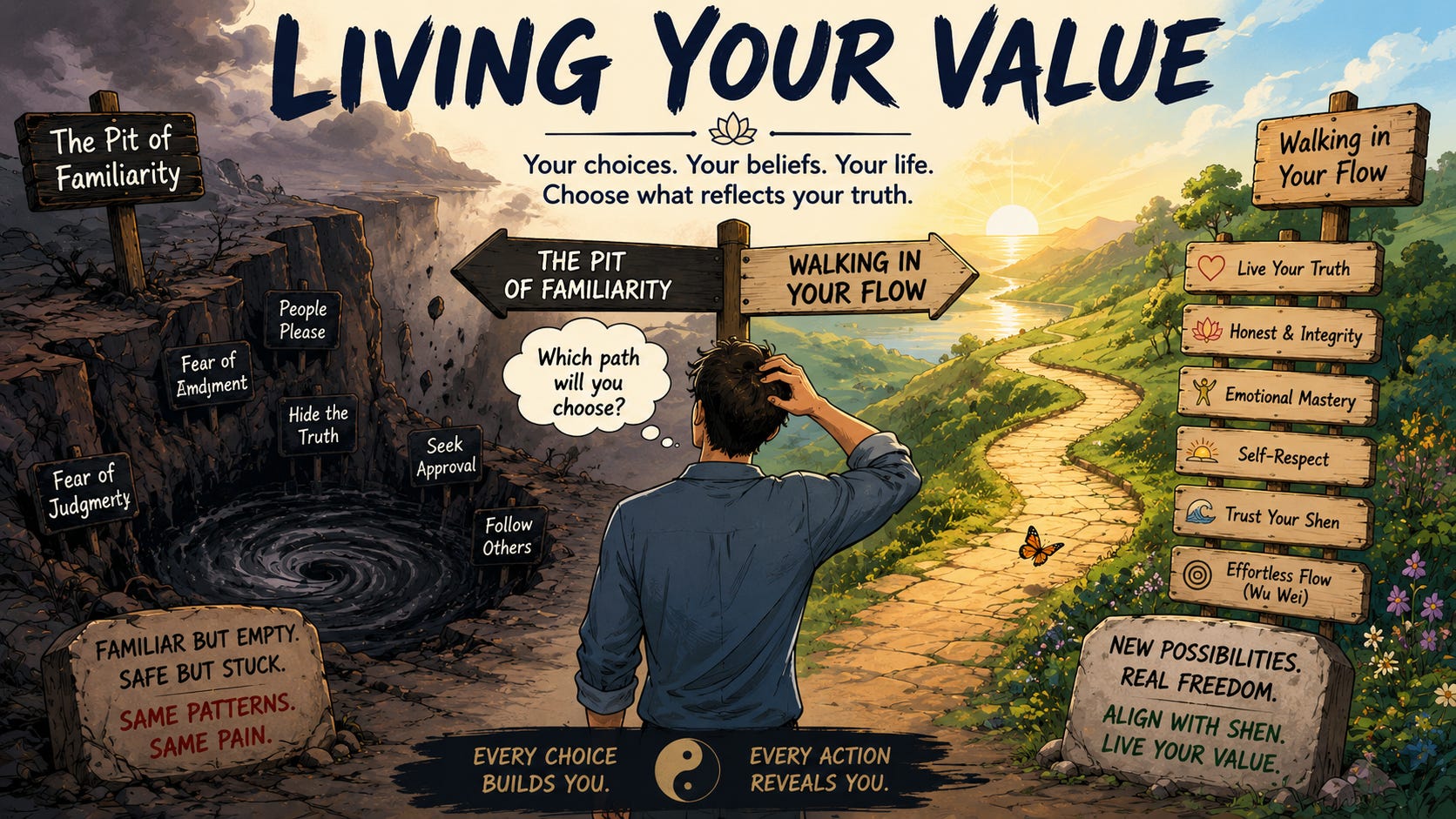
Have you ever said to yourself, “I know what I should do,” and then watched yourself choose something completely different? Have you ever promised to be honest, calm, or disciplined, only to see your Inner Child complain, pressure, or harangue you into reacting, hiding the truth, or following someone else’s lead?
This is where the real teaching begins. Self-worth is not proven in what we say during calm reflection; it is revealed in what we do when we are challenged, watched, tempted, or uncomfortable. It is revealed in the quiet moments where no one else is looking, when we decide whether to follow truth or follow fear. In ‘Living Your Value’, we will explore a deeper and more grounded understanding of self-worth, not as something we think about, but as something we live through our actions. We will look at why dishonesty quietly erodes self-respect, why emotional reactions are often rooted in beliefs rather than reality, and why the gap between knowing and doing is one of the most important places for growth. We will also explore the belief that self-control has limits and how this belief can trap us in patterns that seem stronger than we are. This teaching matters because many of us are not lacking knowledge. We already know what is aligned. The real question is, “Why do we not always live it?”
Our Tao Te Ching translations, Verse 64, offer a powerful reminder: “What is rooted in stillness will not be uprooted. What is firmly grasped will not slip away.” These points lead us toward something essential. When our values are truly rooted in Shen, they become steady. When they are only ideas, they are easily shaken by pressure, emotion, or the need for approval.
The Knowing Within Us
There is a quiet truth that most of us carry: we already know more than we admit. We know when we are being honest and when we are not. We know when we are reacting from emotion rather than responding with clarity, and when we are trying to impress someone instead of being authentic. This knowing is not loud. It does not argue. It does not pressure. It simply presents itself as clarity. This is Shen.
Yet our Inner Child often interrupts this clarity. It may criticise, “You cannot say that; they will judge you.” It may complain, “This is too uncomfortable, just avoid it.” It may pester us, “Everyone else is doing it, just follow along.” These voices are not the truth; they are protective patterns built from past beliefs about safety, approval, and belonging. They are expressions of ‘Emotional Logic’, not ‘Shen Logic’.
So, when we find ourselves acting against what we know is authentic, we are not confused. We are divided. One part of us knows, and another part of us is trying to protect something. The ‘Golden Thread Process’ helps us uncover what that is. We ask, “What belief made this behaviour seem necessary?” If we lie, perhaps we believe the truth would make us look weak. If we react emotionally, perhaps we believe we were being disrespected. If we follow others, perhaps we believe that standing alone would make us feel disconnected.
‘Clarity is not missing; it is often ignored when fear speaks louder.’
This is an important moment of responsibility. Not blame, not shame, but responsibility. Because when we see the belief, we can begin to question it.
When Behaviour Reveals Belief
Every action we take carries a belief beneath it. Behaviour is not random. It is the expression of what we believe to be true in that moment. This is why behaviour becomes such a powerful mirror of self-worth. If we truly believed we were valuable, would we lie to protect an image? If we truly respected ourselves, would we follow others into actions that we know are misaligned? If we trusted our own thinking, would we abandon it so quickly when someone disagrees?
Dishonesty is one of the clearest examples. It rarely begins as a desire to deceive others. It begins as a belief that truth is unsafe. Our Inner Child may pressure us to change the story because it believes that honesty will lead to rejection, embarrassment, or a loss of approval. So, we choose a version of reality that seems easier in the moment. Yet what happens internally is very different. Each time we move away from truth, we weaken the connection to Shen. We create a small division within ourselves.
This is why self-respect and honesty are inseparable. When we speak truth, even when it is uncomfortable, we strengthen our inner alignment. When we avoid the truth, we create a pattern in which appearance becomes more important than authenticity. In our previous teaching, we shared this reflection: “When we protect the image, we quietly abandon the truth that could strengthen us.” This insight brings us back to the core teaching. The goal is not to appear good. The goal is to be aligned and live in flow.
This also applies to relationships. When we react emotionally to someone’s behaviour, we are often responding to the meaning we have created, not the reality itself. If a friend behaves in a way we do not like, our Inner Child may immediately create a story: “They do not respect me,” or “They are wrong,” or “I need to fix this.” From that story, emotion arises, and from that emotion, reaction follows.
Yet Shen invites a different approach. Shen asks us to pause, think and separate what happened from what we made it mean. Our Tao Te Ching translations, Verse 15, remind us: “The wise are cautious and thoughtful, not because they are slow, but because they value clarity.” This is wu wei in action. Not rushing, not reacting, but allowing clarity to guide behaviour.
The Illusion of Limited Control
One of the most powerful beliefs that keeps people stuck is the idea that control is limited. “I can only hold it together once, then it takes over.” This belief can seem true because it is experienced repeatedly. Yet repetition does not make it true. It makes it familiar. This is ‘The Pit of Familiarity’. When our Inner Child believes that control is limited, it stops trying after a certain point. It creates a boundary where none actually exists. It says, “This is as far as we can go,” and then uses that belief to justify the next reaction. Over time, this becomes a pattern that seems automatic, sinking deeper and deeper into the ‘Pit of Familiarity’ with no way out.
So, we challenge it gently. Not with force, not with pressure, but with curiosity. “Is it true that I cannot choose differently, or have I simply not practised the art of exploring fresh choices?” This question opens a doorway. It moves us from limitation into possibility.
‘What we repeat becomes familiar; what we question becomes changeable.’
This is where self-control is redefined. It is not about suppressing emotion. It is about understanding the belief behind the emotion and choosing a response that aligns with Shen. It is about recognising that we always have a moment, however small, where choice exists.
Becoming Someone We Trust
The ultimate goal of this teaching is not perfection. It is trust. We want to become someone we can rely on. Someone who, when faced with pressure, chooses truth. Or, when faced with emotion, chooses clarity; when faced with influence, chooses authenticity. This does not happen in one moment. It happens through repeated, small, consistent choices. Each time we align with ‘The Power of Three’: truth, honesty and integrity, we strengthen that trust. Each time we choose differently, we weaken the old pattern.
This is how we step off the ‘Carousel of Despair’. Not by escaping emotion, but by understanding it. Not by forcing change, but by practising alignment. Not by criticising ourselves, but by guiding ourselves. So, when we look at our actions, we are not judging ourselves. We are learning from ourselves. We are asking, “What does this behaviour show me about what I believe?” And then we gently bring that belief back to Shen.
Living The Power of Three
Let ‘Living Your Value’ become more than an idea. Let it become a daily practice. When we notice ourselves about to react, we pause. When we notice ourselves about to avoid the truth, we breathe. When we notice our Inner Child pressuring us to follow others, we return to our own thinking. We do not need to change everything at once. We begin with one moment, a choice, and an action that reflects who we choose to be.
Never doubt yourself, even when change seems slow. Never assume that a pattern defines you. Never believe that you are controlled by emotion. Shen guides you through the ‘Power of Three:’ truth, honesty and integrity, and that guidance is always available.
Take small, consistent, manageable steps without expectations or Criticism, Comparing, and being Judgmental (CCJ). Choose truth in one conversation, in one reaction and choose authenticity in one decision. This is how ‘Living Your Value’ becomes real. Not through thinking alone, but through action. Not through perfection, but through practice. And as we continue on our path, something beautiful begins to happen. We no longer need to convince ourselves of our worth.
We begin to live it.
Moments of Inspiration…
Reality First
Have you ever noticed how much energy we spend asking life to become more convenient before we accept it? We may want people to respond differently, timing to soften, outcomes to reassure us, or uncertainty to step aside before we move.
‘Yet reality does not adapt to our expectations. We must adapt to reality.’
This is not defeat. This is freedom. Our Inner Child often believes that peace will arrive when life finally behaves as expected. But the Tao teaches something deeper: peace begins when we stop arguing with what is here. As our teachings remind us, “reality does not align with our beliefs; we must align our beliefs with reality.”
Wu wei is not passive acceptance. It is intelligent alignment. We stop pushing the river uphill. We observe, breathe and ask, “What belief is fighting this moment?” Then we choose the next honest step.
Reality may not give us what our Inner Child demands, but it always gives us something to understand. Each disappointment can become a doorway, a delay can become a teacher, and each red-light emotion can guide us back to Shen, where truth is calm, steady, and clear.
Affirm: “I release the demand that life must match my expectations. I meet reality with clarity, courage, and trust in my Shen.”
This week, let us practise meeting life as it is, not as our Inner Child insists it should be. Small steps. No CCJ. Just truth, honesty, integrity, and flow.
In the Next ‘Inner Circle’ (Paid) Journal…
Safe Through Confusion
Truth Without Editing
The Sold Story
Moments of Inspiration
In the Next Free Journal…
The Unperformed Self
The Familiar Pit
Waiting For Original Love
Moments of Inspiration
Journal #F086 22/06/2026
Contact: info@wuweiwisdom.com
Website: www.wuweiwisdom.com
YouTube: www.youtube.com/user/WuWeiWisdom
Facebook Community: www.facebook.com/groups/wuweiwisdomcommunity/
“Pit of Familiarity.” That’s a very useful phrase. Like a bog or a swamp. Thanks.
This really hit home from me. There are more options than just being irresponsible/thoughtless or ruthlessly punishing ourselves. We don’t have to be harsh to learn. We don’t have to be judgmental to bring awareness. We are not on trial and there is no courtroom. Humans make mistakes !