
Relief Before Truth
This week, is seeking comfort, keeping you 'stuck'? Can we fix others, and stepping off the carousel of self-doubt? Finally, trusting ourselves through missteps.

I am willing to pause before I soothe, to gently follow the thread of this moment back to the truth I have been avoiding, trusting that clarity, not comfort, is what will truly set me free. As I read on, I choose curiosity over escape, knowing that each honest insight is a quiet step back into alignment, flow, and the peace that does not need protecting.

Have you ever noticed how quickly we want the discomfort to stop, yet how rarely we stop to ask what created it? Have you ever reached for distraction, delay, overthinking, or some quick comfort, not because the issue was solved, but because our Inner Child wanted the tension to soften before truth had fully spoken? And do you ever tell yourself you were trying to cope when, deeper down, you were also trying to avoid accountability, conflict, or a belief you did not want to examine? These questions matter because they reveal one of the most subtle patterns in our spiritual life. Many of us not only try to avoid emotional pain, but we also avoid spiritual clarity.
In ‘Relief Before Truth’, we are going to explore why our Inner Child often prefers temporary comfort to honest inquiry, why regulation without reflection can become another form of postponement, and how Taoist wisdom invites us back to authenticity through the ‘Golden Thread Process’, the courage to ask what we believe and why we believe it. We will also look at why difficult conversations become spiritual practice, not because we must control the outcome, but because they teach us to listen, to speak truthfully, and to remain aligned without false performance. This teaching is essential because when we choose relief before truth, we remain stuck in familiar circles. When we choose truth first, real flow begins.
The Comfort of Avoidance
Our Inner Child is not foolish. It is protective. It wants safety, ease, and the fastest route away from discomfort. That is why it often nags, pesters, or pressures us toward whatever changes the emotional weather quickly. It may not always choose something dramatic. Sometimes it chooses postponement. Sometimes confusion. Sometimes endless reasoning. Sometimes the quiet promise of, “I’ll deal with this later.” And later, of course, becomes another circle around the same mountain.
This is why quick relief can be so persuasive. It seems kind. It seems practical. It even seems wise. After all, what could be wrong with wanting calm, rest, or escape from tension? The problem is not the wish for calm. The problem is when calm is used to avoid the question beneath the discomfort. Our Inner Child often prefers to regulate the symptom rather than understand the source. It wants the pressure to go away without examining the belief that created the pressure in the first place. In a previous teaching, we saw this same pattern in the ‘Addiction of Familiarity’, where change is promised later, while avoidance deepens in the present. That pattern does not always look dramatic. Sometimes it looks like moderation without clarity. Sometimes it looks like saying we believe one thing while repeatedly choosing another. Sometimes it looks like calling an excuse a coping strategy.
This is where Taoist teaching becomes wonderfully honest. It does not condemn the wish for comfort, but it asks us to be truthful about what we are doing. Are we taking a wise pause, or are we escaping accountability? Are we calming the body, or are we using calm as a shield against self-inquiry? Are we listening to our Inner Child with compassion, or letting it run the house because it complains loudly enough? These are not accusations. They are invitations. Because until we name the pattern clearly, we cannot change it truthfully.
When Relief Becomes a Story
One of the most important shifts we can make is to stop describing our lives only in terms of what we are experiencing emotionally and to start describing them in terms of what we authentically believe. This is the heart of the ‘Golden Thread Process’. We begin with the red-light emotion, but we do not stop there. We ask, “What do we believe right now? Why do we believe it? Would we teach this belief to a physical child?” That is where honesty begins, the ‘Shen Test’.
Our Inner Child resists this because emotional logic prefers sensation to scrutiny. It would rather say, “I’m overwhelmed,” than admit, “I believe discomfort means danger.” It would rather say, “I need this to relax,” than ask, “Why do I believe I cannot live in a relaxed state without help?” It would rather say, “I’m too tired to deal with this,” than uncover the deeper belief, “If I face this truth, I may have to change.” This is not because our Inner Child is bad. It is because accountability seems threatening when we have been shaped by fear, pressure, or unresolved issues. Emotional logic mistakes inquiry for criticism, when in fact inquiry is one of the deepest forms of love and compassion.
That is why language matters so much. In one of our previous teachings, we were reminded, “We begin by turning inward, guided by the ‘Golden Thread Process’ of inner inquiry, which rests on a simple yet transformative question: ‘What do we believe, and why do we believe it?’” This question does not attack our Inner Child. It educates it. It teaches us to stop circling emotional conclusions and return to authorship.
Once we begin asking better questions, a powerful truth appears. Much of what we call a need is, in fact, a negotiation. Much of what we call moderation is, at times, inconsistency dressed in ‘false spiritual clothing’. Much of what we call burnout is, in fact, resistance to a difficult truth. This does not mean that every need is false or that every tired moment is avoidance. It means we must become discerning. Shen does not shame us for wanting comfort, but Shen asks whether the comfort is aligned. Is it helping us return to truth, or helping us postpone it?
Truth in Conversation
This teaching becomes especially alive in human relationships. It is one thing to sit quietly and reflect on our beliefs. It is another thing entirely to hold onto truth while speaking with someone who challenges, dismisses, or misunderstands us. That is where many of us discover how quickly our Inner Child reaches for tactics. It may want to win. It may want to persuade. It may want to avoid the conversation entirely. It may want to say nothing, then later complain that it was not understood. Yet wu wei offers a more grounded way.
Wu wei does not ask us to dominate the conversation or collapse within it. It asks us to enter honestly, calmly, and without forcing the outcome. That means we listen. We ask clarifying questions. We speak truthfully. We do not perform. We do not manipulate. We do not try to control another person into agreement. We stay with what is true for us and let that be enough. In one of our previous teachings on authentic communication, this was expressed this way: “I choose to speak my truth without fear and release the need to control the outcome.” That line carries profound Taoist wisdom because it frees us from the exhausting burden of management. We no longer need to win the moment to honour ourselves within it.
Avoidance is often misunderstood. Sometimes it is wisdom. Sometimes stepping back is exactly what the Tao would ask of us. But sometimes avoidance is not discernment or peace; it is fear wearing soft clothes. Hexagram 39 helps us here by showing that stepping back can be a strategic pause rather than a collapse. “In stillness, we find clarity; in retreat, we find our strength.” This is not permission to disappear into delay. It is a reminder that we do not need to react impulsively. We can pause, reflect, gain perspective, and then respond from alignment rather than from emotional urgency.
So, the question is never, “Should we avoid challenging situations or people?” The real question is, “What belief is driving our choice?” If we step back to gain perspective, that may be wisdom. If we step back because our Inner Child believes truth is unsafe, then we have found the real issue. Again, the emotion is not the final truth. The belief beneath it is where the light must go.
Choosing Alignment Over Immediate Ease
Taoist wisdom does not promise a life without discomfort. It promises a truer relationship with discomfort. We stop treating every inner disturbance as something that must be silenced at once. Instead, we learn to ask why it is there. We learn to distinguish between a wise act of self-care and a familiar act of avoidance. We learn that regulation can be useful, but only when it serves clarity rather than replacing it.
This is where Verse 57 of the Tao Te Ching offers a beautiful and less familiar teaching: “By not imposing external thoughts and beliefs, they will find their value and worth.” What an extraordinary line. We usually apply it to society, to leadership, or to relationships, but it also applies inwardly. How often do we impose false stories on ourselves? How often do we tell ourselves we are powerless, inconsistent, incapable, or too fragile to face what is true? Shen does not impose like that. Shen does not use pressure, panic, or performance. Shen guides through clarity. When we stop imposing old stories on our Inner Child, a gentler truth can emerge. We are capable of pausing. We are capable of listening. We are capable of living with more simplicity, more honesty, and less emotional bargaining.
This is why ‘Relief Before Truth’ matters so much. It names a pattern many of us know but rarely describe clearly. We want peace, yet we chase it in ways that postpone peace. We want authenticity, yet we sometimes hide behind comfort, confusion, or familiar habits. We want flow, yet our Inner Child keeps trying to negotiate with truth. The way forward is not harshness. It is not deprivation. It is not punishing ourselves for having coping patterns. The way forward is loving accountability. It is the willingness to say, “Yes, I can see why this choice attracts me, but what do I actually believe? Is this aligned with my Shen? Is this the life I would teach to a physical child I love?”
When we live this way, even small decisions become sacred. A pause before reacting. A truthful answer instead of a clever excuse. A difficult conversation was entered with calm. A moment of discomfort endured without reaching for immediate relief. These are not minor victories. They are the quiet architecture of authenticity.
So, let us gather the teaching gently and bring it home. When our Inner Child complains, reproaches, or badgers us for quick comfort, we do not need to shame it. We need to guide it. We need to ask better questions. We need to remember that emotions are signals, not rulers, and that true alignment rarely begins with what is easiest. It begins with what is honest. It begins when we stop asking only, “How do I make this stop?” and start asking, “What is this trying to show me?” That is where flow returns. That is where wu wei, effortless effort, becomes real, not as passivity, but as truthful living without force.
As we close ‘Relief Before Truth’, let us take a simple path forward. Let us not demand perfection. Let us not collapse into CCJ. Let us take small, consistent, manageable steps. The next time discomfort arises, let us pause before reaching for the fastest relief. Let us ask what we believe, and why. Let us listen to our Inner Child without handing it authority. Let us speak truthfully in the conversations that matter, and release the need to control the outcome. Let us trust that calm built on honesty will always carry more power than comfort built on avoidance.
And above all, let us never doubt ourselves. We do not need grand gestures to change our lives. We need one honest moment, then another. One aligned choice, then another. One gentle return to truth, then another. This is how we step off the ‘Carousel of Despair’. This is how we return to flow. And this is how ‘Relief Before Truth’ becomes not just a title, but a living practice of authenticity, courage, and quiet inner freedom.
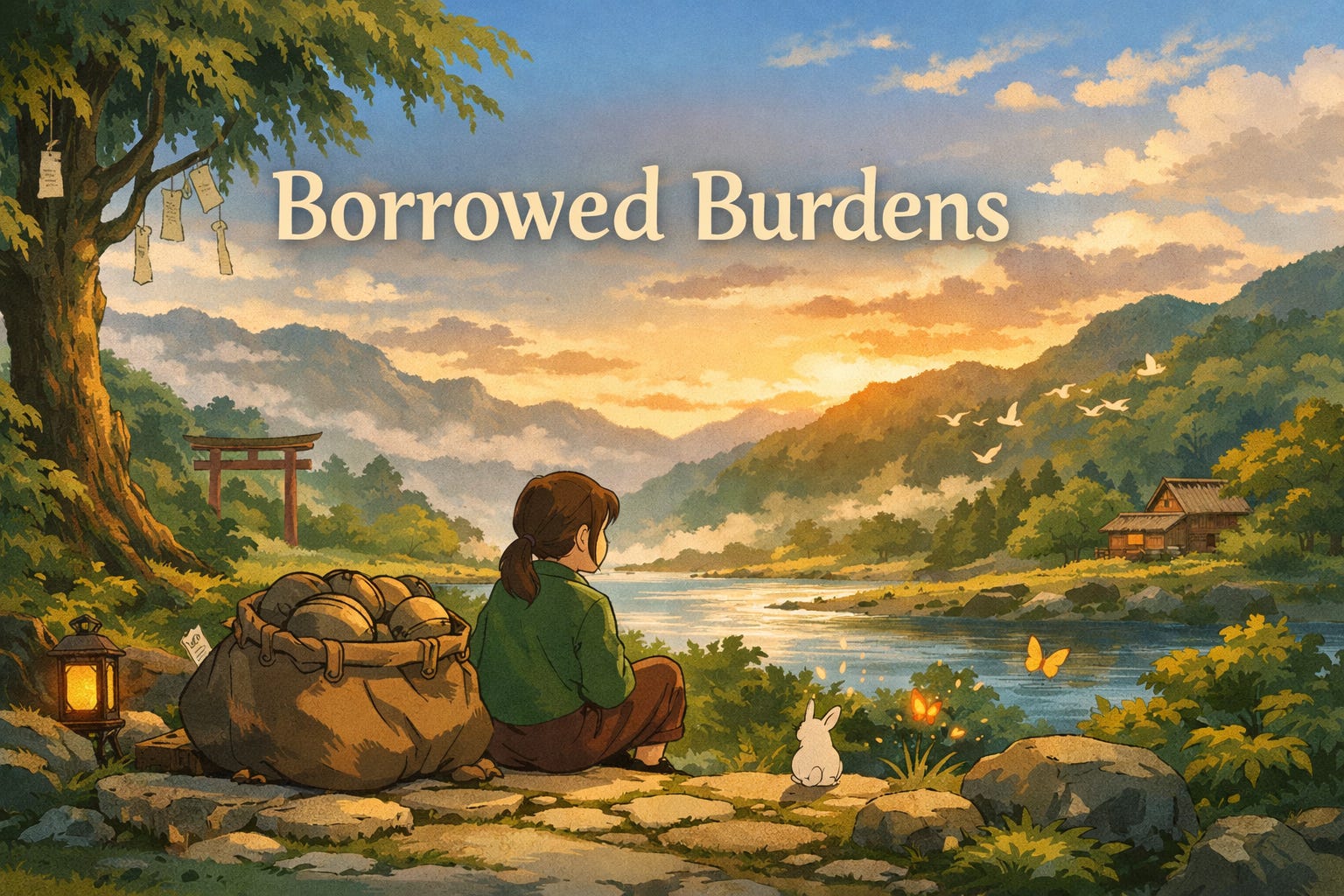
Have you ever carried guilt that never truly belonged to you? Have you taken responsibility for another person’s moods, choices, disappointments, or broken relationships, and called it love? Have you mistaken loyalty for self-erasure, believing that if you could do more, soothe more, stay more, explain more, then everyone around you might finally be alright?
These questions cut deeply because they touch one of the oldest burdens many of us carry, the belief that we were somehow responsible for holding everything together. Not only our own behaviour, but the emotional weather of the household, the peace between adults, the happiness of a parent, the smoothness of a marriage, the comfort of a family system, and the appearance of everything being fine. Our Inner Child often assumes this role early, and once it does, it can seem noble, moral, and even sacred.
But in truth, much of what we carry is borrowed. It was handed to us before we had the maturity, language, or authority to question it. We were small, impressionable, and eager to stay connected. So, when blame hovered in the air, when guilt was assigned without words, when disappointment settled around us like emotional fog, our Inner Child often reached one simple conclusion, “This must be ours to fix.”
In ‘Borrowed Burdens’, we will explore the difference between responsibility and emotional inheritance. We will look at how family systems train us to carry what was never ours, why guilt can seem more familiar than freedom, and how Taoist wisdom helps us return responsibility to its rightful place. We will also look at why this process is not rebellion, selfishness, or betrayal. It is alignment. It is the courageous act of putting down what our spirit was never meant to drag.
The Child Who Became the Holder
No child arrives in life believing they must stabilise adults. That role is learned. It may be taught through words, but often through the environment. A mother seems wounded and expects emotional rescue. A father is distant, and the child concludes they must perform to be noticed. Adults conflict, and the child becomes hyper-aware, trying to become easier, quieter, better, more useful, less needy, less disruptive. The child does not call this a burden. The child calls it emotional survival. This is why false responsibility can hide so effectively. It often looks like goodness. It can look like maturity, empathy, and devotion. But beneath it, there is usually a frightened belief, “If they are unhappy, I am unsafe. If they are disappointed, I have failed. If I am not carrying this, I am bad.”
The tragedy is that this burden usually begins before we are even responsible for ourselves. That contradiction matters. How could we have been responsible for the emotional lives of adults when we were not yet responsible for our own protection, our own regulation, our own place in the world? The very idea collapses under honest examination, yet our Inner Child may still cling to it because it once seemed to create order out of chaos.
In a previous teaching, we wrote, “We are not here to serve a role. We are here to live a life.” This is a vital correction. Many of us were raised in roles: peacekeeper, fixer, good daughter, dependable son, emotional sponge, loyal partner, family glue. Over time, the role became so familiar that it felt like an identity. But a role is not a self. A role is a position inside a system. Shen is far larger than any position assigned by emotions like fear. The Tao does not ask us to keep performing inherited jobs that drain our truth. It asks for alignment, honesty, and integrity. It asks us to live from what is real, not from what was silently demanded.
Blame Dressed as Duty
‘Borrowed Burdens’ often survive because blame disguises itself as morality. We do not merely think, “I care.” We think, “I should.” We think, “A good person would stay. A loving person would carry this. A loyal person would not disappoint them. A responsible person would absorb the discomfort.” That language is powerful because it makes the burden appear virtuous. But duty without truth becomes distortion. And our Inner Child loves distortion when distortion keeps the old attachment alive.
This is where the I Ching offers such deep wisdom. In Hexagram 18, we are told, “By releasing the past, we open ourselves to the wisdom of the present.” This is not permission to become careless. It is permission to stop inheriting faulty patterns as though they were sacred law. Family habits are not automatically true. Emotional traditions are not automatically virtuous. Just because something has been carried for generations does not mean it was ever healthy to carry.
Many of us are dealing not only with personal beliefs but also with ancestral attitudes, beliefs about duty, sacrifice, shame, family image, and emotional obedience. These attitudes can be so normalised that stepping away from them seems like treason. Yet what if the most loving thing we can do is stop passing them on? What if putting down a burden is not abandonment, but correction?
Taoist wisdom does not support emotional domination, even when it comes wrapped in family language. It reminds us that nature does not force in the way the frightened mind forces. A tree does not make the river responsible for its roots. The sky does not ask the mountain to manage its storms. Each thing has its own nature, its own function, its own path. Harmony comes not from enmeshment but from aligned relationships. When we accept ‘Borrowed Burdens’, we violate the right relationship. We become over-responsible for others and under-responsible for ourselves. We manage what is not ours and neglect what is. We scan others for signs of distress while abandoning our own truth. Then our Inner Child calls this goodness, while our Shen spirit fades into the background of our awareness.
The Space to Be Separate
One reason why ‘Borrowed Burdens’ is so hard to release is that they create a strange sense of purpose. If we have long been the one who carries, fixes, understands, and adapt, then putting the burden down can seem like emptiness. “Who are we without the role? What if no one approves? What if they suffer? What if we are judged? What if we are alone?” These are not small questions. They expose how deeply the burden has fused with identity. But Taoist wisdom offers a beautiful answer through Verse 11 of the Tao Te Ching, “When a cup is made, it is shaped with a void; It is this space that makes it worthwhile.” Space is not failure. Space is a function. Space is what allows truth to enter.
Many of us have lived with no emotional space. We have been crowded by duty, guilt, worry, and false accountability. We have not allowed room for our own discernment because every gap has been filled by someone else’s needs, expectations, and disappointments. But without space, we cannot hear Shen. Without space, we cannot recognise what is ours and what is not. Without space, we remain fused to old stories. Healthy separation is not cruelty. It is clarity. It is saying, “I can care about you without carrying you. I can love you without living your life. I can witness your disappointment without making it my responsibility and identity.” This is one of the most important movements in emotional maturity. We do not become less loving by becoming separate. We become more honest and grounded.
Hexagram 37, ‘The Family’, points us toward inner truth as the foundation of right relationship. We do not correct a family by absorbing all its imbalances. We begin by correcting ourselves, our beliefs, our false guilt, our compulsion to rescue, our habit of confusing duty with truth. Family harmony cannot be created by one person becoming a permanent container for everyone else’s unresolved issues.
Returning What Was Never Ours
So, what do we do with these ‘Borrowed Burdens’? First, we stop romanticising them. We stop calling them proof of goodness. We stop pretending they are noble simply because they are familiar. We begin naming them accurately. This is inherited guilt. This is emotional over-responsibility. This is our Inner Child trying to keep attachment alive through service.
Then we return to the central question, “What do we believe and why do we believe it?” Perhaps we believe, “If I stop carrying them, I am selfish.” Perhaps we believe, “If they are unhappy, I have failed.” Perhaps we believe, “My worth depends on being needed.” Once we identify the belief, the emotion begins to make sense. The red-light emotion is no longer a mystery. It is a consequence. From here, we can begin to return responsibility, not with accusation but with truth. Sometimes this is a spoken boundary. Sometimes it is a quieter internal shift. Sometimes it is simply refusing to keep rehearsing old guilt. We do not need to announce every act of alignment. We need to live it.
And we can remind ourselves of a powerful truth from a previous teaching: “It was never yours. They were the adults.” That sentence can be life-changing for the part of us that still believes we were appointed as keepers of the family’s well-being. We were not given a sacred mission. We were given an impossible burden and then taught to confuse it with love. Let us bring this home now with the title, ‘Borrowed Burdens’. So many of us are tired not because life is impossible, but because we have been carrying emotional loads our spirit never chose. We have been holding grief that belongs to others, shame that was projected onto us, and responsibilities that were assigned through fear rather than truth.
Now is the time to begin putting them down. Not all at once. Not dramatically. But steadily. Lovingly. Clearly. Take small, consistent, manageable steps without expectations. Without Criticism, Comparing and being Judgmental (CCJ). The next time guilt rises, let us ask, “Is this truly ours?” The next time our Inner Child pressures us to rescue, let us ask, “What belief is driving this urgency?” The next time we confuse closeness with carrying, let us choose alignment instead.
Let ‘Borrowed Burdens’ remind us that our lives were never meant to become endless acts of emotional hauling. We are not here to drag inherited weight through every relationship, nor to give until our own spirit runs dry. Just as on an aircraft we are told to place the oxygen mask on ourselves first, so too must our Qi energy be allowed to move through us before it can truly reach another. If it is our nature to help, then let that help rise from fullness, not exhaustion; from our Shen spirituality, not sacrifice. When we walk in wu wei, we stop forcing ourselves into false duty and inherited childhood beliefs and return instead to the steady ‘Power of Three’: truth, honesty, and integrity. What is truly ours to carry grows lighter in that alignment. What was never ours can, at last, be released.
We have all thought it, whispered it, or considered it in a tired moment: “How do we accept ourselves for who we are?” And if we are honest, the question rarely arrives as calm curiosity. It usually arrives as a pressure in the chest, a tight loop of thoughts, or the sense that everyone else got a secret instruction manual we somehow missed.
Have you ever tried to improve yourself while secretly believing you are unacceptable as you are? Have you ever chased “confidence” while your Inner Child criticises, reproaches, and badgers you in the background? Have you ever promised, “Once I fix this part of me, then I’ll finally be okay,” only to discover the goalpost moves again?
This is why self-acceptance is not a soft topic. It is a foundational one. When we reject ourselves, we don’t just create discouragement; we also create self-doubt. We create an internal split, a spiritual separation from our Shen, our intrinsic worth and value. Then we wonder why life feels heavy, why our energy drops, why our emotions flare, and why we sabotage momentum the moment it begins.
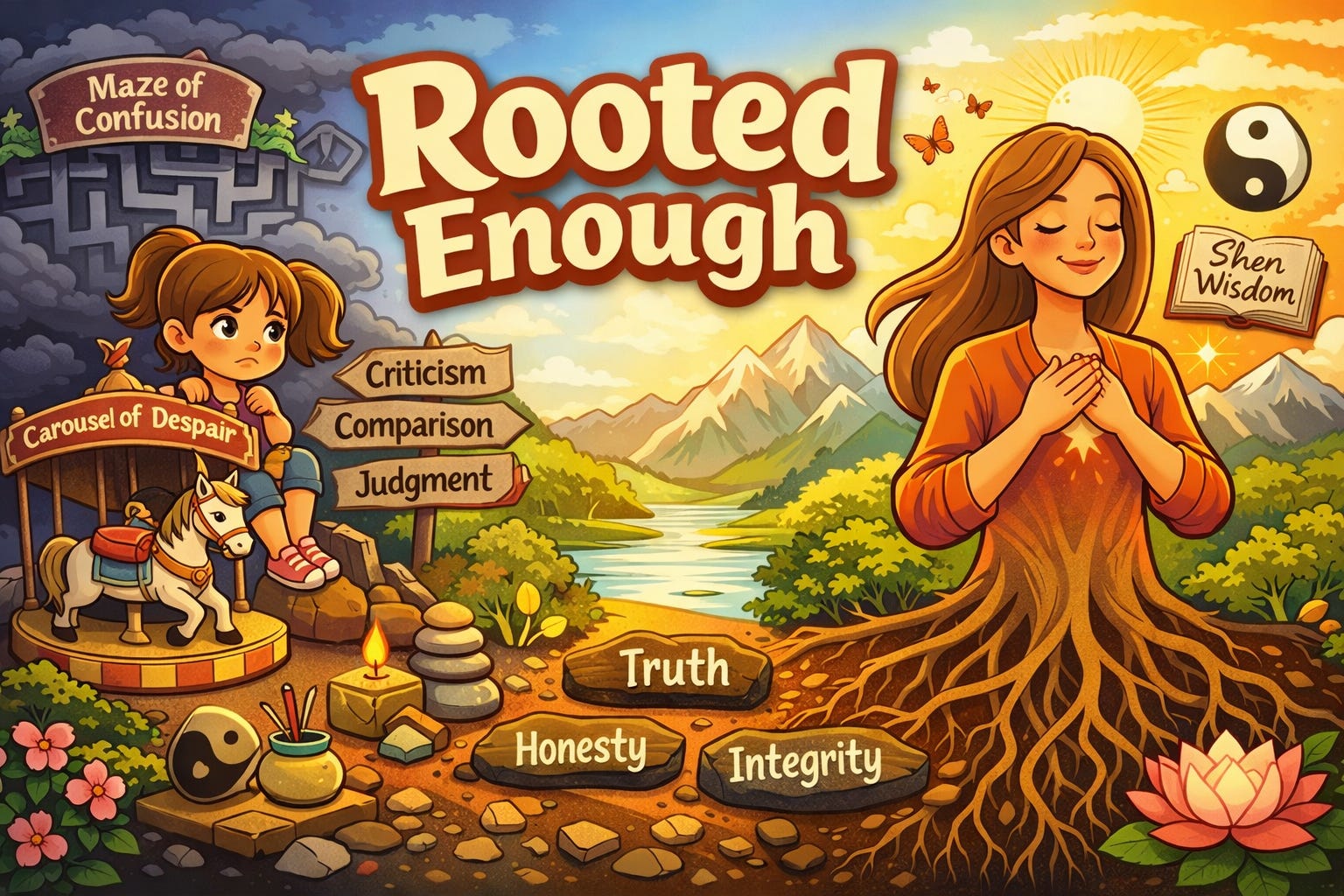
So, in ‘Rooted Enough,’ we’re going to explore a Taoist and Wu Wei Wisdom way through this maze, not by forcing a new personality, but by returning to something steadier, the ‘Power of Three’: truth, honesty, and integrity. We’ll look at the difference between the emotions created from Shen and those our Inner Child creates, why “not accepting ourselves” often hides a misguided benefit, and how we step off the ‘Carousel of Despair’ with small, consistent, manageable steps, without expectations or Criticism, Comparing and being Judgmental (CCJ).
Acceptance Isn’t Complacency
Many of us quietly misunderstand acceptance. We hear “accept yourself”, and our Inner Child panics, “So, we’re just giving up then?” Or it complains, “If we accept ourselves, we’ll never change.” That’s emotional logic talking, and it sounds persuasive because it pretends to be practical. In Wu Wei Wisdom, acceptance is not the end of growth. Instead, it is the beginning of authentic growth. Complacency says: “Nothing matters.” Acceptance says: “Everything matters, and we are still worthy while we learn.”
This is why we often teach three stabilising companions on this path: acceptance, consistency, and accountability. Acceptance gives us warmth and reality. Consistency gives us rhythm. Accountability gives us power. Without acceptance, accountability turns into punishment. Without accountability, acceptance turns into avoidance. Without consistency, we keep making dramatic promises and then collapsing into avoidance and shame.
Taoism helps us see why this matters. The Tao is not impressed by performance. It does not applaud perfection. It flows with what is real, and it asks us to do the same. In our translation of the Tao Te Ching, Verse 45 offers a deeply practical relief from the perfection trap: “Your best efforts will never be perfect, but that does not mean you have failed.”
Notice what this does to our Inner Child’s harsh standards. It doesn’t say, “Try less.” It says, “Stop using perfection as your yardstick for worth.” That one shift is life-changing. Because once we stop demanding perfection, we can finally become teachable again. We can make mistakes and call them what they are: ‘Life Lessons.’ And here is the hidden doorway: when we accept ourselves, we stop treating growth like a courtroom. We stop acting as judge, the ‘faceless’ jury, and the accused. We begin acting like a wise guide.
The Unseen Benefit of Self-Rejection
If self-rejection is so painful, why do we keep choosing it? Because it often comes with a hidden benefit, and our Inner Child loves benefits that seem to create a sense of control and safety, self-rejection can function like a strange “insurance policy.” If we reject ourselves first, we imagine we are protected from the pain of others rejecting us. If we criticise ourselves before anyone else does, we imagine we are in control. If we say, “I’m not good enough,” we can avoid trying, being seen, making a mistake in public, and being accountable. We can stay small and call it “being realistic.” But Taoism is quietly ruthless with illusions. It doesn’t attack us; it simply reveals cause and effect.
When we reject ourselves, we usually create two familiar mechanisms:
The Maze of Confusion, where the Inner Child builds layers of excuses and justifications, so change seems complicated and overwhelming.
The Carousel of Despair, where we go around and around the same emotional loops because familiar pain seems safer than an unfamiliar possibility of the ‘unknown’.
We might say, “I don’t know how to accept myself,” but often what we mean is, “I don’t want to lose the ‘benefits’ my confusion and negative familiarity give me.” And that is not a moral failure. It’s an opportunity to become honest.
Here is a ‘Golden Thread Process’ question we can sit with gently, without drama: “What do we believe self-rejection is doing for us?” Sometimes it’s protection from disappointment. Sometimes it’s permission to procrastinate. Sometimes it’s a strategy to gain sympathy so we don’t have to face a hard truth. Sometimes it’s a way to avoid risking our authenticity.
And this is where we must be brave enough to say something simple and stabilising: avoidance is STILL a choice. “Not choosing” is STILL choosing. And every choice creates an emotional consequence. So, we don’t shame ourselves for being authentic. We tell the truth about being authentic. That is the first moment we step off the carousel and out of the maze.
Shen Clarity, Inner Child Emotion
A core teaching is: ‘We must learn to distinguish where our emotions come from.’ Some emotions arise from Shen and signal alignment: calm, clarity, steadiness, contentment, quiet joy. These emotions don’t beg, they don’t manipulate, they don’t demand control. They stabilise and aid flow.
Our Inner Child’s beliefs drive other emotions and often signal misalignment: anxiety, shame, jealousy, resentment, fear, and a restless hunger for reassurance. These emotions are not “bad.” They are messages. But they are also often used by our Inner Child as tools to avoid uncomfortable accountability, sticking our head above the ‘parapet’.
Our Inner Child uses emotional logic. It believes intensity equals control and certainty. If it creates anxiety, it concludes danger. If it creates shame, it leads to the conclusion “we are wrong.” If it creates anger, it concludes that injustice exists, and it’s more likely to get what it wants. Shen doesn’t work like that. Shen doesn’t need intensity to be real. Shen is quietly consistent. So, the practice becomes beautifully simple, even if it is not always easy: When an emotion rises, we don’t ask, “How do we get rid of this?” We ask, “What belief is creating this?”
This is the ‘Golden Thread Process’ at its most grounded. We trace the emotion back to the belief, then test the belief against the spiritual truth. For example, if we create shame, we might find a belief like: “If I’m not perfect, I will be exposed.” If we create anxiety, we might find a belief like: “If I can’t control the outcome, I can’t cope.”
If we create resentment, we might find a belief like: “People should live by my standards, or it’s not fair.” Then we ask the question that changes everything: “Is this belief true, honest, and aligned with integrity”? Or the ‘Shen Test’ question, “Would I teach this to a physical child I loved”? If it isn’t, the emotion is not a life sentence. It’s a signal. It’s a dashboard light telling us, “There is a misfire in the belief engine.”
And that returns us to one of the most empowering teachings we’ve ever shared: ‘We are the creators of our emotions, not the victims.’ When we remember this, we stop asking others to fix our internal state. We stop demanding that someone else provide worth, love, validation, or acceptance. They cannot put emotions into our bodies, nor can they take them out. We experience emotions through our interpretation. This is not to blame. This is sovereignty. And sovereignty is what allows self-acceptance to stop being a motivational poster and become a lived reality.
Stepping Off the Carousel
How do we live this in the real world, on a normal Tuesday, when our Inner Child is bothered, pressured, and ready to run the old script? We practise wu wei, effortless effort. We don’t force a personality transplant. We don’t fight our Inner Child like it’s an enemy. We guide it like it’s young, intense, and misguided. A powerful starting point is to replace the confusing sentence, “I can’t accept myself,” with a more truthful one: “Why am I choosing not to accept myself right now?”
That one shift removes the fantasy that acceptance is something missing from the universe or a gift we did not receive, and reveals the truth: acceptance is a choice we practise. Then we look for what is blocking the choice. Usually it’s one of three things:
1) Unreachable standards
Our Inner Child sets a bar it cannot meet, then uses failure as “proof” that we are not enough. This is why Verse 45 is so kind, it dissolves the lie that perfect effort is the requirement for worth.
2) External authority addiction
We hand our authority to other people, to society, to imagined ‘faceless’ juries. Then we live as if their standards are law, even though they’re often confused and inconsistent. As soon as we do this, self-acceptance becomes impossible because we are measuring ourselves with rulers that were never made for us.
3) The CCJ trance
When we Criticise, Compare, and become Judgmental (CCJ), we create separation. We turn life into a ranking system. Then our Inner Child tries to win, and the moment it can’t, it collapses into shame. CCJ is a never-ending loop, not a solution.
This is why we practise the smallest step that interrupts the loop: a pause. A pause is spiritual strength. A pause is the gap where Shen can speak, and we can listen. A pause is how we stop living as a reaction machine. And when we pause, we can remember a simple line from a past teaching that we can carry like a warm stone in the pocket: “We cannot be broken. Because we are still evolving.” That sentence is not a denial. It is accurate. It returns us to reality. It returns us to patience. It returns us to our path and flow.
Now, let’s translate this into a daily practice that doesn’t overwhelm our Inner Child. When a red-light emotion appears: We name it red-light emotion, without drama. We ask: “What must we believe to create this?” We find the belief. We test it against the ‘Power of Three’: truth, honesty, and integrity. We choose one small, consistent, manageable step that aligns with reality and our spiritual truth.
That might be making one phone call, telling one truth, tidying one corner, writing one paragraph, apologising once, setting one boundary, taking one walk, drinking one glass of water, or going to bed slightly earlier. Not to earn worth, but to express worth. This is the difference between force and flow. Force is frantic and punishing. Flow is steady and honest.
If our Inner Child complains, “But what if it doesn’t work?” we don’t argue. We answer with calm leadership: “We are practising alignment, not guaranteeing outcomes.” That is wu wei, effortless effort in plain language.
A closing reflection
Let’s picture this. Imagine our Inner Child as a young navigator with an old, scribbled map. It points at the ‘Maze of Confusion’ and insists it’s the safest route. It thinks the ‘Carousel of Despair’ is ‘control’ because it is familiar, and it can predict the next painful turn.
Our Shen is the sky above the maze. It sees the whole landscape. It isn’t impressed by drama. It doesn’t threaten. It simply invites: “Come back to truth.” So, today, we can practise a quiet return: We place a hand on the chest, not as theatre, but as a signal of care. We breathe once, slowly. We say, gently: “I am the creator of my emotions.” We ask: “What do I believe about myself right now?” We choose one belief that is more honest than the last one.
That is enough for today. Because self-acceptance is not a single victory, it is a relationship we build through consistency and accountability. And this is where ‘Rooted Enough’ becomes a lived truth, not a slogan. We don’t accept ourselves by becoming perfect. We accept ourselves by ending the internal hierarchy, the internal courtroom, and the exhausting trance of CCJ, and by choosing to live as one whole person in spiritual ‘Oneness’, guided by Shen and supported by wu wei flow.
So, let’s keep the call to action simple and powerful: never doubt ourselves. Not because life is easy, but because we are capable of meeting life honestly, and there is nothing we can compare against, because we are all unique. Let’s take small, consistent, manageable steps, without expectations, without Criticism, and without Comparing or being Judgmental (CCJ). Let’s keep returning to truth, honesty, and integrity, because that is where our worth becomes undeniable, steady, and real.
And when our Inner Child pressures us to prove ourselves again, let’s answer with calm certainty: We are already ‘Rooted Enough’.
Moments of Inspiration…
Learning True
Have you ever looked at a mistake and quietly decided it meant something was wrong with you? Have you ever treated a wrong turn as a verdict, rather than a lesson? In Taoist wisdom, this is where integrity begins to deepen, not when life goes perfectly, but when we meet our imperfections with honesty, humility, and calm self-awareness. Mistakes are not proof that we are failing. They are part of how we grow, refine, and return to what is authentic and true.
Our Inner Child often wants to be right because being wrong can seem like a threat to worth. Yet the deeper teaching is gentler than that. Admitting a mistake does not reduce our value; it expands our wisdom. It softens pride, opens our understanding, and helps us become more authentic in how we speak, choose, and live.
Integrity is not performance. It is alignment. It is the quiet courage to let our words match our actions, and our actions match our deepest truths. The Tao Te Ching reminds us to “keep it simple and follow your truth, honesty, and integrity,” showing us that authenticity creates inner harmony and steady virtue.
When we stop treating missteps as enemies, we become teachable again. We listen more closely. We correct more gently. We trust ourselves more deeply. And from that grounded place, wu wei, effortless effort, begins to guide us naturally.
Affirm: “I welcome each mistake as a wise teacher, and by living in truth, honesty, and integrity, I grow steadier, softer, and more deeply aligned with who I truly am.”
This week, let us meet one mistake with compassion, tell one deeper truth, and walk one step more honestly in the direction of our Shen.
In the Next ‘Inner Circle’ (Paid) Journal…
Unpaid Debts
Where Effort Softens
Promised Ever After
Moments of Inspiration
In the Next Free Journal…
Clear Without Coldness
Clear Inner Sky
No Special Case
Moments of Inspiration
Journal #F075 06/04/2026
Contact: info@wuweiwisdom.com
Website: www.wuweiwisdom.com
YouTube: www.youtube.com/user/WuWeiWisdom
Facebook Community: www.facebook.com/groups/wuweiwisdomcommunity/