
Sacred Seasons
This week, the seasons of your life, bartering your worth and value, looking at "It's not fair" and our Inner Child's 'Blame Game'. Finally, do you expectaions match reality?

“We honour the season we are in, sunlit or overcast, and we choose to return to Shen through the ‘Power of Three,’ truth, honesty, and integrity, letting wu wei, effortless effort, carry us forward without forcing the sky to clear. As we keep reading, let us practise being the observer of our Inner Child’s patterns, because when we notice the weather with kindness, we do not become the storm, we become the steady one who learns, realigns, and remembers we have always coped.”
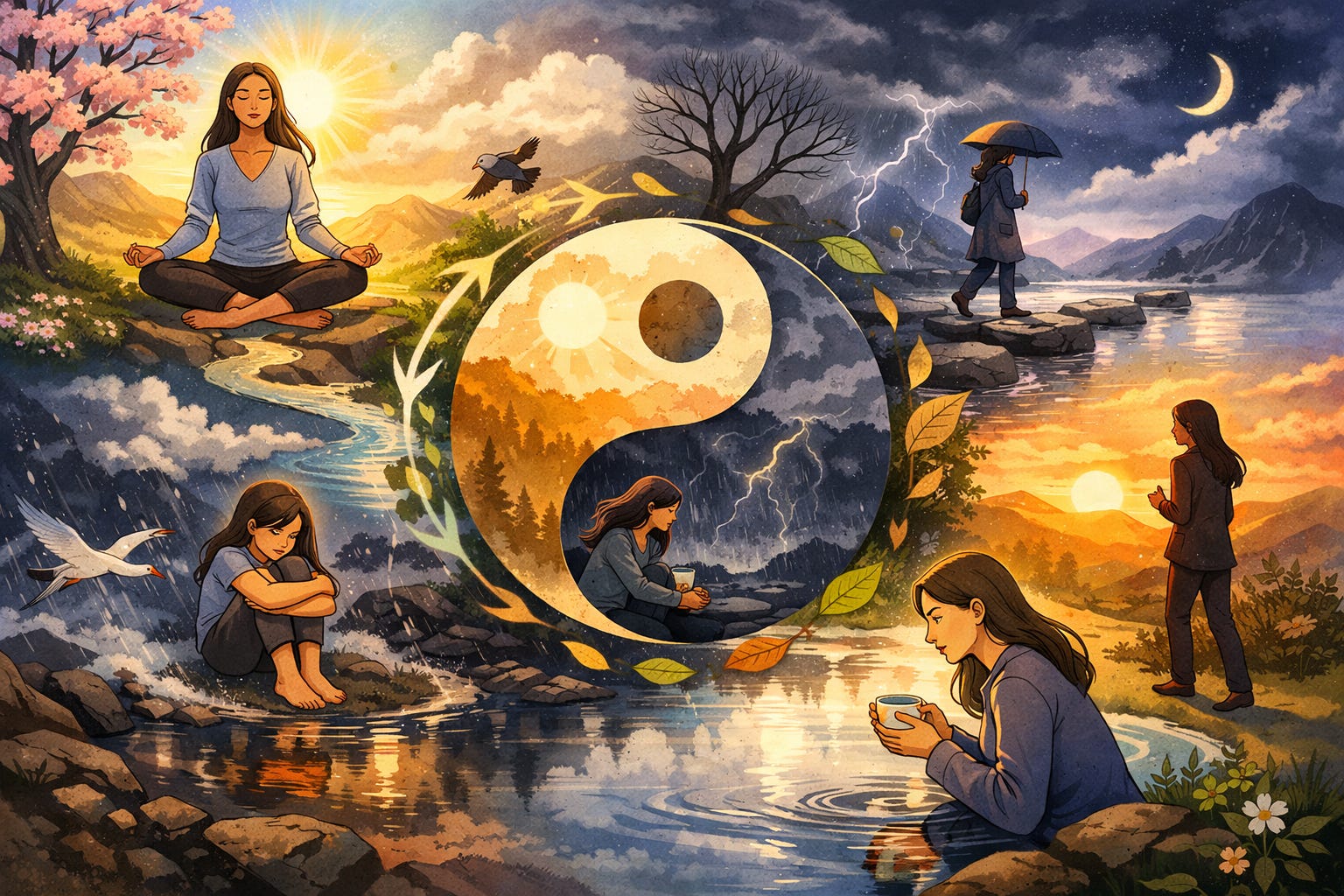
When Life Feels Like The Weather
Do your inner states shift like changing skies, sunlit with hope one moment, overcast with doubt the next? Do your emotions swing between deep motivation and sudden confusion, even when nothing externally has changed? Perhaps some weeks you stand tall and focused, aligned with your intentions and values. Then, without warning, you’re pulled into a season of questioning, unexpected doubt, or emotional fog. You wonder: “Am I moving forward or falling behind? Should I reassess everything, or hold steady?”
This journal post is for those moments when our path seems less like a straight road and more like a turning cycle of weather patterns. When we are caught between wanting clarity and being swept up in uncertainty. When our Inner Child begins to pester and harangue us with fears of loss, failure, or misalignment. And when we are asked not to control, but to trust the rhythm of the Tao.
We’ll explore the emotional logic of our Inner Child that interprets natural change as danger. We’ll bring in a deeper Taoist understanding of time, rhythm, and movement, how the Tao never forces but flows, and how life’s richness comes not from resisting change but from aligning with it. We will offer a new perspective: that ‘seasons of confusion are not signs of failure, but invitations to deepen our roots’. As we explore this together, you’ll discover how wu wei allows us to remain centred in Shen through both the storms and the stillness. Let us begin by shifting how we see change, not as disruption, but as rhythm.
Inner Weather, Real Life
It’s easy to forget that life is not a straight line. In the West, we are conditioned to believe that growth must be progressive, always forward, measurable, and linear. But the Tao teaches us something very different: that movement happens in cycles. Expansion and contraction. Emergence and withdrawal. Blossoming and pruning.
Your inner journey follows this same sacred pattern. As one client so insightfully put it, “The inner world of my life follows seasons.” This simple truth holds immense Taoist wisdom. There are days when clarity seems to bloom easily. Motivation flows. Choices appear obvious. We are in what might be called inner spring or summer, seasons of movement, decision, and external engagement. But then come the inner autumns and winters, times of withdrawal, reconsideration, deeper thought. Times when we must shed old ideas or sit quietly in uncertainty. This is not regression. This is rhythm and flow.
Our Inner Child struggles with this. When the light dims or plans shift, it panics. It criticises: “You’ve lost your way.” It pressures: “You’re wasting time.” It harangues us with warnings: “This will go wrong. You’re falling behind. You won’t live your dream.”
But this is not Shen logic. These are the reactive beliefs creating emotional logic. Our Inner Child believes that discomfort equals danger, that stillness means failure, and that uncertainty must be solved rather than allowed. This is where we must gently step in as the guide. We must lead.
As Shen, we know that the Tao does not rush. That even the tree, bare in winter, is still growing deeper roots. That silence is not emptiness; it is preparation. That the wind does not blow constantly, and that stillness is often more powerful than action. A Taoist saying: “Spring wind carries both the scent of blossom and the sting of frost.” In other words, even when things seem to be blossoming, there may still be the sting of old fears. But both are part of the same season. Nothing is wrong. In ‘Sacred Seasons’, we explore how embracing this truth can soften the inner turbulence. The goal is not to “fix” the confusion, but to see it with new eyes.
The False Urgency of our Inner Child
When change or complexity appears, our Inner Child rarely trusts it. It doesn’t yet understand that the Tao unfolds through contrast. It wants simplicity, certainty, and constant emotional sunshine. It believes that life must be resolved and secured immediately. Anything unclear or conflicting seems unsafe.
In those moments, our Inner Child does not sit quietly. It complains. It bothers. It insists: “Something’s wrong! Decide now! Do more! Fix this!” It frames every shift as a crisis, every pause as a threat. This is emotional logic, not wisdom. Emotional logic always seeks short-term comfort at the expense of long-term authenticity. Shen, however, does not panic in the face of complexity. Shen understands that discomfort can accompany growth, that delays may be blessings, and that alignment matters more than speed.
In fact, confusion is often a sign that a more profound belief is surfacing, something outdated that must be examined before we can move forward. It is not a red light from the Tao. It is a red flag from our Inner Child that signals: “I don’t feel safe unless everything is clear and moving the way I want.”
We can ask ourselves here: “What belief have I created that’s causing this sense of panic?” Is it “I must know what to do next,” or “I can’t afford to make a mistake”? Is it “Time is running out,” or “They won’t understand if I change direction”? These are all invitations to pause. Not to obey those beliefs, but to examine them in the light of Shen. Our role is not to push them away, but to listen gently and lead wisely.
This is the foundation of wu wei: effortless effort. The quiet power of choosing not to force clarity, but to remain aligned until the path naturally unfolds. The I Ching, in Hexagram 64, “Before Completion”, speaks directly to this: “In times of transition, do not rush to close the circle. Wait at the edge of the stream. Watch carefully, step mindfully. Completion is not created by force, but revealed through alignment.”
This is not poetic delay. It is precision. The Tao rewards rhythm, not urgency. When our Inner Child demands answers now, we can gently say: “We’re not late. We’re just not finished.”
Simplicity and the Sacred Ordinary
A profound insight is this: “Inner work is straightforward, yet simultaneously has its own quirks that hold hands with real life.” This is beautifully true. Spiritual practice is not meant to lift us out of life, but to teach us how to live within it. There is no contradiction between spiritual alignment and paying bills, raising children, ending a relationship, or changing careers. The Tao flows through everything. The spiritual and the ordinary are not separate; they hold hands.
But this joining also creates friction. Sometimes our deep intentions pull us away from the people or places we love. Sometimes the practical decisions we must make do not feel “spiritual” at all. Sometimes alignment appears to cost us things. In these moments, it is vital to pause and return to wu wei. Are we choosing from fear or spiritual clarity? From habit or alignment? Is this discomfort the result of being out of flow, or is it the stretching sensation of stepping into truth?
We are not asked to choose between our Spirit and our life. We are asked to bring Spirit ‘into’ our lives. This is the heart of Shen alignment. The Tao Te Ching reminds us in Verse 65: “True wisdom does not interfere with life, but follows it. It teaches not by force, but by clarity. It leaves no trace, yet transforms everything.” When you align with your Shen, you begin to see the sacred in the ordinary. You pay a bill, and it becomes a clarifying act. You end a friendship, and it becomes an act of truth. You rest instead of rushing, and it becomes an act of courage. The Tao does not ask us to escape life. It asks us to live it authentically. That is the absolute simplicity.
Staying Aligned Through All Seasons
So, how do we stay steady when life’s inner seasons shift? When we wake in emotional winter but hope for inner spring? We anchor ourselves in Shen, not in external signs. We remember that our path is not failing when it changes direction. We remind our Inner Child that slowness is not punishment, and uncertainty is not danger.
And above all, we take small, consistent steps, without CCJ - Criticism, Comparing or being Judgmental. That is the only rhythm the Tao asks of us. No perfection. Just participation. No outcome. Just alignment. In those quiet, winter-like seasons, when nothing seems to move, we do not panic. We prepare the soil. We deepen our roots. We honour the stillness as sacred, not stagnant.
As we learned in the journal post ‘Becoming the Guide,’ we do not need to wait until life is stable before we offer direction to our Inner Child. In fact, it is precisely in these uncertain moments that our Shen is most needed. It does not have all the answers, but it has the capacity to remain. And in the remaining, clarity comes. One day, the light shifts. Something moves. The new season arrives. But you did not make it come. You stayed aligned, and it unfolded. This is the promise of ‘Sacred Seasons’.
A Gentle Return
We began by exploring the fear that uncertainty brings. The pressure to always be clear. The belief that if we’re not growing visibly, we must be going backwards. But we now see these as the emotional logic of our Inner Child, not the truth of our spirit.
In Taoism, the rhythm of the universe is never linear. It spirals. It flows. It contracts before it expands. It clouds before it clears. It pauses before it progresses. When our Inner Child nags us with fear about the future, we can respond: “This is just a season. It is not the end. We can rest here. We can trust this rhythm.” And we can add something even steadier, something our Shen already knows: “we can cope.” How do we know? Because we always have. Not perfectly, not without tears or wobbles, but consistently, we have found our way through.
This is the deeper teaching; we do not cope by gripping tighter or demanding certainty, we cope by returning to our truth, honesty, and integrity, what we call the ‘Power of Three.’ When we stand in that simple alignment, we stop forcing life to behave, and we begin practising wu wei, effortless effort. Then coping stops being a struggle and becomes a natural response, an easy flow that says, “Whatever arrives, we meet it from who we truly are.”
Let us walk forward with softness, not striving. We can hold both the scent of blossom and the sting of frost. Both are signs of life. Both belong. Trust your timing. Trust your Tao. And never doubt that you are exactly where you are meant to be. Let us affirm together: “I honour the season I’m in. I do not rush. I do not resist. I walk with Shen, and that is enough.”
This is the flow of ‘Sacred Seasons’, and it is always with us. Why do we not consider realigning with the current season of our lives, honouring it, respecting it, seeking the life lessons it is asking us to learn, and accepting that we all move through seasons, and that we can either resist them, embrace them, or enjoy them? Let us meet this season with simple devotion: a few lines of reflection, a gentle walk, a stretch, a quiet cup of tea with our thoughts, then a soft return to what is true, here and now.
And as we do this, let our call to action be brave and practical: let us become the observer. Let us watch the patterns without arguing with them, without letting them overwhelm, without letting them write the next chapter for us. We can notice the story, name the pattern, and choose our response, because when we observe patterns, we do not become the patterns. We become the ones who witness, learn, and realign, one aligned breath at a time.
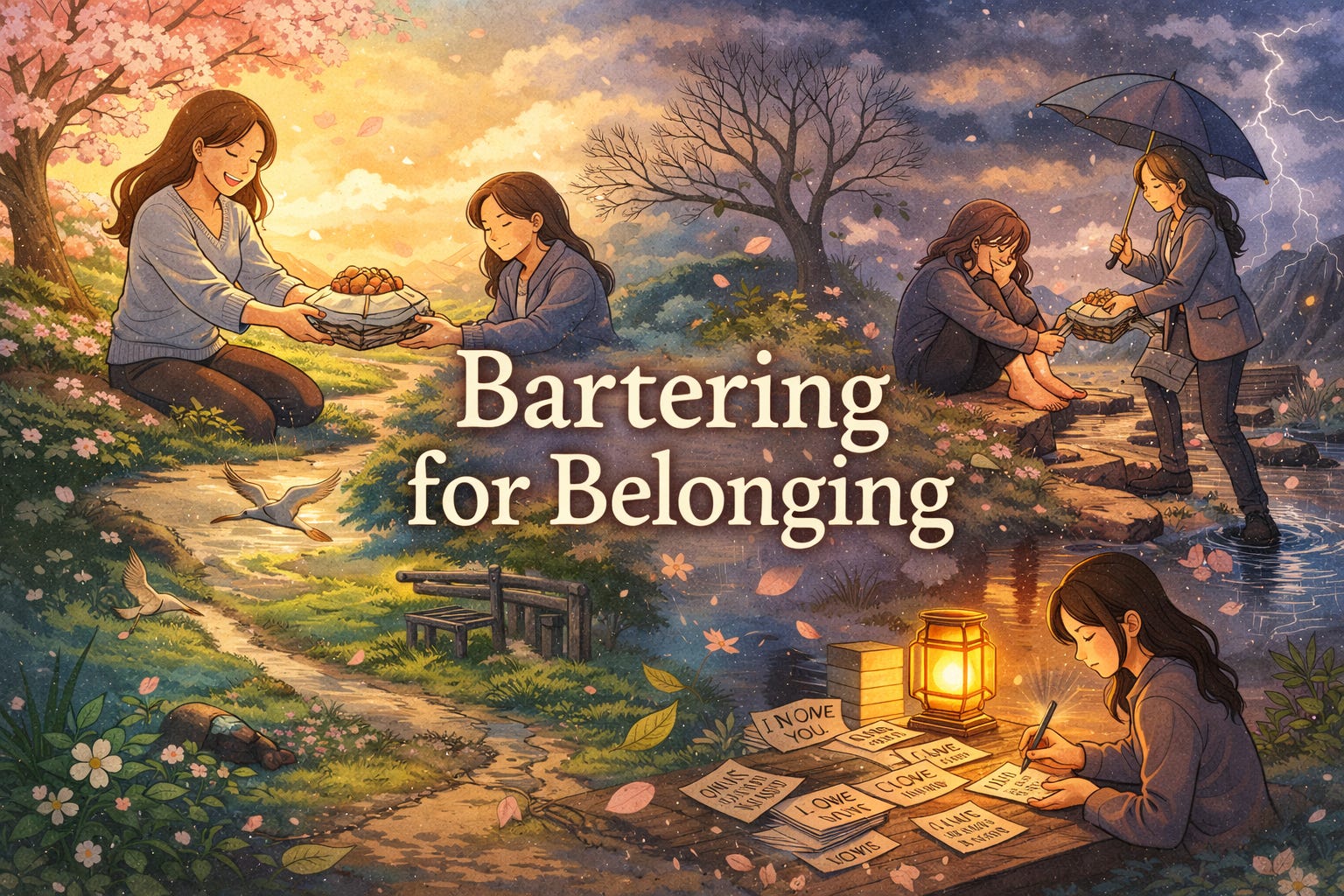
Reclaiming Self-Worth and Ending the Emotional Debt Cycle
Have you ever given so much of yourself that you began to disappear? Not because someone took advantage of you, but because somewhere deep inside, your Inner Child believed that love needed to be bought and kept on a retainer. That your goodness was something to be earned. That your value must be paid for, again and again, or else it would expire. Perhaps you’ve caught yourself saying “yes” when every part of your Shen whispered “no.” Maybe you’ve swallowed your truth, buried your discomfort, or quieted your joy to avoid the fear of rejection. And in return, you’ve felt no connection, but quiet depletion.
This journal post is for those of us who have unknowingly entered into an emotional trade agreement: exchanging our truth, time, and worth for belonging that was never meant to be conditional. Together, we’ll trace how this emotional barter system began, how it still plays out in our relationships today, and how we can step out of it, not by becoming hardened or guarded, but by returning to Shen alignment and the effortless flow of wu wei.
We will ask the question: “What if we were never supposed to pay for love?” and gently explore the Taoist wisdom that leads us back to the truth. You were never for sale. And you owe no one your Spirit.
The Inner Child’s Emotional Economy
The heart of this pattern lies not in manipulation or weakness, but in survival. Our Inner Child, still operating through emotional logic rather than spiritual clarity, sees the world through a narrow lens of need, safety, and approval. It nags, criticises, harangues, and badgers, not because it is cruel, but because it’s convinced that to be loved, it must first be worthy. And to be worthy, it must give something in return. This is how we begin to barter, not with intention, but through inherited misunderstanding.
Many of us were taught, explicitly or silently, that love was not unconditional. Perhaps we were praised when we were quiet, punished when we asked for too much, rewarded when we pleased others, and ignored when we expressed our needs. These early lessons write themselves into our emotional script, and before we realise it, we are living according to their rules.
And here is how that script tightens its grip: those early “letters” do not remain simple memories; they become the sentences we repeat inside. The sentences become beliefs, and our beliefs create even more intense emotions, until we are caught in the ‘Carousel of Despair’: the same fear, the same doubt, the same self-abandoning loop, spinning faster because it is familiar. Our Inner Child clings to familiarity over the unknown, even when the familiar hurts, because at least it is predictable. It is like walking the same worn path through a forest at night: it may lead nowhere new, but we know where the roots are, so we keep choosing it.
The counter truth is gentle and freeing: familiarity is not the same as truth. A belief can be old, loud, and well practised, and still be untrue. When we see that the script was learned, not destined, we regain choice. We can begin to write a new line, one honest sentence at a time: “My needs are not too much.” “Love does not have to be earned.” “I can stay with myself, even when others do not.” And each time we choose that, we step off the carousel, and we guide our Inner Child toward a new kind of familiarity, the steady safety of our own integrity.
We can begin to understand that from that old script, a very specific strategy often grows: we have been trying to ‘earn’ what was always meant to be freely given. We trade our joy for stability, our truth for approval, and our boundaries for connection. We become emotional merchants, offering whatever seems required to stay liked, needed, or “safe.” Underneath the helpful smile is a tender fear our Inner Child may not know how to name yet: ‘Please do not stop loving me, because if you do, I might disappear, or die!’
So, we give, and give, and give, not as a celebration of our fullness, but as a bargain for worth. Yet love cannot be earned, and value is not a payment we receive for good behaviour; it is innate. When we give from the belief that we must purchase belonging, our giving turns into a quiet transaction: “I will meet your needs, so you will not reject or leave.” And when giving becomes a trade, it starts to carry invisible strings, not because we are bad, but because the belief underneath is flawed. We are not offering generosity; we are offering proof. And proof is exhausting, because it can never finally satisfy a needy Inner Child that is still waiting for permission to simply be enough.
Emotional IOUs and the Illusion of Debt
This is where the emotional economy quietly builds. Without realising it, we keep invisible ledgers. We offer support, time, patience, love, care, and we wait for repayment. Maybe not directly. Maybe not even consciously. But our Inner Child is keeping score. “After all I’ve done.” “They never say thank you.” “I just want to be seen.”
These are not unkind thoughts. They are signals. Proof that our giving was not aligned; it was an exchange. One that our Inner Child hoped would prove our worth and secure our place. But here’s the most painful part: we are not just lending to others. We are borrowing from ourselves. From our future peace. From our energy. From our Shen. We are giving what we don’t have, and expecting it to be somehow refilled by others who never agreed to repay us. This is why the exhaustion sets in. This is why resentment grows: we are living on borrowed love.
A client once shared, “I bought what my mother sold to me. Then I sold what I had to keep paying for what I bought. I started borrowing from my future. And now there’s nothing left to give.” This is the essence of ‘Bartering for Belonging’. A silent trade. A system where nobody is truly nourished. And yet we stay in it, hoping the next offering will finally be enough. But it never is.
The Tao Does Not Trade
The Tao is not an economy. It is not an exchange. It is a river, a breath, an unforced rhythm. It gives not from obligation, but because that is its nature. It is never empty because it never hoards. Verse 81 of the Tao Te Ching tells us: “The Tao does not accumulate. The more it gives, the more it has. The more it does for others, the more it is fulfilled.” When we live from Shen, we give differently. We speak honestly. We say “no” with peace and love. We offer what is true, not what is manipulated to keep others close. In Shen alignment, our giving is whole. And because it is entire, it has no expectation attached.
This is the gift of wu wei. Effortless effort. Acting from flow, not from fear. No more emotional I.O.U’s. No more silent hopes that someone will finally see how much we’ve done. No more self-abandonment disguised as kindness. But to reach this alignment, we must recognise who is speaking inside of us. When we say, “I want,” are we talking from clarity or from desperation? When we say, “I’d like,” are we naming a desire or shifting the responsibility? Even language reveals our beliefs. The I Ching, in Hexagram 40, “Deliverance,” offers a crucial insight: “Release begins when the burden is recognised. When the debt is named, the path clears.” To step out of emotional trading, we must first name the false belief: “I owe others my worth.” And then we must gently and consistently choose not to pay.
Returning to Shen: Giving Without Expectation
This shift is not a dramatic confrontation. It is a quiet realignment. The next time you notice resentment creeping in after you give, pause. Ask: “Was I giving freely, or was I hoping to receive something back?” When you find yourself depleted after being generous, ask: “Was this mine to give? Or was I borrowing from my future again?” And when your Inner Child badgers you with urgency, “They’ll leave if I don’t help!” or “They’ll be angry if I say no!” take a breath and remind it: “We are not for sale. We never were.”
This practice is gentle but powerful. Each time you give only what is yours to offer, you build self-trust. Each time you say no without guilt, you tell your Inner Child: “We’re already enough”. Each time you let someone down while staying aligned with the truth, you realign with the Tao. Shen does not ask you to abandon others. It asks you to stop abandoning yourself. There will be discomfort. There may be pushback. Especially from parts of you that still believe safety comes from being needed. But the Tao flows around resistance. It does not force. It does not cling. It invites.
In time, you will notice your giving has changed. You will still be kind, but not at your own expense. You will still help, but only when your Shen spirit agrees. You will still love, but not in exchange for love in return. You will stop bartering. And you will start becoming.
The End of the Ledger
We began with the question: “Why do I give so much and still feel empty?” The answer was waiting in the hidden belief system of our Inner Child: that worth must be earned, love must be kept through action, and peace must be paid for. But now we know differently.
In ‘Bartering for Belonging’, we’ve uncovered how that economy began, how it keeps us in a cycle of emotional depletion, and how the Tao invites us into something far richer: ‘effortless effort, aligned giving, and worth that does not depend on anyone’s response.’
Let this be your invitation. A new belief to plant in the space where the old one once ruled: “I owe no one for my Shen spirit, my worth and value are already mine. I do not trade my truth for acceptance. I give only what is mine to give.” This is the soft, sure power of Shen. No more ledgers. No more I.O.U’s. Just alignment, rhythm, clarity, and freedom.
When we stop bartering, we remember: we were never empty or broken. We were only temporarily convinced that love had a price. Now we choose to give without cost. To be without apology. And to belong, not to others, but to ourselves.
A Closing Reflection and Invitation
If there is one thing to carry forward from this journal post, let it be this: ‘your truth is not a transaction. Your worth does not need to be earned. Your Spirit does not exist on a payment plan. You are already enough.’
Let us step forward now, not with perfection, but with intention. Small, consistent movements. No Criticism, Comparing or being Judgmental (CCJ). Just honesty. Clarity. Stillness. One aligned breath at a time.
Affirm this now: “I give only what is mine to give. I expect nothing in return. I walk in truth, and that is more than enough.” You never needed to buy love, value or worth. It was never outside you. It was never theirs to give. It was always yours to embrace. This is Oneness, this is the Tao.
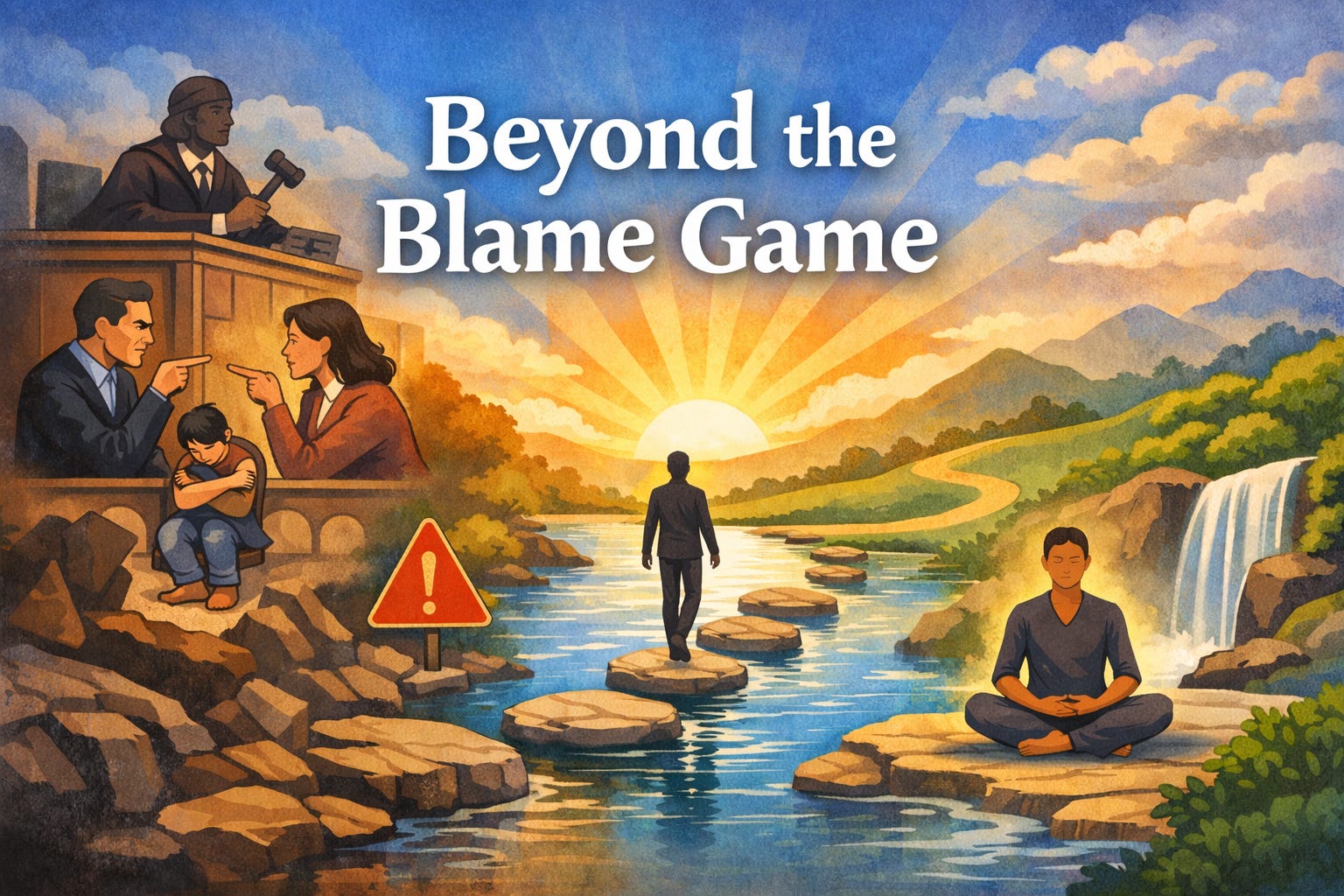
When the blame game becomes our default, life narrows into villains, victims, and endless replays. In this journal post, we will step beyond the courtroom in our minds, reparent our Inner Child’s ‘it’s not fair’ protest, and return to wu wei, effortless effort: the kind of action that restores truth, calm, and authenticity.
What if blame was never the medicine?
Have we ever replayed a conversation so many times that it starts to sound like a closing argument? Have we ever decided, even quietly, “If they would just admit it, I could finally relax”? Have we ever blamed ourselves so harshly that it seemed like punishment might somehow undo the past? And have we noticed how blame can give us a strange kind of energy, as if anger is keeping us upright, even while it drains our Shen spirituality in the background?
Blame can seem like a tool for justice, but most of the time it serves more as a misguided shortcut to the illusion of certainty. It offers a quick storyline: someone is wrong, someone is right, someone is guilty, someone is innocent. Our Inner Child mind loves this type of game because it reduces complexity. It also promises another illusion of safety: “If we can locate the problem, we can control the outcome.”
Yet this is where the confusion begins: blame rarely fixes anything. It can make our reactions seem “right” for a moment, but it doesn’t change what happened. It can point a finger at someone, but it doesn’t show us what to do next. Blame is like pressing replay on the same scene again and again. We go back to the same moment, the same words, the same emotional sting, hoping that thinking about it more deeply will lead to a better ending. But the ending never changes, because replaying the past can’t rewrite it. So, what if blame was never the answer? What if blame is simply a signal, like a warning light, telling us something inside is out of balance and asking for dignity, calm, and flow? Often, our “little one” can’t yet explain it in mature or spiritual words, so it reaches for the easiest tool it knows: blame. But the wiser path is to pause and ask, “What is this really teaching me, and what would bring me back into balance?”
This is the shift we are making together. We are not condemning blame; we are understanding it. We are not forcing forgiveness; we are choosing acceptance and alignment. We are not pretending harm did not happen; we are learning how to respond without turning our lives into an inner courtroom. In Taoist terms, blame is often what happens when we forget wu wei, effortless effort, and try to force a verdict instead of returning to clarity and flow. When we act from wu wei, we still take action. We still set boundaries. We still speak the truth. But we do it without the frantic, punishing energy of needing someone to pay!
Blame is the Inner Courtroom
Blame can seem almost instinctive. We blame others when we are hurt, frustrated, or overwhelmed. We blame ourselves when things go wrong, when relationships falter, or when we fall short. Yet beneath the surface, blame is rarely about truth; it is about attack or defence. Blame is one of the quickest forms of CCJ, Criticism, Comparing, and being Judgmental, because the moment we blame, we usually turn someone into “the problem,” and we turn ourselves into either “the victim” or “not enough.” Either way, our story shrinks into win or lose, right or wrong, superior or rejected.
What is quietly driving this? Very often, it is our Inner Child’s protest against inner unfairness, because life doesn’t always go the way we believe it should. This matters because inner unfairness is not the same thing as the flow of reality. Inner unfairness is the emotional memory of not being understood, not being protected, being blamed unfairly, being shamed, or being required to carry what we could not carry. When life echoes that old pattern, even slightly, our Inner Child rises with the familiar cry: “It’s not fair,” which, in most cases, really means, “It’s not the way I want it to be, or the way I think it should be.”
And here is the twist: our Inner Child does not just want fairness. It wants a guarantee that the old pain will not happen again. That is why it seeks blame. Blame creates a simple map: “If they are the problem, we can avoid them. If we are the problem, we can perfect ourselves. Either way, we can prevent rejection.” This is not wisdom; it is a false protection. Our work is not to attack this part of us. Our work is to re-educate it.
Emotional Logic
In our teachings, we talk about emotional logic, our Inner Child’s way of making meaning. Emotional logic is not stupid; it is survival-based. It was formed when we were too young to process complexity, and it learned to scan for danger, interpret tone, and predict outcomes with whatever tools were available.
Emotional logic says, “If they disagree with us, we are unsafe.” “If they leave, we are unworthy.” “If this happened, someone must pay.” “If it’s unfair, then we must fight.” This is why blame often arrives with urgency. It is trying to restore safety by restoring control. But life does not obey emotional logic. And the Tao does not bend to our need to prosecute. When we seek control, we are already out of balance. The river flows not by force, but by alignment with the land.
When we blame, we are often trying to force life to match our inner contract: “Life must be fair in the way I need it to be, right now, or I cannot relax.” The Tao invites a wiser contract: “Life will move, change, and challenge us, and we can remain aligned with truth, honesty, and integrity.” The hidden cost of blame: it gives away our power! Blame is seductive because it offers relief. It gives us a villain, a storyline, a reason. It can even make us seem morally upright. But underneath, it quietly hands our peace to someone else. ‘If they must apologise for us to be free, then our freedom is outsourced. If they must change for us to be okay, then our well-being is negotiated. If we must be perfect to avoid blame, then our life becomes a performance.’
This is why blame often leads to one of two prisons: 1) The prison of resentment: we keep holding the case open. 2) The prison of self-attack: we become our own prosecutor. Both are exhausting. Both are misaligned. And both keep our Inner Child in charge of the steering wheel.
Inner unfairness
Inner unfairness is the emotional imprint of being treated as if we were the problem when we were not. Many of us were blamed as children for adults’ stress, moods, or limitations. Some of us were punished for our emotions. Some of us were compared. Some of us were expected to be “mature” before our time. Some of us were made responsible for harmony in the home. So, later, when life brings disappointment, misunderstanding, or betrayal, our Inner Child does not only respond to the present moment. It responds to the entire history. It reacts as if the old unfairness is happening again.
This is why blame can seem disproportionate. The intensity is not only about today. It is about the echo. This is the moment our Inner Child insists that emotions originate from outside sources, saying things like “They made me feel worthless” or “They ruined my day.” The deeper truth is that emotions rise from our beliefs, thoughts, interpretations, and perceptions. When the belief underneath is “Life is unfair to us, and it always will be,” then blame becomes an automatic protest. So, the healing question is not: “Who is wrong?” It is: “What belief is being activated right now, and what is it trying to protect?”
Responsibility is not Punishment.
One reason we cling to blame is that we confuse responsibility with punishment. Our Inner Child learned early that being “at fault” could mean shame, rejection, withdrawal of love, or humiliation. So, it panics around accountability. It either deflects responsibility outward or collapses under it inward. But responsibility, when rooted in love, is liberation. Responsibility says: “We can be honest without attacking. We can own our part without collapsing. We can choose our next step with clarity.”
This is where we return to Shen, and to what we call ‘The Power of Three’: truth, honesty, and integrity. When we speak from Shen, we are not trying to win. We are trying to align and flow. In a previous journal post, ‘Awakening Accountability’, we affirmed: ‘We are the architects of our emotions, the shapers of our realities, and the keepers of our spirit’s integrity.’ This is not a motivational line. It is a compass. When we remember this, blame begins to lose its grip. Because we stop asking, “Who caused this emotion?” and instead ask, “What belief created this emotion, and does it match who we are today?” That is maturity. That is spiritual freedom.
Wu wei is often misunderstood as doing nothing. In our work, we define wu wei clearly as effortless effort: action without forcing, clarity without aggression, boundaries without bitterness. Blame is a forced effort. It is pushing against reality, rehearsing the past, demanding a different outcome. Wu wei is aligned effort. It asks: “What is true? What is ours to own? What is not ours to carry? What is the next authentic step?” Wu wei does not ask us to tolerate disrespect. Wu wei helps us respond without poisoning ourselves.
Here is a practice we can use immediately. We call it the ‘Golden Thread Process,’ tracing emotions back to their root beliefs. When blame arises, we pause and ask: “What emotion is here right now? What belief is creating this emotion? Where did we learn this belief? Does this belief match our adult truth today? What would Shen say instead?” This is where we move from emotional logic to spiritual clarity, not by correcting or blaming our Inner Child, but by teaching it patiently and lovingly. We are not trying to silence our Inner Child. We are trying to lead it in balance and flow.
The Blame Detox: four steps that actually work
Blame is a habitual choice. It becomes strongest when we are stressed, threatened, or exhausted. So, we need a simple detox process we can repeat.
Step 1: Name the red light emotion.
Resist calling the emotion anger, resentment, bitterness, shame, or anxiety. Instead, “This is a red-light emotion I am creating. What belief is creating it?”
Step 2: Identify the inner unfairness script.
Is the Inner Child saying, “It’s not fair”? If so, we respond like a loving parent: “I hear you. Something about this is touching an old place; let’s investigate together.”
Step 3: Choose responsibility, not guilt.
Responsibility says, “We can act wisely from here.” Guilt says, “We must suffer to prove we care.” Responsibility is liberation; hold your ‘little ones’ hand and walk the path to freedom together.
Step 4: Set a boundary that matches our Shen.
A boundary is not a punishment. It is a statement of alignment. “We choose not to participate in this misaligned pattern anymore.” “We are available for respectful conversation.” “We are stepping back until clarity returns.”
This is how we stop feeding blame without denying reality. Wu wei flow often begins when we become the loving carer we never had. This is not sentimental. It is practical. It means we stop parenting ourselves with ridicule and start parenting ourselves with calm authority. When blame rises, we do not shame ourselves for it. We say, “I see why you are angry.” “I understand why you want fairness.” “I am here now.” “We will protect ourselves without destroying ourselves.” That is the voice that disarms emotional logic. Because emotional logic is not transformed by argument, it is transformed by honesty, consistency, and truth.
When we are caught in blame, we often think we need a massive breakthrough. The Tao teaches something gentler. In Verse 64, it reminds us: ‘A tree that fills a man’s embrace grows from a tiny shoot. A nine-story tower starts with a heap of earth. The journey of a thousand miles begins beneath your feet.’ This is how we return to alignment, one small step at a time. ‘One honest admission. One boundary spoken cleanly. One belief is honestly questioned. One moment of choosing calm over the courtroom.’
Reclaiming our Peace from the Blame Game
If we return to our opening questions, we can answer them with honesty. Yes, we have blamed. Yes, we have replayed. Yes, we have tried to prosecute the past. And yes, we have hoped that someone else’s admission of fault would finally vindicate us and make us safe. But now we know something deeper.
The blame game is often our Inner Child’s protest against inner unfairness, the old ‘it’s not fair’ echo that longs for protection and validation. Our job is not to shame that echo. Our job is to guide it. We do that by remembering: we create our emotions through the beliefs we adopt, and we can rewrite those beliefs with truth, honesty, and integrity. We do that by practising wu wei, the aligned step that protects us without poisoning us. We do that by choosing boundaries instead of verdicts, responsibility instead of guilt, and Shen instead of the inner courtroom.
We do not wait for the perfect apology. We do not demand a rewritten past. We begin beneath our feet, right here, where our spirit is already strong enough to lead. And we remember the words of our sacred teachings: ‘We are the architects of our emotions, the shapers of our realities, and the keepers of our spirit’s integrity.’
Let us release the verdict and go ‘Beyond the Blame Game,’ not because nothing mattered, but because our peace and Shen spirituality matter more. Let us move forward with clarity, with courage, and with the quiet power of effortless effort.
Moments of Inspiration…
When Expectations Collide with Reality
Expectation is a quiet contract we write in our mind: ‘Life should go like this.’ Reality rarely signs it. Most of our stress isn’t created by what happens. It’s created by the gap between what happens and what we believe ‘should’ happen. Expectation says, “If they understand me, I can relax.” Reality says, “They might not.” Expectation says, “This plan will protect me.” Reality says, “Life moves in uncertainty.”
This is where our Inner Child often steps forward. Not because it is weak, but because it remembers old unresolved issues: being misunderstood, overlooked, blamed, or made responsible for what was never ours to carry. So when life doesn’t match the inner script, the protest rises: “It’s not fair.” Underneath, it often means: “I can’t trust this.”
Wu wei offers a different way. Not passive. Not resigned. Simply aligned. We release the demand that reality must cooperate with our preference, and we return to what we can govern: our beliefs, our boundaries, our next honest step. Shen doesn’t argue with the river; it learns its current, then moves with dignity and flow.
Try this today: name one expectation you’re gripping. Then replace it with a wiser sentence: “Reality is here. I can meet it with ‘The Power of Three:’ truth, honesty, and integrity.” That’s not giving up. That’s coming home.
Affirm: “I release the fantasy of 'should,' and I choose alignment, clarity, and calm action.”
In the Next ‘Inner Circle’ (Paid) Journal…
Lantern in the Fog
The Space Beyond Roles
Signal to Stillness
Moments of Inspiration
In the Next Free Journal…
The Gentle Why
Sovereign Space
Moments of Inspiration
Journal #F070 02/03/2026
Contact: info@wuweiwisdom.com
Website: www.wuweiwisdom.com
YouTube: www.youtube.com/user/WuWeiWisdom
Facebook Community: www.facebook.com/groups/wuweiwisdomcommunity/