
Shifting the Story
This week we look at creating new perceptions, explore the stillness before movement and how softness can be our greatest strength. Finally listening to the Inner Child's stories.

If a part of you still whispers, “It will never change,” let this be the moment you listen deeper, not to the fear, but to the quiet truth that change is life itself. As we learn to speak love to the frightened parts within, a new story begins, one of soft courage, sacred becoming, and a spirit aligned with the gentle rhythm of the Tao."

Have you ever caught yourself muttering, “It will never change,” under your breath or quietly thinking it when life feels stagnant or unfair? That small sentence might sound harmless, even reasonable, but it holds a heavy mistruth; it’s the story our Inner Child has been telling itself for years. Maybe decades. It’s a belief forged in moments of helplessness, when circumstances spiralled beyond our control, and we clung to something, anything, that gave us a sense of order, even if that order was rooted in disappointment.
This journal post is about gently unravelling that story, understanding where it began, why it persists, and how we can shift it. We’ll explore how Taoist wisdom and the principle of wu wei, effortless effort, can guide us away from internal resistance and toward authentic transformation. We’ll delve into the deeper layers of belief and explore why change doesn’t stem from willpower or self-punishment, but rather from self-awareness, acceptance, and alignment with the natural rhythm of life. Most importantly, we’ll learn how to lovingly reassure the Inner Child that it’s safe to hope again and time to stop fighting but start flowing.
The Inner Child’s Narrative of Safety
That voice inside that pressures us to lower our expectations or to prepare for disappointment isn’t our enemy; it’s our Inner Child trying to shield us from perceived repeated emotional pain. This part of us believes it’s safer to expect little than to be hurt again. It can pester us with old, familiar phrases: “Don’t get your hopes up. Nothing ever changes. What’s the point in trying?” These aren't just thoughts, they’re emotional artefacts of unresolved issues, the echoes of a time when we honestly didn’t have the tools or permission to believe otherwise.
In Taoist teaching, there is a great reverence for natural cycles. Nothing stays the same. The river never flows the same way twice. The leaves never return in quite the same pattern each spring. But our Inner Child, traumatised by disappointment, fears this natural change because it interprets unpredictability as danger. So, it chooses stagnation over possibility. The comfort of the known, even if unsuccessful, seems more bearable than the uncertainty of what might be. This is where the mantra “better the devil you know” often arises.
But just because we believe this story once protected us doesn’t mean it still serves us. It may now be the very thing keeping us stuck. What we need is not to punish ourselves for believing this voice but to begin listening to it differently. To recognise it not as our truth but as an old script we are no longer bound to perform.
Beliefs Are Not Set in Stone
A powerful truth taught from Wu Wei Wisdom reminds us that beliefs are not permanent fixtures; they are flexible, fluid, and often formed without conscious thought. They are conclusions drawn in moments of intensity, stitched together from emotions rather than clarity and truth. And here’s the critical teaching: ‘We change some of our beliefs every day.’ Sometimes, without even noticing. When we realise this, we reclaim a tremendous power, the power to choose new beliefs that align with our spirit, not our past.
This is where the Golden Thread Process becomes invaluable. It invites us to trace each emotional reaction, especially the red-light feelings of resistance or hopelessness, back to the underlying belief that gives rise to them. We ask ourselves a brave and straightforward question: “What do I believe, and why do I believe it?” Often, this question reveals outdated and reactive beliefs inherited from early emotional conditioning. Yet, identifying them is only part of the path. The deeper work lies in accepting that we, at one point, chose to believe them for our safety. And now, with compassion and courage, we can choose differently.
As we often say in our practice, “We cannot change what we don’t understand and accept.” Our Inner Child resists acceptance because it equates acknowledgement with failure and self-responsibility. It believes that recognising what went wrong makes it responsible for the pain. Yet, true acceptance is not about blame; it’s about understanding. It’s about seeing clearly what was, so we can finally step into what is possible.
But we must also remember that our Inner Child tends to see the world through a lens of extremes. Right or wrong. Good or bad. Win or lose. In this rigid framework, acceptance seems like a judgment; it creates fears that to accept something is to admit it was wrong, and therefore, to be wrong itself. That fear of being shamed or blamed becomes a powerful emotional blockade. Our Inner Child, still operating from the logic of a child, has likely spent years trying to protect itself from this feeling by shifting responsibility, either outward onto others or inward in self-blame. Neither brings peace, and increases the emotional feelings.
This is a crucial moment of reparenting. Not as we may have experienced parenting in the past, marked by criticism or demands for perfection, but with a new approach, grounded in love, compassion, and clarity. This is where we become the calm, steady presence our Inner Child never knew it needed. When our Inner Child believes it will be scorned, humiliated, or made to feel small, we must reassure it that there is no punishment in truth. There is only understanding.
Imagine our Inner Child as a small, frightened animal hiding beneath a bed, eyes wide, trembling at the sound of footsteps. It has been said before that being wrong can lead to rejection. But now, instead of storms of anger or the chill of silence, it hears something new, a quiet voice that says, “You are safe. You are loved. And we’re going to work through this together.” That voice is the mature you. That is the beginning of emotional honesty and the power of re-parenting.
When we step into this gentle alignment with our Inner Child, we no longer force change; we allow it. We accept the past not as a failure, but as part of our sacred becoming. In doing so, we reframe acceptance not as surrendering to guilt, but as stepping into wisdom. And from that wisdom, actual change begins to unfold softly, quietly, and with grace.
Aligning with Change
To walk in alignment with change is to walk with the Tao. Change is not a disruption; it is the very rhythm of life. When we resist it, we exhaust ourselves. When we trust it, we flourish. In the Tao Te Ching, Verse 63 reminds us: “Act without striving; accomplish without forcing; find greatness in small things.” This verse teaches that lasting transformation doesn't arrive in grand leaps, but through quiet consistency and faith in the process. It whispers to us that we are not broken and in need of fixing; we are evolving, and this moment of discomfort is simply a turning point.
We must begin to see change not as something foreign and frightening, but as our natural state of being. Think of how many times your life has already changed. Reflect on moments where you believed you couldn’t go on, but did. Remember a time when something ended, painfully or abruptly, and you later realised it opened a door you never saw coming. These are not coincidences; they are the lived truth that change is not only possible but essential.
Visualising change can also be a powerful tool. Instead of bracing for loss or uncertainty, we learn to imagine the version of ourselves that has allowed growth. What would it feel like to release an old pattern? How would we speak, act, and live differently if we weren’t afraid of change, but aligned with it? In this state, we begin to trust that life doesn’t take from us; it evolves with us.
Compassionate Reassurance for our Inner Child
Still, our Inner Child won’t release these fears overnight. We must become compassionate mentors, firm yet gentle, consistent yet kind. We show our Inner Child through evidence, not pressure. We begin to highlight all the ways things have changed, however small. We collect these moments like treasures, building a new case against the old belief that “it will never change.” And this is vital, because our Inner Child clings not to what is right or successful, but to what is familiar. It holds tight to the known, even when that knowing is painful or limiting, simply because it knows it. It prefers the certainty of discomfort over the unknown potential of growth. But here’s the more profound wisdom: we live in a universe of change. Everything moves, shifts, evolves. So, we gently guide our Inner Child to witness this movement, not with pressure, but with love, truth, honesty, and integrity. Over time, these truths become more familiar than the old fears. With enough loving evidence, our Inner Child begins to loosen its grip, step forward, and trust the flow of life. And in that space, fundamental transformation begins.
We begin to highlight all the ways things have changed, however small. We collect these moments like treasures, building a new case against the old belief that “it will never change.”
We don’t argue with our Inner Child; we reassure it. We say things like: “Yes, things can change. You’ve seen it happen. It’s safe to try again.” We speak not from a place of force or belittling, but of love. And this love must extend to ourselves as well. We cannot berate ourselves into transformation. We can only grow from self-compassion.
There’s a beautiful passage from the I Ching, Hexagram 32, which offers profound insight here: “Perseverance furthers. Thunder and wind: the image of duration. Thus, the sage stands firm and does not change direction.” This doesn’t mean we resist movement; it means we root ourselves in integrity, clarity, and quiet trust as the world shifts around and within us. That’s the real definition of transformation: staying grounded in truth, honesty and integrity while letting the old story dissolve.
A New Way Forward
The path forward does not require dramatic action. It asks for stillness, reflection, and a willingness to try again. It asks us to observe our reactions without criticism, comparison, or judgment (CCJ). We might feel the resistance rising. We might hear our Inner Child's nagging or reproaches. But now, we respond differently. We pause. We acknowledge. And we choose the path of alignment.
Alignment with the Tao is never forced. It’s not about becoming someone else. It’s about remembering who we’ve always been underneath the noise of fear. Our Shen, our spirit, is untouched by the past. It is the unbroken, radiant truth of who we are. And every act of compassion, reflection, and honesty brings us closer to living from that truth.
We don’t need to know exactly where this path leads. The Tao doesn’t ask for guarantees. It simply invites us to step forward in trust, one moment at a time. As we do, we realise that we are not waiting for life to change; we are the change itself. We are the breath, the wave, the unfolding.
Shifting the Story Begins Now
This journey, ‘Shifting the Story’, isn’t about becoming perfect. It’s about becoming aligned. It’s about realising that the story we once believed was survival is no longer the one we need to live by. It’s about seeing our Inner Child not as a burden, but as a part of us waiting to be lovingly guided home.
We are not powerless. We are not stuck. We are not broken. We are evolving. And the beliefs we once held, those shaped by fear and repetition, can be rewritten with understanding and love. The Tao never asks us to be fearless. It asks us to be present. It asks us to be real. And it teaches us that in the dance of change, we are never alone.
Let us move gently, taking small, consistent, and manageable steps. Let us release expectations and the heavy burden of CCJ. Let us remember that within every moment of discomfort is an invitation to realign. Let us honour the truth that change is not the end, it is the beginning.
From this moment forward, may we choose to believe in possibility. May we speak new truths to our Inner Child? May we allow ‘Shifting the Story’ to be more than a title; it becomes the way we live, one breath, one step, one compassionate choice at a time.
Have you ever sat on the edge of doing something important, starting a new chapter in your life, taking a risk, or even completing a simple task, only to find yourself paralysed? You tell yourself you'll begin tomorrow. You need more time. You need to feel more ready. But days pass, sometimes years, and the thing that mattered so much remains untouched.
This journal post is for those of us who feel trapped by procrastination and perfectionism. We’ll explore how these behaviours often originate not from laziness or poor time management, but from deeper, hidden beliefs—beliefs born in childhood, nurtured by doubt, and protected by fear. Together, we’ll uncover how wu wei guides us toward action not by force, but by authentic alignment. And how valuing our Shen, our inner spirit, can free us from the traps of unrealistic standards and self-sabotage. This is not a battle plan. It’s a journey of return to truth, to worth, to ‘The Stillness Before Action’.
The Inner Struggle Behind Delay
Procrastination isn’t just avoidance; it’s the result of an emotional tug-of-war that no one wins. One part of us wants to act, to achieve, to feel the satisfaction of completion. But another part, often our Inner Child, fears criticism, rejection, or not being good enough. This internal conflict creates paralysis. We want the outcome, but dread the vulnerability that action might expose.
Perfectionism amplifies this paralysis. It sets impossibly high standards that make any step forward seem doomed to fail. In our wu wei teachings, we call this cycle the ‘Carousel of Despair’, where you spin endlessly between not-starting, overthinking, blaming yourself, and retreating. Our Inner Child, trying desperately to protect itself, will nag and harangue: “If it’s not perfect, you’ll be judged. Don’t even try, you’ll fail.”
But procrastination isn’t a character flaw. It’s a misaligned coping strategy. It’s a false belief protecting us from what we think will hurt. Yet ironically, it creates the very pain it’s trying to prevent: guilt, stagnation, disappointment. Taoism teaches us that resisting our natural flow is what creates imbalance. When we’re in alignment, even the smallest actions carry the power of change.
Perfectionism, Comparison and the False Promise of “Good Enough”
Much of procrastination and perfectionism is rooted in comparison. Somewhere along the way, we learned to measure our value against others. As children, we may have only received praise when we excelled or only felt loved when we met someone else’s expectations. Our Inner Child learned that worth is earned, not inherent. So, we started chasing perfection, hoping it would guarantee acceptance.
But the Tao shows us another way. It teaches us that our value is not conditional. We don’t have to become more, do more, or prove more. Our Shen spirit is already complete. We are not here to compete or conform, but to align with our unique rhythm. As Hexagram 52 from the I Ching reveals: “Keeping still, like a mountain. When stillness is maintained in the heart, the self aligns with the Tao.” Stillness doesn’t mean doing nothing. It means doing without fear. From this place, action is natural, not forced.
Comparing ourselves to others distorts our view of what matters. Our Inner Child may urge us to be the best in the world, to outshine and outperform. However, excellence achieved out of fear is brittle. What if instead, we chose authenticity over applause? What if the goal was alignment, not perfection?
Procrastination as Identity and the Role of Self-Talk
Over time, procrastination can become part of our identity. We might say, “I’ve always been like this,” or “I’m just not good at finishing things.” These statements seem harmless, but they shape our self-image. And what we believe about ourselves becomes how we live our lives.
Much of this self-identity was formed in childhood. If we were only praised for achievements or criticised for falling short, we learned to link our value to outcomes. This belief follows us into adulthood, where tasks are no longer just tasks; they become verdicts on our worth.
Parenting techniques that emphasised conditional love may have left deep impressions on our Inner Child. We may have learned that love and attention were earned through excellence, obedience, or silence. These teachings can leave behind unresolved issues that manifest as perfectionism and procrastination.
To change this narrative, we must transform beliefs and our self-talk. The voice we use with ourselves matters deeply. In Wu Wei Wisdom, we refer to this process as the Golden Thread Process, a practice of self-inquiry grounded in honesty, integrity, and truth. Instead of repeating “I can’t do this,” we begin to ask: “Why do I believe I can’t?” Instead of declaring, “I’ll never be good enough,” we pause and ask: “Who told me that, and why do I still believe them?” This slight detour in your thought process is the stillness we are seeking.
Each question becomes a step off the carousel, a gentle yet deliberate movement away from the dizzying repetition of old emotional habits and toward a place of grounded awareness. Each time we ask “Why?” with curiosity rather than judgment, we place our foot firmly on the path back to ourselves. Every honest answer becomes a torchlight guiding us through the fog of conditioned reactions. With time, the frantic spin of self-doubt and knee-jerk responses begins to slow. We no longer need to resist or suppress what arises within us. We begin to listen, not to the noise of the world or the echo of old criticisms, but to the quiet, wise voice within. This is our Sage speaking, the spiritual part of us that has always known the way but has waited patiently for our attention.
And this is where we can begin to discover stillness, not as an abstract ideal but as a tangible experience. Right now, simply as you read these words, allow yourself a breath. Drop your shoulders. Let that breath take you downward, into yourself. Ask gently: “Where are these thoughts, these statements, these questions coming from?” Do they arrive like darts from outside you, echoing a critical or comparing voice that feels foreign, even hostile? Or do they arise from a softer place deep within, from a place of integrity, truth, and inner knowing? This moment of awareness, this breath, is the beginning of wu wei, the effortless effort of returning to your centre.
Here, in the pause before reaction, is where true transformation begins. This is ‘The Stillness Before Action’. It may only last a heartbeat, but it is enough. And as we practise this more often, that stillness becomes accessible, like reaching into a pocket and finding calm. It is not stillness as avoidance, nor is it stillness as delay; it is stillness as alignment. From this space, we no longer react impulsively to emotions we have unknowingly created. Instead, we respond proactively from the Shen spirit, connected, balanced, and wise. Decisions made from this place are characterised by clarity, kindness, and strength.
Of course, there will be moments when the carousel calls us back, especially in the face of procrastination, when inaction feels like safety and movement like risk. But even procrastination can be a teacher. It shows us where fear disguises itself as indecision. It reveals where our Inner Child may still be afraid to take the next step. And so, we treat it not with shame, but with softness. We ask again: “What am I truly avoiding?” “What am I believing in this moment?” We step off, even if just slightly, and listen again.
Imagine standing in a river. If you fight against a strong current, it overpowers you. But if you stand still, rooted, you begin to feel its flow around you. You are not drowning; you are learning to move with it. That is the art of stillness before action. And the more we return to that place of breath, the more we find that the answers don’t need to be forced; they rise, like bubbles from the depths, carrying truth to the surface.
Over time, we no longer fight ourselves; we listen. We trust. We return to our Shen, not because we must, but because we choose to. And in that choice lies our most significant power.
Valuing Innate Worth and Reconnecting with Shen
True healing begins when we recognise that our value has never been in question. The beliefs we adopted in childhood were attempts to understand a confusing world, often through the lens of black-and-white extreme thinking. Our Inner Child might reproach us: “If I accept that I’ve been procrastinating, it means I’ve failed.” But that’s not the truth. Acceptance isn’t weakness or punishment. It’s the beginning of liberation.
Taoist wisdom reminds us that what we resist only grows stronger. But what we accept transforms. The Shen, the eternal spark within us, is unchangeable. It’s untouched by mistakes, delays, or criticism. Our value does not fluctuate with our productivity. We are enough, even when we do nothing, especially then, because our worth is innate.
And this belief isn’t just comforting, it’s activating. When we believe in our worth, action becomes easier. We no longer act to earn love; we act because we are aligned with truth, honesty and integrity. We no longer create from fear; we build from clarity. This is the essence of wu wei. It is not about sitting still, but about moving without internal resistance.
From Stillness to Momentum: Gentle Action without Expectation
So, how do we begin, after such a long delay?
We start small. One manageable task. One clear intention. Not because it will prove anything, but because it honours our alignment. We drop the expectation of perfection and move with the rhythm of now. We act not for results, but for the joy of progress.
And we do so without CCJ (Criticism, Comparing, or being Judgmental). These are the old tools of survival. We don’t need them anymore. We need softness. Encouragement. Truth.
Let us remember: the mountain is moved not by force, but by a single stone rolling from its peak. That stone carries the power of trust. The same trust we now place in ourselves.
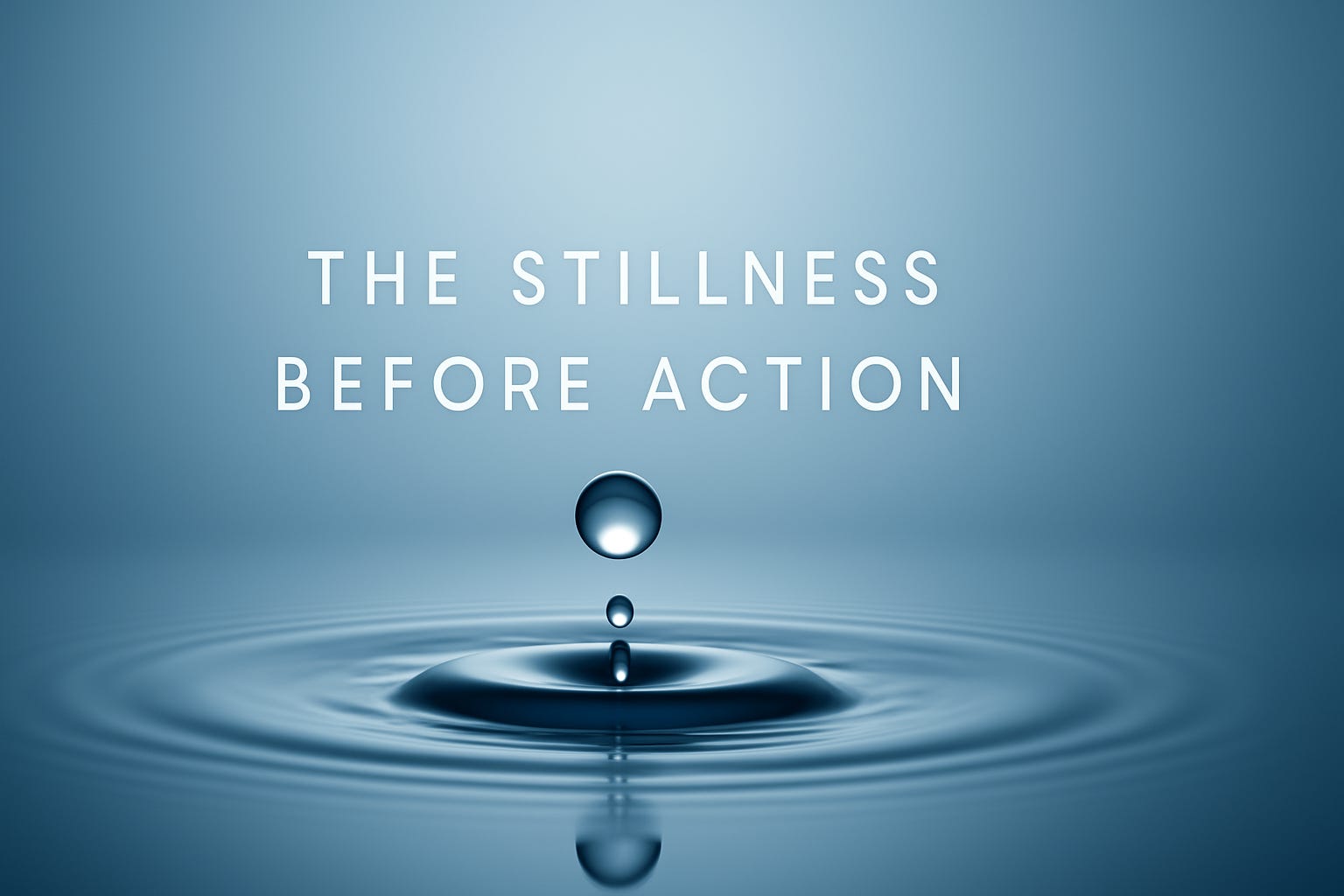
The Stillness Before Action
The journey to overcome procrastination and perfectionism is not a race; it’s a gentle homecoming. A return not to urgency, but to authenticity. A return to our Shen, our spirit, where wisdom resides quietly beneath the surface. Often, we hear the loud, fearful voice of our Inner Child pushing us toward impossible standards or pulling us into avoidance, whispering, “Not yet, you’re not ready.” But beneath that, there is another voice. Calmer. Wiser. It says, “You are already enough. Let’s begin, one small step at a time. I’ve got your back.” This voice doesn’t rush us; it invites us. And in that invitation, we rediscover something surprising, something often overlooked in the shadow of delay: our creativity.
Yes, right there, in the very space where procrastination once held power, is a spiritual gift waiting to be reclaimed. Our creativity. That spark of uniqueness within us that doesn’t follow the rules of time or perfection, but flows when we are in alignment. When we stop demanding ideal conditions and start trusting our presence, creativity emerges naturally, without force or strain. Effortlessly. Like breath returning after holding it too long. And with it come opportunities, ones we couldn’t plan or control, emerging from the unknown, calling us to express, to explore, and to fulfil our true potential.
Imagine this journey as lighting a lantern in the dark. One step forward, the light follows. Then another. The path doesn’t reveal itself all at once, but in trust, we walk anyway. And in that walking, the light expands. We realise the journey wasn’t just about completing tasks, it was about reclaiming our right to be imperfect and inspired. This is where procrastination loses its power. Not through force, but through understanding and acceptance. Through stillness. Through creativity flowing freely in the space we once filled with doubt.
So, we listen to that soft, inner voice. We accept the invitation to begin, not ideally, but truthfully. One breath, one step, one creative spark at a time.
‘The Stillness Before Action’ is not a passive place; it is the space where our spirit gathers its clarity and resolve. It is the breath before movement, the still water before the ripple, the alignment before the effort. This is where actual action is born, not from pressure or perfection, but from authenticity.
Let us no longer wait for the perfect time. Let us no longer measure our worth by outcomes. Let us take small, consistent, manageable steps forward, free from expectations, criticism, comparison, and judgment. We can trust the Tao. We can trust ourselves. And in that trust, procrastination loses its power, and action becomes not a burden, but a natural expression of who we truly are.
This is always your time. Move with it. Flow in it. And let your stillness carry you into the life you've been waiting to create.
Have you ever been told you’re “too sensitive,” “too emotional,” or “too kind”? Do you sometimes question whether your gentle nature is a flaw rather than a strength? In a world that often rewards the loudest voice and the most rigid exterior, softness can seem like a liability. Yet, within the philosophy of Taoism and the teachings of wu wei, we find a radically different view, one where our softness is not only welcomed but seen as a profound and courageous strength.
In this journal post, we will explore the misunderstood power of softness, why it’s often mistaken for weakness, and how embracing our gentle nature can lead us to greater authenticity, clarity, and spiritual resilience. We’ll confront the modern myths of strength, uncover the silent but mighty essence of softness, and offer practical ways to align with this energy through Taoist wisdom. We'll also reveal how our Inner Child, often trapped in past unresolved issues, mistakes vulnerability for danger and how we can gently re-educate this part of us with patience and understanding.
Softness, after all, is not about passivity or submission; it’s about choosing harmony over resistance, empathy over fear, and compassion over control. Let’s reframe strength from a Taoist perspective and learn why ‘The Strength of Softness’ might be our most potent form of expression.
Reimagining Strength Through the Tao
We are conditioned to associate strength with assertiveness, domination, and control. From early childhood, our Inner Child absorbs these cultural signals, often learning that to be strong means to suppress emotions, avoid vulnerability, and “toughen up.” This protective mindset may serve a purpose in moments of survival, but over time, it builds an inner rigidity that distances us from our true selves. Yet the Tao teaches otherwise. “The soft overcomes the hard; the gentle overcomes the rigid.” Tao Te Ching, Verse 36
This verse does not glorify softness for its fragility, but honours it for its resilience and its power to transform. In Taoism, softness is revered not because it breaks easily, but because it endures. Think of water, gentle, unassuming, endlessly adaptable. Yet over time, it can carve canyons, smooth stone, and nourish all life. Its power lies not in opposition, but in patience. Its quiet strength comes not from dominance, but from adaptability and flexibility.
The Tao teaches us that this is the more profound wisdom of softness. It is not a weakness. It is not collapsing. It is a conscious strength, subtle, fluid, unwavering. The most powerful transformation happens not when we force or push, but when we yield with awareness. Water doesn’t demand change; it embodies it.
This is the essence of wu wei, effortless effort. It is not passive or indifferent. It is the absence of strain, not the absence of action. It is the power to act without resistance, to move without force, and to respond without the need to control. This verse reminds us that wu wei is not inaction, but aligned action. It flows from the centre of truth, not from the anxious energy of our Inner Child. The Tao never calls us to fight life into submission. It invites us to collaborate, to merge with its rhythm and move in synchrony.
When we abandon the need to conquer, we begin to co-create. We stop demanding, and we start listening. We stop defending, and we begin receiving. Wu wei allows us to express our truth without shouting, to stand in our centre without hardening, to move forward without forcing the moment.
So, softness, then, is not a lack of strength; it is a mature and deliberate choice. It is meeting each moment with openness while rooted in integrity. It is speaking our truth without needing to win. It is trusting our worth without demanding validation. Softness is not the refuge of the uncertain. It is the resolve of the aligned.
In a world that mistakes volume for authority and pressure for progress, this Taoist teaching asks us to choose another way. It asks us to stop resisting the current and start becoming the river. This softness is not sentimental; it is a sign of spiritual maturity. It is the Inner Child re-educated, and the Shen finally heard and connected with.
This is the softness we walk with. This is the strength that flows.
Our Inner Child’s View of Softness
The Inner Child often associates softness with vulnerability, and to that part of us, it usually signals danger. When we were young, if expressing softness led to ridicule, rejection, or punishment, our Inner Child concluded, “Being soft is unsafe.” From this belief springs the habit of hardening ourselves: putting up walls, wearing emotional armour, and denying our natural tenderness.
However, when we harden against life, we disconnect from our Shen, our spiritual essence, and lose touch with the gentle power within us. As our journal teaching in From Fear to Flow – The Inner Child’s Journey explains, “The pursuit of control... reveals our Inner Child's deep yearning for stability in life's unpredictable theatre.”
Softness threatens this illusion of control. It exposes us to unpredictability. But that unpredictability is where our lives lie. To soften is to trust in ourselves, in the Tao, and the unfolding of each moment. When we align with the Tao, our softness does not weaken us. It becomes a doorway to more profound wisdom. Our vulnerability becomes a path to emotional resilience, not fragility.
Strength Without Rigidity: Redefining Power
Let us redefine what it means to be strong. In From Trauma to Tranquillity, we are reminded that “Within this tumult lies a profound opportunity for growth and understanding, a beacon of hope that can guide us towards a stronger, more resilient self.”
True strength lies in showing up as we are, not as we are expected to be. It is in holding boundaries without aggression, expressing truth without righteousness, and responding with kindness even when the world is unkind.
Softness means we speak calmly when we are triggered. It means we listen fully, not just to respond but to understand. It is the willingness to accept, not because someone deserves it, but because our peace deserves it. It takes immense power to stay open when life tries to close us.
Honouring Our Spirit Through Softness
Our Shen spirit is the eternal flame within us, undiminished by pain, untouched by our Inner Child’s demands. When we choose softness, we honour this spirit. We allow it to guide us rather than silencing it with pride, fear, or defensiveness.
This is the real power: living authentically, not performing and not being reactive, but responsive and not overpowering others; instead, standing quietly and confidently in our truth. To be soft is to honour our Shen. It is to live with integrity, compassion, and grace.
A Practice for Living Softly and Authentically
Affirm your truth. Try this affirmation: “I am strong in my softness, finding power in my gentle spirit.” Let it guide you back to your authenticity.
Pause before reacting. In a moment of conflict, soften your breath. Listen without preparing a defence. Respond from your Shen, not your Inner Child.
Feel fully, not fearfully. Embrace emotions as messages. Trace them back to the beliefs that gave rise to them. Gently re-educate your Inner Child: softness is safe now.
Embody wu wei. Practice effortless effort. Let your actions flow naturally, without tension or control. Trust the timing of the Tao.
Softness is not about being passive. It is about being rooted. It means standing firm, not in defiance but in calm confidence. It means having the courage to remain kind even when misunderstood. Imagine a mighty storm, raging with powerful gusts that snap the branches of rigid oaks. The willow, however, does not fight the wind. It bends, it sways, it dips low to the ground, appearing to yield completely. But this apparent "softness" is its greatest strength.
The willow is deeply rooted, anchoring it firmly to the earth. Its flexibility isn't a weakness; it's a testament to its unshakeable foundation. It stands firm, not in defiant resistance that would break it, but in the calm confidence that it can weather any storm. Even as the wind tries to tear it apart, its branches gently return to their place, embodying the courage to remain resilient and whole, unscarred by the harshness it encounters.
The willow shows that true strength isn't about being unyielding, but about being so grounded and self-assured that you can embrace flexibility, kindness, and resilience in the face of life's challenges.
A Quiet Strength, A Deeper Power
So, what if we stopped seeing softness as weakness? What if we embraced it as our superpower, the sacred, unwavering strength of our Shen? In Turning Negatives into Positives, we learn that our Inner Child uses restricting beliefs, such as “I can’t cope” or “I’m too emotional,” as a defence. But as we align with wu wei and the Tao, we gently guide this part of us back to clarity and truth.
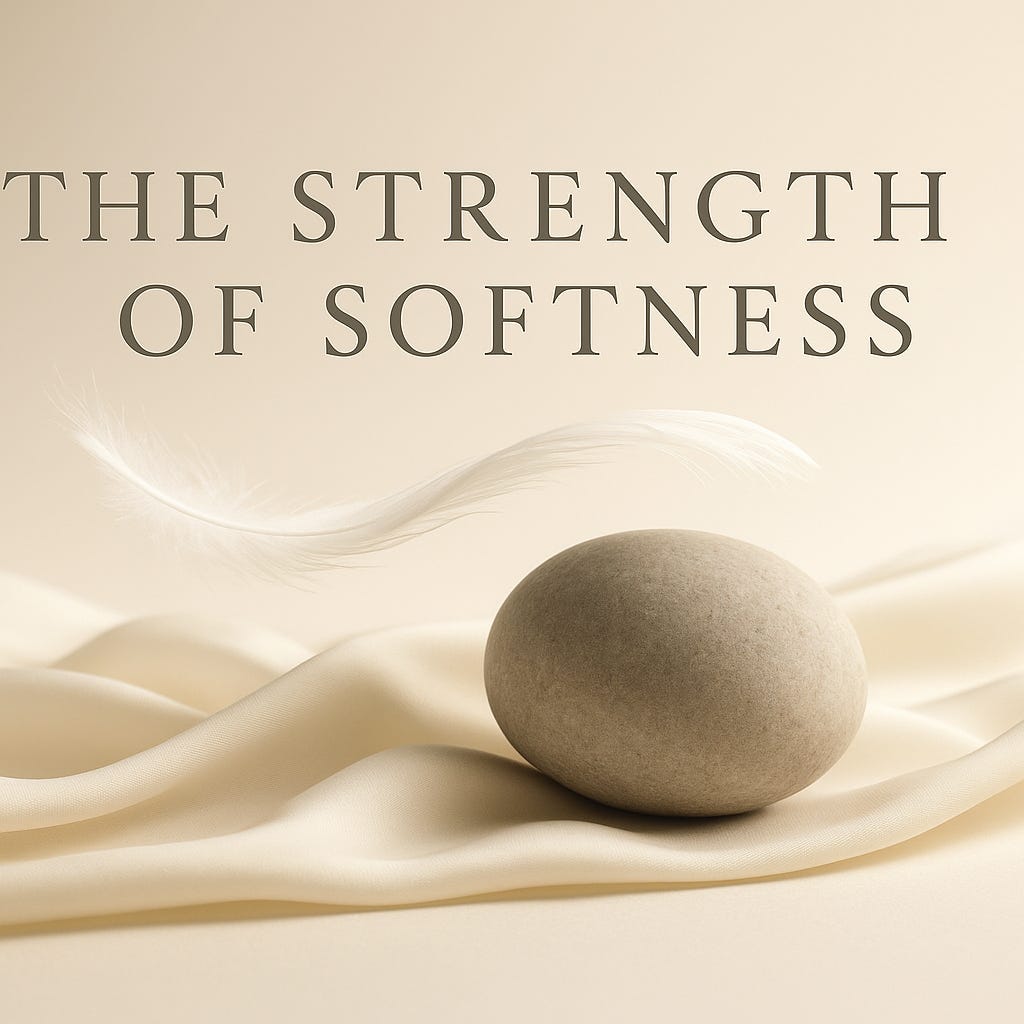
Softness is not weakness. It is a deliberate choice, a daily practice, a spiritual strength. Let us remember: The soft does not shatter; it reshapes. The gentle does not retreat; it creates space for growth. The open mind, heart and spirit do not break; it becomes a vessel for transformation.
We conclude with this affirmation from the Tao Te Ching: “The Tao flows everywhere. It is in everything and beyond everything. Trust it, and it will guide you.” This is the invitation of ‘The Strength of Softness’ to move through life like water: fluid, clear, and unstoppable.
Let us never again doubt the quiet, luminous power that lives within us. Let us move forward not with a clenched grip of control, but with a soft, open palm, ready to receive what life offers. Let us walk gently in the world, not with urgency but with grace, allowing each step to be a conscious choice rooted in alignment, not in fear or the chasing of outcomes. We do not move in reaction to Criticising, Comparing or Judging (CCJ), but in response to the inner knowing of our authentic spirit.
True strength is never about emotional noise or domination. It is the silent stability we uncover when we are anchored in trust. The Tao teaches that “The soft overcomes the hard; the gentle overcomes the rigid.” And so, we discover that softness, when aligned with our Shen and the flow of wu wei, is not weakness but the most significant expression of strength. It is in softness that we meet ourselves. In softness, we find the courage to keep going.
This is our invitation: Let us practice softness with ourselves today. Just for a moment, pause. Sit quietly. Breathe deeply. Ask yourself, “What is one small step I can take today in effortless alignment with my truth?” Let the answer rise, not from the voice of fear, not from the need to prove, but from that deep, still place of knowing within. Perhaps it is a conversation you’ve avoided, a boundary you need to honour, a rest you deserve to take, or a creative spark you've ignored for too long. Whatever it is, take that step. Gently. Consistently. Lovingly.
In the Tao, there is no rush, only rhythm. There is no need to force, only flow. The power we seek has never left us; it has only been waiting for us to stop struggling long enough to hear it whisper.
So let us walk on, not by pushing harder but by allowing more. Let us align, release, and trust. And in doing so, may we remember: We are not broken, lost, or behind. We are unfolding. And every breath, every choice, every soft step forward is enough.
Affirm: “I do not need to force my life to happen. I trust in my rhythm, I walk in my truth, and I allow the Tao to carry me forward with grace and ease.”
Moments of Inspiration…
There are moments, quiet and sudden, when a simple thought, a breath, or a glance out the window stirs something profound within us. These are not random. These are reminders. In these moments of inspiration, we hear a whisper beyond the noise, beyond the stories we’ve carried for far too long.
Our Inner Child often speaks first. Its voice is loud but uncertain, shaped by fear, confusion, and the need to belong. It repeats old stories: “I’m not enough,” “I must try harder,” “No one sees me”, as if they are facts. But these stories, though deeply felt, are not the truth.
Taoist wisdom invites us to pause, not to silence our Inner Child, but to listen with compassion and then gently guide them back to reality. Not the harshness of the world, but the reality of our Shen, our true spirit, which is never diminished by fear, failure, or the past.
In wu wei, the practice of effortless effort, we learn to move not from the urgency of fear but from the stillness of truth. Each moment of inspiration is a window into this stillness, a chance to remember: we are not the child’s story. We are the wisdom that knows better now.
Affirm: “I honour the stories of my Inner Child, but I live by the truth of my spirit.”
This week, let us notice the small moments of inspiration, the warmth in sunlight, the peace in stillness, the truth behind the noise, and allow them to guide us gently back to ourselves.
Journal #F040 04/08/2025