

Softening Certainty
This week, do disagreements seem like a fight for survival? Learning how to say “stop!” And are you ‘on trial’? Finally, “You always know the way”

“Today, we gently loosen our grip on certainty and open our hearts to the quiet wisdom already waiting within us. As we trust Shen more than the fears of our Inner Child, we discover that peace is not found in always having the answers, but in courageously walking with truth, honesty, integrity, and curiosity, allowing the Tao to reveal each next step in its own perfect time.”
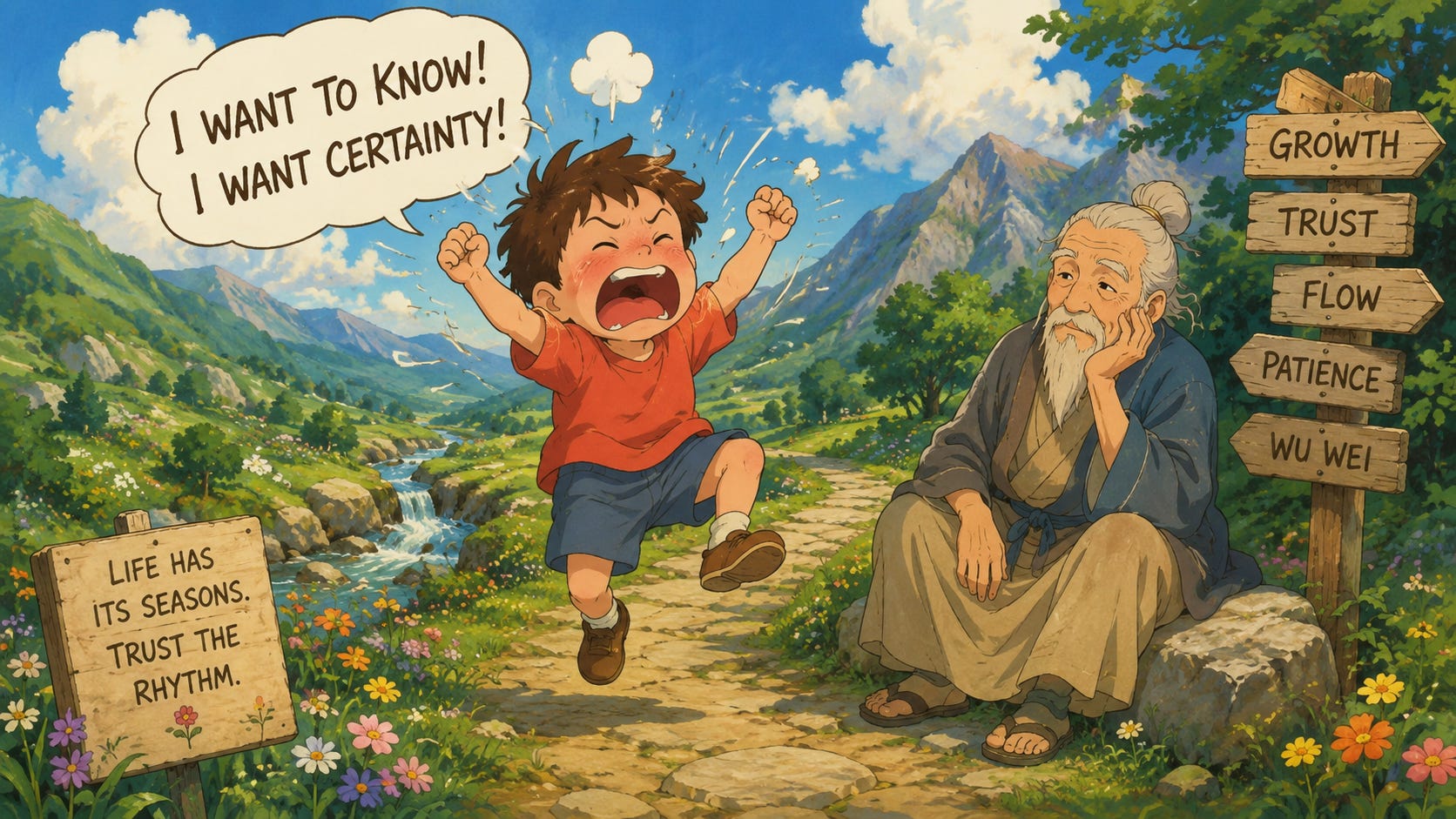
Have you ever noticed how quickly a conversation can change once our beliefs seem challenged? One moment, we may seem calm and open, and the next, our Inner Child is already defending, explaining, reproaching, or quietly withdrawing. Have you ever walked away from a disagreement carrying resentment, not because someone truly harmed you, but because something inside you interpreted the moment as rejection, disrespect, or loss of control? And perhaps even more importantly, have you ever wondered whether some of your strongest certainties were actually attempts to create emotional safety?
In this journal post, ‘Softening Certainty’, we will explore one of the quieter yet deeply influential emotional patterns shaping relationships, identity, and personal growth. We will examine how our Inner Child often mistakes certainty for safety and why rigid emotional positions can slowly create distance between ourselves and the people we love. We will also explore how Taoist wisdom and wu wei guide us toward openness, curiosity, and alignment with Shen rather than emotional defensiveness and the exhausting need to protect fixed identity structures.
This teaching matters because many people remain trapped within what we call the ‘Maze of Confusion’, believing that emotional certainty must equal truth. Yet certainty can sometimes become a shield that protects unresolved fears, inherited conditioning, or familiar emotional roles. Through self-examination, honesty, and gentle accountability, we begin to recognise that authentic connection often returns when the need to emotionally “win” softens.
When Safety Becomes Certainty
Our Inner Child longs for safety. This is natural and human. Yet the way it seeks that safety is often shaped by childhood experiences, family conditioning, emotional approval, and the lessons we absorbed long before we had the maturity to question them. If praise arrived through performance, obedience, being “good,” or being “right,” then our Inner Child may quietly conclude that certainty equals emotional security. Over time, this creates a hidden emotional equation: “If I am certain, then I am safe.”
At first glance, this equation may seem harmless. After all, certainty can create structure and stability. It can offer reassurance in times of difficulty or challenge. Yet, problems begin when certainty becomes emotionally fused with identity. Then, the disagreement no longer seems like a difference in perspective. It seems personal. Our Inner Child may begin to interpret another person’s questions, boundaries, or choices as emotional rejection.
This is where many relationships quietly drift into tension. Not because love disappears, but because emotional identity becomes more important than openness. The Inner Child then starts to protect its emotional certainty rather than remaining curious, reflective, and aligned with Shen.
Our previous teaching, ‘Before Belief Speaks’, explored how early emotional patterns silently shape adult reactions. Before a child consciously understands the world, it is already forming emotional conclusions about belonging, approval, and worth. Those early conclusions often continue into adulthood disguised as unquestionable truth.
So, when someone challenges one of our beliefs, our Inner Child may not interpret the situation logically. Instead, it may create red-light emotion and begin pressuring us with emotional arguments: “They don’t respect me.” “They are rejecting me.” “I must defend myself.” “I cannot back down.” Yet, Shen quietly asks a deeper question: “What belief am I protecting, and why?”
‘When certainty hardens into identity, connection quietly begins to close.’
The Emotional Need to Be Right
One of the more difficult truths to recognise is that many emotional arguments are not about truth. They are about emotional permission. Our Inner Child often believes that being “right” protects it from uncertainty, shame, vulnerability, or accountability. This creates what we call a ‘Dual Belief System’. One part of us may genuinely value connection, compassion, and understanding, while another, emotionally reactive part, still seeks certainty, superiority, or protection by being correct.
This is why some conversations become exhausting. People may appear to discuss ideas, but emotionally, they are defending identity structures. The discussion is no longer about curiosity or growth. It becomes about preserving emotional safety.
Taoism gently guides us away from this trap. Our Tao Te Ching translation, Verse 8, reminds us: “The highest good is like water. Water benefits all things and does not compete.” Water does not argue with the shape of the riverbank. It adapts while remaining true to its nature. This is profound emotional wisdom. Shen does not need to dominate to remain authentic. It does not require emotional control over others to maintain alignment. It remains open, honest, and flowing.
Yet our Inner Child often fears openness because openness introduces uncertainty. It may complain: “If I question this belief, what happens to my identity?” “If I admit I was mistaken, what does that say about me?”
This is where emotional maturity begins, not in becoming passive or voiceless, but in developing the courage to separate identity from certainty. A belief can change without diminishing our worth. In fact, authentic growth often requires us to let go of outdated emotional conclusions. Many people unknowingly remain trapped inside ‘The Pit of Familiarity’. Familiar emotional reactions may seem safer simply because they are known. Even resentment can become emotionally familiar. Defensiveness can become habitual. Distance can become comfortable. Yet familiarity does not equal alignment.
The Tao continually flows because it does not cling rigidly to fixed forms. Nature transforms constantly. Seasons change. Rivers shift. Trees bend. Taoist wisdom reminds us that flexibility is not weakness. Flexibility is harmony.
When Relationships Become Emotional Mirrors
Relationships possess a beautiful and uncomfortable quality. They often reveal beliefs we did not realise we carried. A disagreement with a child, partner, parent, or friend may expose emotional equations that have been hidden beneath the surface for decades. Perhaps our Inner Child carries the belief: “If someone truly loves me, they will see life the way I do.” “If people disagree with me, I am losing significance.”
These beliefs may seem convincing because the emotions attached to them seem intense. Yet intensity does not automatically make a belief truthful. This is why the ‘Golden Thread Process’ is so powerful. Rather than reacting to the emotion itself, we trace the emotional reaction back to the underlying belief creating it.
This process requires humility because it asks us to stop treating emotions as unquestionable proof. In our previous teaching, ‘Anchored in Truth’, we explained:
“Emotions are messengers, not masters.” This insight changes everything. Rather than asking, “Why are they making me create these emotions?” We begin asking, “What belief within me created this emotional reaction?” That shift returns responsibility and emotional freedom to us.
Often, beneath defensiveness lies fear. Fear of becoming irrelevant, of being wrong, of losing identity, and fear of no longer understanding who we are if old certainties dissolve. Yet, something beautiful happens when we stop defending and begin listening. Relationships soften. Conversations deepen. We discover that openness does not weaken us. It reconnects us with Shen.
One of the most profound emotional shifts occurs when we realise: people are not rejecting our worth when they disagree with our perspective. This single insight can dissolve years of resentment. Our Inner Child frequently conflates disagreement with abandonment because it still reasons in terms of emotional absolutes. Shen sees something broader. Shen recognises that authentic relationships allow individuality, curiosity, growth, and evolution. This is why humility is such an essential Taoist quality. Humility does not diminish us. It releases us from the exhausting burden of needing certainty to create emotional safety.
‘The Tao flows because it does not fear becoming something new.’
Conscience, Conditioning and Shen
Another important distinction emerges here, one many people overlook entirely: The difference between conscience and conditioning. Conditioning is repetitive. It often arrives through inherited emotional patterns, fear-based structures, social expectations, or rigid identity roles. Conditioning tends to create emotional reactions rooted in protection and familiarity. Conscience aligned with Shen behaves differently. It remains open. Reflective. Curious. Accountable. Conscience does not demand emotional superiority. It gently invites self-examination. It asks: “Am I aligned with truth, honesty and integrity?” This is the essence of ‘The Power of Three’.
Many people unknowingly confuse emotional conditioning with spiritual truth. Yet Shen’s guided conscience remains alive and flexible. It is willing to grow, willing to recognise misunderstandings, and it is willing to soften.
This is why wu wei becomes so important within relationships. Wu wei teaches us to stop forcing emotional control over life and people. Instead, we align with authenticity, openness, and natural flow. We stop trying to emotionally future-proof ourselves through certainty.
The Inner Child often seeks certainty because certainty seems to promise protection from future discomfort. Yet life cannot be emotionally controlled into safety. Taoism continually reminds us that change, uncertainty, and growth are natural. Our I Ching translation beautifully reflects this understanding: “Harmony is not a fixed destination but a fluid process.” This line reveals something deeply important. Many people search for emotional certainty because they believe certainty will finally create permanent peace. Yet Shen’s alignment does not come through rigid certainty. It comes through learning to move gracefully with life’s unfolding changes.
Returning to Connection
As we begin ‘Softening Certainty’, something surprising often happens. Relationships begin breathing again. Conversations lose their hidden tension. Defensiveness slowly gives way to curiosity. We become more interested in understanding than in emotionally protecting ourselves. This does not mean abandoning discernment or pretending every idea carries equal wisdom. Taoism does not encourage passivity. Instead, it encourages openness without emotional rigidity. We remain aligned with our values while also remaining willing to self-examine honestly.
This balance requires courage because our Inner Child may still pressure us toward old emotional habits. It may still nag: “Stay defensive.” “Protect your position.” “Don’t admit uncertainty.” Yet Shen quietly reminds us: “You do not lose yourself through openness. You rediscover yourself through truth.”
Many people spend years trying to manage emotional discomfort through control, certainty, criticism, or emotional distance. Yet these strategies often deepen loneliness rather than resolving it. The more tightly our Inner Child clings to certainty, the more difficult it becomes to form an authentic connection.
So, perhaps one of the great Taoist invitations is this: can we remain open without losing ourselves? Can we question inherited emotional equations without shame? Can we allow relationships to evolve without interpreting every difference as rejection? The answer unfolds quietly through awareness and honest self-examination. As we begin recognising the beliefs beneath our emotional reactions, old conditioning gradually loosens its grip. Conversations become softer, less about defence and more about understanding. Humility gently returns us to Shen, where openness no longer seems threatening but becomes a natural part of growth, connection, and authentic alignment with the Tao.
As we close ‘Softening Certainty’, let us remember that true wisdom rarely arrives through emotional rigidity. Wisdom remains alive, flowing, reflective, and deeply human. The Tao does not force itself upon the world, and neither must we. We can choose openness without fear. We can choose curiosity without losing integrity. We can choose connection without demanding emotional sameness.
Take small, consistent, manageable steps. Pause before reacting. Question the belief beneath the emotion. Notice when your Inner Child seeks certainty for emotional protection. Return gently to Shen. Step away from Criticism, Comparing and being Judgemental (CCJ). Trust your ability to grow beyond old emotional equations.
And most importantly, never doubt yourself. Because every moment of honest self-examination, every act of humility, every willingness to soften certainty and return to authenticity is already guiding you back into harmony with the Tao.

Have you ever found yourself standing in the midst of a difficult conversation, knowing that if one more sentence is spoken, the whole exchange will tip into blame, theatre, or emotional collapse? Have you ever stayed too long in an argument because your Inner Child pressured you to explain, correct, defend, or prove your intention? And have you ever walked away exhausted, quietly knowing that the problem was not only what was said, but the moment when nobody chose to pause?
In this journal post, ‘The Sacred Stop’, we will explore a fresh and practical Taoist doorway into emotional responsibility, clear boundaries, and Shen-guided communication. This teaching is not about becoming cold, avoidant, or superior. It is about recognising the precise moment when our emotional system begins to lose alignment, and choosing to interrupt the old pattern before it pulls us onto the ‘Carousel of Despair’. Many of us already know how quickly conflict can become repetitive. One person becomes reactive, another becomes defensive, someone raises their voice, someone withdraws, and soon the original issue disappears beneath a fog of accusation, disappointment, and unresolved beliefs. ‘The Sacred Stop’ is the moment we refuse to feed that fog.
The Pause Before the Pattern
There is a powerful moment in every difficult exchange when we can still choose clarity. It may arrive as a tightening in the body, a rush of words, a need to justify ourselves, or a sudden urge to make the other person understand. Our Inner Child often experiences this moment as danger. It nags, “Don’t let this go. Prove your point. Make them see. Keep talking until they agree.” Yet Shen knows that more words do not always bring more truth. Sometimes another sentence only strengthens the storm.
The sacred stop is the conscious pause that protects truth from becoming performance. It may be said aloud, “Stop, we need to pause this conversation.” It may be spoken inwardly as “We are becoming reactive; let us return to Shen.” Either way, the purpose is not control. The purpose is alignment. We are not trying to manage another person’s emotions because we cannot place calm, guilt, love, validation, or rejection inside anyone else. We are responsible for the beliefs and interpretations that create our emotions, and others are responsible for theirs.
This distinction changes everything. Many people believe a boundary is something we use to make another person behave differently. In Taoist understanding, a boundary is a clear expression of our own alignment. It says, “This is how we will remain truthful, honest, and with integrity.” When someone crosses a line, we do not need to collapse, explode, or become theatrical. We can name the moment cleanly and step back with dignity.
‘A sacred stop is the doorway where reaction ends, and Shen may lead.’
When Fairness Becomes Control
One of the hidden beliefs that often fuels conflict is the idea of fairness. Our Inner Child may complain, “This is unfair. They should not speak like that. They should understand me. They should know better.” Of course, fairness matters in human relationships, yet we must look carefully at what we mean by the word. Sometimes unfair means, “Reality is not matching my preference.” This is an important distinction because once our Inner Child labels something unfair, it may give itself emotional permission to react.
This is where the ‘Golden Thread Process’ helps us. Rather than saying only, “I am upset because they were unfair,” we trace the red-light emotion back to the belief creating it. We might discover, “I believe they must speak calmly before I can stay calm.” “I believe I cannot be peaceful unless they agree with me.” “I believe their anger means I am unsafe.” These beliefs may seem convincing in the heat of the moment, but they place our emotional stability in another person’s hands.
Our Inner Child reasons through ‘Emotional Logic’, not ‘Shen Logic’. ‘Emotional Logic’ says, “If they are intense, we must become intense.” ‘Shen Logic’ says, “Their intensity belongs to them, and our response belongs to us.” This does not mean tolerating disrespect or remaining in conversations that become harmful. It means we stop pretending that another person’s emotional state gives us no choice.
Our I Ching translation offers a beautiful reminder through Hexagram 31: “By resting firmly in your virtue, influence flows naturally and gently, creating harmony.” Resting firmly is not passive. It is the quiet strength of staying aligned when the emotional weather around us changes.
Clear Language, Clean Energy
Many people struggle with boundaries because they wait until they are emotionally overwhelmed before speaking. By then, the words often arrive carrying resentment, sarcasm, fear, or accusation. The sacred stop asks us to prepare clean language before the storm arrives. This is not scripting control. It is practising responsibility.
Clean language might sound like, “I want to continue this conversation, but not while we are speaking over each other.” “I am going to pause now because this is no longer constructive.” “I will return to this when we can both speak with respect.” These sentences are simple, but they carry immense power because they do not attack, diagnose, shame, or plead. They describe reality and name the next aligned step.
Our Inner Child may resist this clarity. It may pester, “If we stop, they will think they have won.” Or, “If we pause, nothing will be resolved.” Yet many arguments continue precisely because nobody is willing to stop. The Inner Child confuses continuation with resolution. Shen understands that a conversation needs spaciousness to become wise.
In our previous teaching, we offered this line: “A pause is spiritual strength.” That insight belongs here because ‘The Sacred Stop’ is not the absence of courage. It is the presence of discipline. It gives our emotional system time to recalibrate. It protects the relationship from careless words. It allows the belief beneath the red-light emotion to be examined rather than acted out.
This is wu wei, effortless effort. We are still acting, but without forcing. We are still communicating, but without pushing. We are still caring, but without taking responsibility for what belongs to another person. The Tao does not rush to correct the river. It allows the current to reveal where movement is needed.
The Boundary That Loves Truth
A sacred stop is often misunderstood by our Inner Child, which may interpret pausing as abandonment, failure, or rejection. Yet stepping back can be one of the most loving choices available when a conversation becomes flooded by unresolved issues. Love does not require us to stand inside emotional chaos until both people are depleted. Connection does not grow through repeated escalation. Trust is supported by clear boundaries, calm repair, and the willingness to return when Shen can guide the conversation.
This is where we bring in ‘The Power of Three’: truth, honesty and integrity. Truth asks, “What is actually happening here?” Honesty asks, “What am I believing that is creating this emotion?” Integrity asks, “What step now honours my Shen and respects the other person’s responsibility?” When all three are present, ‘The Sacred Stop’ becomes clean. It does not punish. It does not manipulate. It does not secretly hope the other person will chase, apologise, or collapse. It simply creates space for alignment.
We may need to practise this many times. At first, our Inner Child may badger us to return to the old pattern. It may say, “Explain more. Defend more. Make them understand before you leave.” Yet we can guide our Inner Child with warmth and firmness: “We are not abandoning the conversation. We are refusing to abandon Shen.” That sentence alone can become a doorway into a new relationship with conflict.
‘The Sacred Stop’ also asks us to be willing to be wrong. This is deeply important. Sometimes we pause because the other person has crossed a line. Sometimes we pause because we are the one becoming reactive. Sometimes both are true. If our goal is only to prove innocence, we remain inside the ‘Maze of Confusion’. If our goal is alignment, we become teachable. We can return later and say, “I have reflected, and I can see where I became defensive.” Or, “I still hold the boundary, and I want to speak more clearly.” This willingness keeps ‘The Sacred Stop’ from becoming another strategy of superiority.
Returning Without Repeating
The real measure of ‘The Sacred Stop’ is not whether we pause. It is how we return. If we step away only to rehearse blame, gather evidence, and prepare a stronger argument, we have taken the ‘Carousel of Despair’ into another room. The pause becomes sacred when we use it to examine our beliefs. We ask, “What did I make this mean?” “What did I expect?” “What belief is asking for control?” “What would Shen choose now?”
This is where practical Taoism becomes life-changing. We do not need a dramatic transformation. We need small, consistent, manageable steps. One calmer sentence, a cleaner boundary, or a moment of not entering the storm. Then one return to our breath before speaking, and an honest reflection without Criticism, Comparing and being Judgemental (CCJ). These small steps gradually teach our Inner Child that intensity is not power, and peace is not weakness.
As we close ‘The Sacred Stop’, let us remember that a boundary is not the end of love. It can be the place where love becomes more truthful. It is where we stop using emotional confusion to seek control. It is where we return to Shen and allow the Tao to guide our next step with calm strength. We cannot manage another person’s emotional system, and we do not need them to manage ours. We can speak clearly, pause wisely, return honestly, and we can trust that there is always a way through when we remain aligned with truth, honesty and integrity.
So, when the next difficult conversation begins to rise, practise ‘The Sacred Stop’. Let it be simple. Let it be clean. Let it be kind without becoming weak. Never doubt yourself. You already carry the Shen wisdom to know when to speak, when to pause, and when to return. Take one small step, without expectation, without CCJ, and allow wu wei to show you that the most powerful movement in a storm may be the quiet decision to stop feeding it.

Have you ever carried guilt so long that it began to seem like proof? Have you ever lived as though you were defending yourself in an invisible courtroom, trying to prove that your needs were reasonable, your choices were harmless, and your self-love was not selfish? This is one of the quietest forms of suffering because nothing obvious may be happening on the outside. Yet, inside the emotional system, our Inner Child is behaving as if a serious accusation has been made. It nags, reproaches and badgers us with the same old questions: “What if they think I’m selfish? What if choosing myself means I’m bad? What if my truth hurts someone, and that makes me guilty?”
In this journal post, we are exploring the profound teaching of “Guilt Without Crime”, the emotional pattern where we punish ourselves for violating rules we never consciously chose. We will look at how our Inner Child can confuse self-love with wrongdoing, how inherited values can become mistaken for virtue, and why proving innocence becomes unnecessary once we recognise there was no crime. We will also explore how Taoist wisdom helps us return to our Shen, where truth, honesty and integrity guide us more reliably than fear, approval or family conditioning.
This matters because many of us do not question what we were taught when the teaching was attached to survival. A child does not pause and say, “Is this belief spiritually aligned?” A child absorbs the emotional weather of the home and builds an inner law from it. If love seemed conditional, the law became, “Please them.” If disagreement seemed dangerous, the law became “Stay small.” If being yourself created disapproval, the law became, “Hide your truth.” Later in life, when we begin to choose differently, our Inner Child may treat freedom as rebellion and self-love as a crime.
The Hidden Courtroom
False guilt is not the same as genuine conscience. Genuine conscience arises when we have acted against our values, our virtue, our Shen, and it invites correction. False guilt arises when we act against old conditioning and our Inner Child mistakes that discomfort for danger. This distinction is essential. Without it, we may spend years apologising for growth, explaining our needs to people committed to misunderstanding them, and trying to prove our goodness to those who benefit from our self-abandonment.
This is where ‘Emotional Logic’ becomes so persuasive. Our Inner Child reasons from memory, urgency and survival. It says, “If they are upset, I have done something wrong.” “If they call me selfish, I must defend myself.” “If I disappoint them, I may lose love.” These thoughts can seem morally serious, yet they may be old survival equations dressed as conscience. ‘Shen Logic’ asks a calmer question: “What is true?”
When we use ‘The Shen Test’, we are not asking whether everyone agrees with us, approves of us, or likes the consequences of our choices. We are asking whether our beliefs and behaviours align with ‘The Power of Three’: truth, honesty and integrity. If we are acting with clarity rather than manipulation, responsibility rather than blame, and self-respect rather than punishment, then the accusation of selfishness may be someone else’s interpretation. Their opinion belongs to their emotional system. It is not evidence in our inner courtroom.
‘There is no guilt in choosing truth with clean hands.’
This is a powerful turning point because the need to prove innocence often keeps the old story alive. When we keep defending ourselves against the charge of being selfish, we quietly accept that there may be a case to answer. The Taoist path is subtler. It does not ask us to win the trial. It asks us to leave the courtroom.
Inherited Values and Living Virtue
Many unresolved issues begin when we confuse inherited values with authentic virtue. We may have been taught a version of goodness that required obedience, silence, pleasing, self-sacrifice, or loyalty to another person’s reality. The teaching may have arrived through family, religion, culture, authority, or emotional pressure. The problem is not that all inherited values are wrong. The deeper issue is that they must eventually be examined through Shen. A borrowed value that aligns with truth can become wisdom. A borrowed value used to secure approval becomes a cage.
Our Tao Te Ching translations offer a beautiful doorway through Verse 51: “Everything comes from the Tao, the virtue nourishes it along the way… Enriching everything we do without dominating, doing everything freely without wanting anything in return… Acting without wanting or taking control.” This verse reminds us that Te, our virtue, is not performance. It is not appearing good enough to satisfy another person’s expectations. Te is our inner compass, our lived alignment with the Tao, where goodness flows naturally because it is rooted in truth.
So, when we live according to someone else’s values to satisfy our own need for approval, we may appear obedient, but we are not spiritually aligned. We are using their belief system as emotional shelter. Our Inner Child may call this love, loyalty, or duty, yet underneath it is often a form of bargaining: “If I become who they want, I will be safe.” This is how the ‘Maze of Confusion’ forms. We are not simply choosing between right and wrong; we are trying to meet emotional needs through a value system that may not be our own.
A mature conscience is not inherited whole. It is refined through awareness. This refinement does not require attacking the people who taught us. It asks us to become honest about what we now choose to believe. We can respect where we came from without living as prisoners of it. We can acknowledge that our Inner Child once needed those rules to survive, while also recognising that Shen does not need them to live.
The Impossible Cannot Define Worth.
One of the most painful emotional equations our Inner Child creates is this: “If reality gives me what I want, I am worthy. If people behave as I want them to, I am safe. If life matches my story, I matter.” This equation seems reasonable to a child because children experience the world personally. When love is absent, they may conclude they are unlovable. When someone withdraws, they may conclude they are at fault. When life disappoints them, they may conclude their value has fallen.
In adulthood, this becomes exhausting because reality cannot be controlled into proving our worth. Other people cannot be made into permanent mirrors of our value. Life cannot be forced to obey the private script of our Inner Child. When we make the impossible responsible for defining us, we condemn ourselves to instability. We begin watching outcomes as if they are judges. We scan faces, replies, moods and results, waiting to discover who we are.
This is where the ‘Golden Thread Process’ becomes so important. We trace the red-light emotion back to the belief that gives rise to it. If guilt appears when we choose ourselves, we ask, “What belief says self-love is wrong?” If anxiety appears when someone disapproves, we ask, “What belief says their opinion controls my safety?” If shame appears when life does not go as planned, we ask, “What belief says outcomes define my value?” These questions do not attack our Inner Child. They guide it.
The story we create is familiar because we are the ones creating it. Familiarity can seem like truth, especially when our emotional system has rehearsed the same conclusion for many years. Yet our story about reality does not control reality itself. It only shapes our relationship with it. This is both humbling and freeing. We cannot make everyone love us by imagining a world where everyone loves each other. We cannot make others accept our truth by managing their reactions. We cannot become safe by controlling life. We become steady by aligning with Shen.
‘The world does not need to obey our story for our worth to remain whole.’
Self-Love Ends the Accusation
The deepest fear beneath false guilt is often simple: “If I admit I love myself, I may lose the protection that self-rejection seemed to give me.” Our Inner Child may have learned that rejecting itself first prevented the shock of being rejected by others. It may have believed that self-criticism kept it humble, pleasing kept it lovable, and guilt kept it morally safe. These strategies can become part of ‘The Pit of Familiarity’, where the known discomfort seems safer than unfamiliar freedom.
But self-love is not arrogance. It is a responsibility. It is the quiet recognition that we are entrusted with our own life, our own Shen, choices, and alignment. When we love ourselves, we stop demanding that others carry what belongs within us. We stop turning relationships into emotional rescue missions. We stop asking the world to prove a worth that was never missing.
This is why self-love supports Oneness rather than threatening it. When we take responsibility for our own emotional creations, we reduce chaos. We stop handing our unresolved issues to others and calling it love. We stop expecting another person to regulate our worth, our peace, or our identity. We become clearer, kinder and more truthful because our giving is no longer a hidden request for rescue.
There may be a counterargument from our Inner Child: “If I stop feeling guilty, won’t I become careless?” This is an understandable fear, but it misunderstands the difference between guilt and integrity. Guilt can keep us trapped in self-punishment, while integrity guides us into responsible action. A person aligned with Shen does not need false guilt to be loving. They have something stronger: truth, honesty and integrity.
So, the practice is beautifully simple, although not always easy. When guilt rises, pause before obeying it. Ask whether a real value has been violated or whether an old rule has been challenged. Ask whether the guilt is guiding you toward repair or pressuring you back into self-abandonment. Ask whether your action is rooted in Shen or whether your Inner Child is using fear to preserve an old identity. This is how we step off the ‘Carousel of Despair’ and return to wu wei.
Let “Guilt Without Crime” become a lantern for this stage of the journey. The next time our Inner Child reproaches us for choosing ourselves, we can respond with calm authority: “There is no crime here. Self-love is not betrayal. My truth does not require a defence. I choose alignment.” This sentence is not a performance. It is a return.
Never doubt yourself when your Shen is guiding you toward a cleaner, clearer life. Take small, consistent, manageable steps without expectations and without CCJ. Begin with one moment of not defending what needs no defence. One choice made from virtue rather than fear. One breath before guilt becomes obedience. One gentle correction to our Inner Child: “I am not afraid anymore. I love you.”
That is where the false trial ends. That is where the Tao opens. That is where self-love stops seeming like a crime and begins revealing itself as the most natural expression of truth. Let “Guilt Without Crime” remind us that we were never guilty for wanting to live honestly. We were only waiting for enough clarity to stop punishing ourselves for being whole.
Moments of Inspiration…
The Quiet Knowing
Have you ever asked for advice while quietly knowing the answer already? Have you searched for signs, reassurance, or permission because the truth within us seemed too simple, too honest, or too challenging to accept?
We may call this inner knowing intuition. In our teachings, we call it Shen, the calm spiritual wisdom that remains aligned with truth, honesty and integrity. Shen does not shout, threaten, or rush us. It speaks with the quiet certainty of water finding its natural course.
Our Inner Child sounds very different. It creates emotional urgency, asking, “What if we are wrong?” “What will they think?” or “How can we guarantee the outcome?” These emotions are not enemies. They are invitations to look deeper into the beliefs creating them. Yet they are not always wise instructions.
As we shared in our previous journal, “When Shen speaks, there is no fear, no urgency, no need to convince.” Wu wei asks us to stop forcing certainty and create enough inner space to listen. Before making the next choice, we can pause, drop our shoulders, breathe gently, and ask: “What do we already know beneath the emotional noise?” The answer may not promise comfort, approval, or control. It may simply offer the next truthful step.
This week, let us revisit our previous teachings on ‘Hidden Knowing’ and ‘Guided by Shen.’ Then let us practise one small act of trust: choosing what aligns, without demanding guarantees.
Affirm: “We trust the quiet wisdom of our Shen. Beneath emotional noise, truth is already guiding us home.”
In the Next ‘Inner Circle’ (Paid) Journal…
Masks of Harmony
Borrowed Virtue
Beyond the Familiar Story
Moments of Inspiration
In the Next Free Journal…
Leaving the Pit
The Knowing Beneath
The Worth Ledger
Moments of Inspiration
Journal #F092 27/07/2026
Contact: info@wuweiwisdom.com
Website: www.wuweiwisdom.com
YouTube: www.youtube.com/user/WuWeiWisdom
Facebook Community: www.facebook.com/groups/wuweiwisdomcommunity/