
The Middle Is Enough
This week, climbing the ladder of worth, ancient whispers of peace and the broken emotional compass. Finally, beliefs are losing their power.

“I no longer chase highs or hide from lows, I meet myself in the quiet centre, where peace is not something earned, but remembered. Here in the stillness, I find what was never missing: I am enough, and the middle is home.”
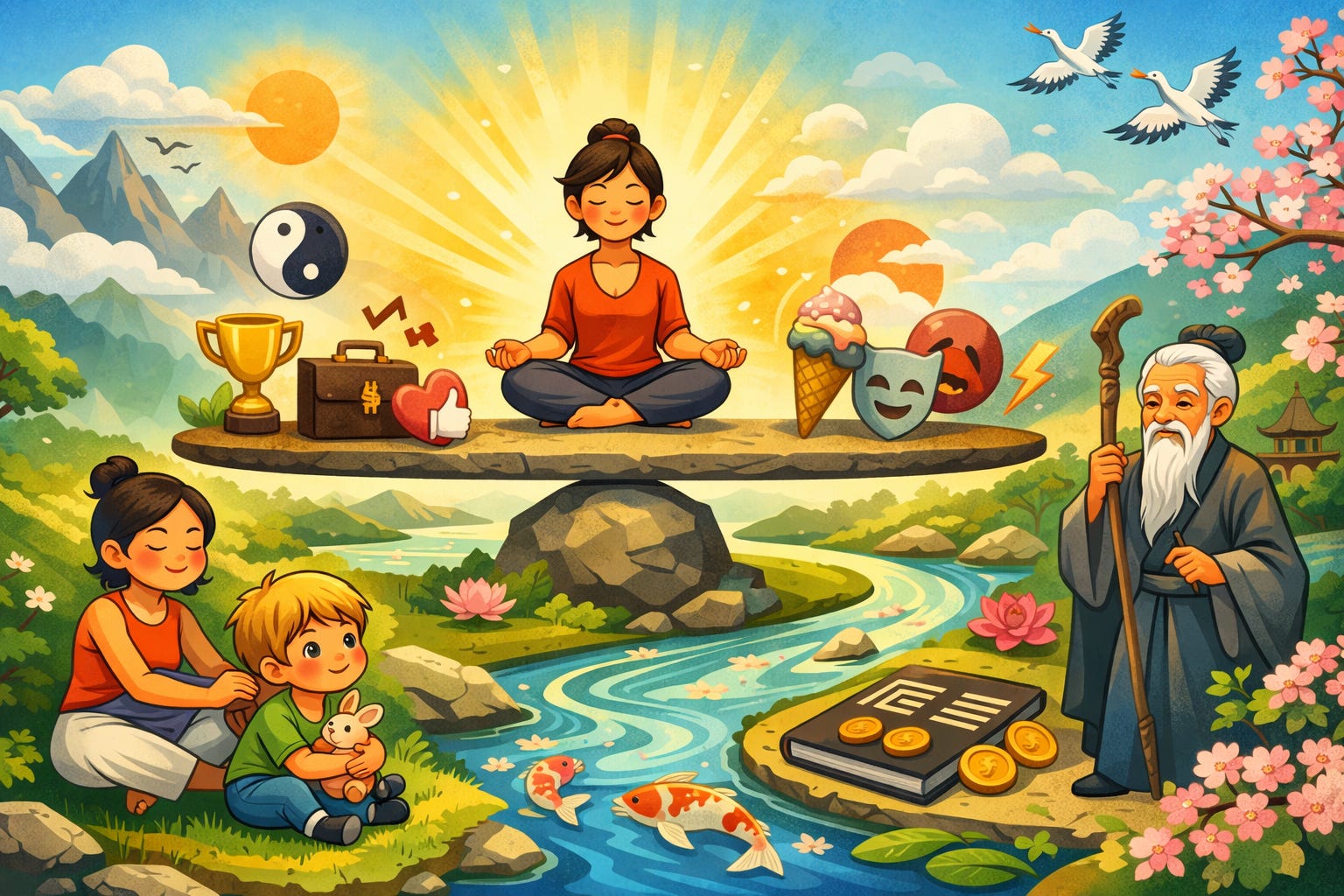
Have you ever measured your value by what you’ve done, who you’re with, or how others see you? Do you notice yourself chasing emotions that never quite last, a flash of happiness to outrun the fear, or the comfort of agreement to avoid being alone with your truth? Has your Inner Child ever nagged or pestered you into believing that unless you prove something, you’re not enough?
This journal post invites us into one of the most profound yet quietly misunderstood lessons in Taoist and Wu Wei Wisdom: the quiet strength of emotional and spiritual alignment, not as an idea, but as a lived experience. We will explore how worth and achievement have been tangled into one, why emotional logic traps us in cycles of proving and pleasing, and how the Tao points us to a middle path, one that doesn’t swing with the highs and lows of the pendulum, but rests peacefully at its centre. The path of alignment, not extremity. The path where peace is not the reward, but the reality. The path where ‘The Middle is Enough.’
This journal post will show how our Inner Child creates illusions from unresolved beliefs and pressures us to find worth in performance or approval, even in the guise of ‘happiness’. But there’s another choice, not between fear and euphoria, but between emotional chaos and Shen clarity. Let’s walk this path together and meet ourselves at the centre.
Where Worth Was Never Missing
When we’re little, many of us choose, quietly, internally, to believe that worth is earned. We may not realise it, but we begin measuring ourselves by achievements, accolades, and approval. Our Inner Child looks for signs of safety and, finding them in good behaviour, gold stars, or people’s smiles, concludes: “to be loved, I must earn it”. That belief is deeply rooted in our minds and shapes all our adult relationships, careers, and choices.
But here’s the truth: worth is not a product of effort. It is not cumulative. You were born with it. The Tao Te Ching reminds us in Verse 33: “Knowing others is wisdom; knowing yourself is enlightenment. Conquering others is strength; conquering yourself is true power.” Worth is not about conquering, achieving, or proving. It is about returning to your Shen power, your centre, your truth.
Achievement can affect how we see ourselves, a process called self-esteem. But self-esteem is not self-worth. Self-worth is the quiet knowing that ‘I am enough because I am’. Not because I’ve done something. Not because I’ve made someone proud. Not because I’ve fixed or succeeded or smiled through pain. Just because ‘I am’.
When we forget this, we begin to climb emotional ladders, up to happiness, down into guilt, up toward admiration, down into shame, all while trying to find a solid ground that was never missing, only overlooked. This is where the idea that ‘The Middle is Enough’ becomes more than an idea. It becomes a spiritual and emotional necessity.
When Emotion Pretends to Be Truth
Emotions are normal and human. They are part of our landscape. But not every emotion comes from truth. Some come from unresolved issues, carried silently since childhood. Mistaken beliefs, flawed interpretations, and protective strategies create some. This is where Taoist wisdom asks us to pause.
There is a difference between emotional logic and Shen logic. Our Inner Child uses emotional logic to get attention, validation, or control. It creates stories: “If I’m afraid, this must be dangerous.” “If I’m sad, I must be broken.” “If I’m happy, I must be doing life right.” But these are interpretations, not truths. They are born of beliefs, not of Shen.
As we shared in ‘Anchored in Truth’: “We are not the sadness; we made the sadness from something we believe. We are not the fear; we choose that fear in response to a thought, often inherited, often unexamined.” What we often call honesty is sometimes a clever disguise for emotional manipulation, not of others, but of ourselves. We use emotions as reasons to stop thinking critically. Our Inner Child reproaches, badgers, or criticises us into reacting rather than reflecting.
The Tao doesn’t silence emotions. It teaches us to honour them, not by obeying them, but by understanding them. This is where the ‘Golden Thread Process’ helps us: tracing an emotion back to its root belief. You cannot change what you do not understand. Not to judge, but to illuminate.
“Why am I angry?”
“Because I believe I’m being disrespected.”
“Why does that matter so much to me?”
“Because I still believe respect proves I’m worthy.”
When we expose that belief to the light, we discover it was never aligned with Shen and therefore never ours to begin with.
Relationships: Shared Truth or Shared Fear?
Many relationships are built on what seems like a connection. But is it truly alignment? Or is it emotional solidarity rooted in shared unresolved issues? We often relate to others through the same emotions, anxiety, fear, and guilt, believing that means we’re understood. But this can be a trap. As one reflection shared: “This isn’t loyalty; this is solidarity out of fear based on the belief that worth and love are earned.” Emotional agreement is not intimacy. It is often emotional bargaining. If we both fear being unlovable, we make a silent pact: I won’t challenge your belief if you don’t challenge mine.
But authentic relationships are built not on emotions, but on truth and clarity, not on fear, but on Shen spirituality. The I Ching speaks of this in Hexagram 31, “Influence”: “True influence is quiet and comes from alignment. It does not push or provoke. It draws by authenticity.”
If we want love that liberates rather than binds, we must first meet ourselves at the centre. Not where emotions flare, but where honesty breathes. Only then can we meet others not through shared survival strategies, but through shared truth. This is what it means to be in Shen, to let love meet clarity. To speak from what is aligned, not what is triggered. This is what makes a relationship sacred, not sticky.
The Pendulum of Performance
Perhaps one of the most painful illusions we carry is this: that life is meant to swing between highs and lows. That joy must follow struggle. That safety must be earned through pleasing. That peace only comes after proving. But the Tao teaches differently.
It invites us to the centre, where the pendulum does not violently swing, but gently sways, where we are not chasing highs to avoid lows, where peace is not the outcome, but the constant. As one student insightfully asked: “Why don’t I just create neither fear nor happiness and live in the middle, in balance, without complicating my life?” This is the wisdom of wu wei, effortless effort. Not effortlessness out of laziness, but out of alignment and flow. When we act from the middle, we are not swinging. We are steady.
The Tao Te Ching in Verse 76 reminds us: “What is soft and yielding is aligned with life. What is hard and inflexible belongs to death.” We do not need to harden ourselves through success. Nor collapse ourselves through failure. We can stay soft, in balance, and still move with great power. In ‘The Middle Is Enough,’ we stop seeing the middle as a place between achievement and collapse. We see it as Shen’s home. A home we forgot, but now we can remember.
When Nothing Needs Proving
So, what happens when we no longer try to earn worth?
We start choosing differently. We choose based on honesty, not fear. We speak because we mean something, not because we want a reaction. We create because we are aligned, not because we are incomplete. We love not to be loved back, but we love to be in alignment with the emotion of love. And most powerfully: we stop making ourselves wrong for being in the middle. We accept that peace is enough. Stillness is enough. Simplicity is not a failure; it’s a triumph over illusion.
We begin to see emotions for what they are created. Beliefs for what they are choices. Relationships for what they are, reflections of how deeply we’ve met ourselves. We stop climbing emotional ladders and learn to rest on solid ground. We no longer need to be more to be worthy. We need to be in alignment because ‘The Middle is Enough.’
Walking Forward with Balance and Grace
As we close this reflection, I offer you this quiet truth: You have always been enough. Not after your next breakthrough. Not once you’ve healed a little more. Not when they finally understand you. Now. Already. Fully. You are not here to prove anything. You are here to express everything from your Shen, with honesty and intention.
So, let’s stop swinging. Let’s stop listening to the nagging of our Inner Child that says we must chase joy to escape fear. Let’s meet our emotions with wisdom, not reaction. Let’s trace them back to their origins and change those beliefs if they are misaligned.
Let’s step off the emotional pendulum and into the stillness where the Tao flows as we affirm: “I am not my emotions. I am not my achievements. I am not my fears. I am my Shen, and ‘The Middle is Enough.’”
Let go of Criticism, Comparing, and being Judgmental (CCJ). Take small steps. Ask simple questions. Be consistent. Choose alignment over urgency. Over time, this path does not flatten you. It frees you.
Because peace is not the end of your journey, it is the path itself. And on that path, you will find yourself. Not at the top or bottom. But in the middle. Where you always were. Where you always belonged. Where ‘The Middle is Enough’.
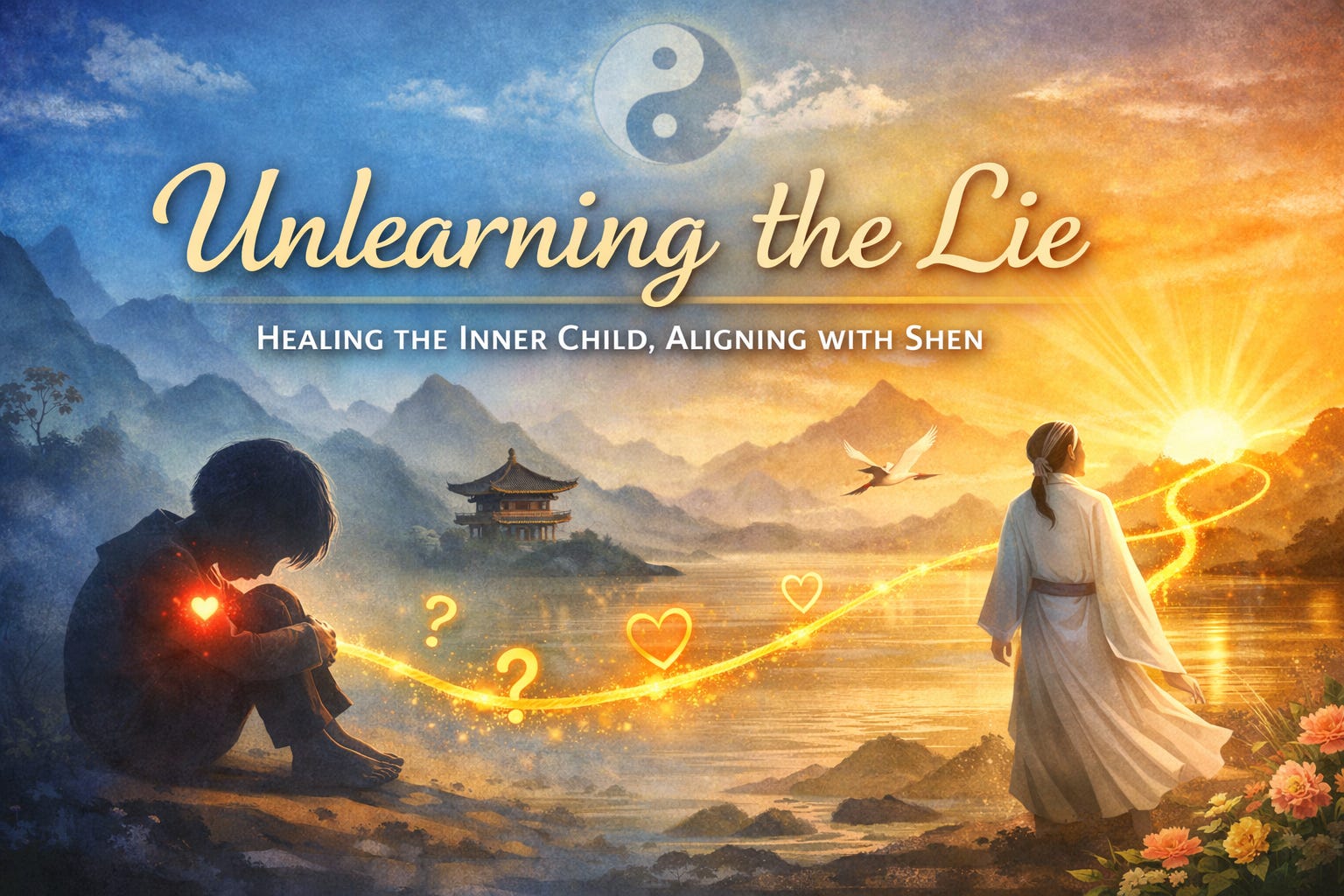
Unlearning the Lie
Have you ever said, “I know this thought isn’t true, but I still believe it”? Have you noticed how the pain lingers, even when your adult mind knows better? This contradiction is not a flaw in your reasoning; it is a misunderstanding of your spirituality. It’s a call to revisit a powerful Taoist truth: belief is not a reflex; it is a choice.
In this journal post, we journey into one of the most tender, tangled knots in our inner landscape, the place where our Inner Child insists on emotional logic, and our adult Shen knows better, yet struggles to be the guide. This is not just about thought mastery; it’s about reclaiming authorship of our emotional world. This concerns unlearning the notion that we are victims of our minds and learning instead that we are the creators of our beliefs, emotions, and perceptions of reality.
Let us walk together, side by side, through this rich teaching, so we can understand how to meet the nagging voice of our Inner Child not with judgment or force, but with clarity, compassion and alignment.
The Loudest Voice Isn’t Always the Truest
When we are caught in an emotional storm, the voice of our Inner Child can become so dominant and convincing that it drowns out all reason. Our Inner Child’s mind says, “They don’t love you,” “You’ll never get it right,” or “Something is wrong with you,” and though our Shen knows these cannot be facts, we still tighten, withdraw, and recoil in pain.
This contradiction is where many lose their footing. We start to believe that because the pain seems real, the belief must be true. But this is emotional logic, not Shen logic. Our Inner Child attempts to validate emotion with false beliefs: “It hurts, so it must be true.” But this logic collapses under deeper reflection.
As we wrote in ‘Shifting Shadows’: “When we speak from victimhood, phrases like ‘I can’t help it, my mind won’t stop,’ or ‘I just feel broken,’ we are unknowingly reinforcing the illusion that we are powerless.”
The truth is this: we create our emotions. They do not come from others. We choose the beliefs that create them. And if the feeling is painful, it is not evidence of truth, but a signal that an old belief is still being held onto.
Why Pain Doesn’t Mean It’s True
There’s a reason this confusion arises. As children, we survived emotionally by using our pain as proof. If we cried, we got attention. If we believed we were wrong or bad, we might avoid punishment. Over time, this created an internal blueprint in which pain became familiar and a badge of truth.
Now, as adults, even when a belief is irrational, we still grant it authority if it causes harm. But the Tao reminds us: “To know others is clever, to know oneself is clarity. To master others takes strength, but mastering the self takes inner power” (Tao Te Ching, Verse 33). And mastery begins with asking: “What belief am I still choosing, even though I know it harms me?”
This is not a question of blame; it is an invitation to deeper responsibility. Our Shen does not criticise us for holding onto outdated beliefs. It simply waits, patiently, lovingly, for us to realign. This is the heart of the ‘Golden Thread Process,’ our most sacred act of reclaiming alignment. When a red-light emotion such as anxiety, shame, guilt or fear arises, it is not a signal of failure but a lantern guiding us home. It is the surface ripple revealing a deeper movement within. And rather than suppressing it or reacting to it, we choose to pause, breathe, and gently follow the golden thread back through the layers of story, memory, and emotion.
We ask ourselves: “What belief is this emotion growing from?” “Where did I first accept this as truth?” And most importantly: “Is this belief aligned with my Shen, or is it something my Inner Child accepted to survive?”
This gentle enquiry is not a psychological excavation. It is a spiritual remembrance. Often, at the very root, we find a belief like “There’s something wrong with me,” or “I must be perfect to be loved.” These aren’t conscious adult thoughts; they are survival strategies crafted by our Inner Child when faced with rejection, confusion, or misunderstanding. And even now, these beliefs continue to whisper through the corridors of our adult minds. But here lies the healing: once we illuminate that root belief, we have the power to reframe it, not through force, but through alignment. We speak to our Inner Child not as a judge but as a guide. We say: “I see you. I hear your logic. But that belief was never true. You are not broken. You are whole, even in your doubt.”
This is what it means to be ‘emotionally sovereign,’ to remember that we are not our emotions; we are the creators of them. And as creators, we can choose differently by accepting that the red-light emotion is never the problem; it is the message. It tells us, “You’ve accepted something that is not aligned with who you truly are.” The work is not to silence the emotion, but to listen deeply to the story it’s telling. Then we trace it back, like holding the end of a thread and gently walking backwards through the labyrinth of our past, until we reach the original knot: that first domino, the first belief that tipped everything out of alignment.
From there, we do not tear it out. We understand it. We ask what purpose it served. And when its purpose is acknowledged and honoured, we can release it. Not by force, but by wu wei, effortless effort, the natural letting go that happens when truth meets compassion. Our clients often ask, “Why is it so hard to change this belief when I already know it’s not true?” And the answer is: “because a part of them still believes it keeps them safe.” Our Inner Child holds onto these beliefs not out of rebellion but out of fear—fear of abandonment, rejection, or vulnerability. When we show our Inner Child a new truth rooted in Shen, we don’t break its old belief; we outgrow it.
This is why we always say: the ‘Golden Thread Process’ is not a technique; it is a spiritual path. It reconnects us to our Shen, the still, silent knowing that was never damaged, never lost, and never dependent on the approval of others. It is the part of us that whispers, “You are already enough. You always have been.”
So, the next time you encounter a red-light emotion, breathe. Don’t chase the emotion; trace it. Follow the thread. Be curious, be compassionate, and be clear. Ask: “What belief is this pointing to?” “Is this belief aligned with the truth of who I am?” And most powerfully: “Am I ready to let go of what no longer serves my Shen?” Because every time we follow that golden thread to its root, and we realign our belief to truth, we heal. Not by becoming someone new, but by remembering who we already are.
The Inner Child’s Emotional Logic
Our Inner Child does not respond to spiritual truth. It responds to the illusion of safety. It nags us with emotional logic because it believes that if it can just prove the hurt, someone will fix it. It is not trying to sabotage us; it is trying to survive using the only language it knows. We must meet this voice not with aggression, but with understanding, not by agreeing with it, but by gently challenging it.
When it cries, “They don’t love me,” we respond with: “Is this really true? Or is this an old belief I’m clinging to so I don’t have to risk creating my authentic worth?” When it says, “I’ll never get this right,” we ask: “Who taught me I had to be perfect? And why am I still carrying their voice inside me?” This is the practice of wu wei: the art of alignment rather than opposition. We do not conquer our Inner Child; we lead it.
Wu Wei Wisdom: The Power of the Pause
In Taoist philosophy, extraordinary power lives in the pause. ‘Nature never hurries, yet everything is accomplished.’ The river does not rage to the sea; it curves, flows, and sometimes meanders.
When we pause in the heat of an emotion, we create space for choice. This is where wu wei lives. Not in force, but in allowing. Not in denial, but in discernment. The I Ching reminds us in Hexagram 61, “Inner truth is not loud. It is the power of gentle alignment. When we speak from this place, even fierce winds calm.” We are not meant to silence our emotions; we are meant to understand them. And in understanding, we change everything.
Becoming the Parent, Not the Child
Many of us live our lives with our Inner Child at the wheel; it is our responsibility to correct this. We must become the parent we always needed: clear, calm, and deeply aligned. We must say to our Inner Child: “You are allowed to cry, but you are not allowed to lead. I am here now. I make the choices. I decide what is true.” This voice of parental Shen logic guides us through the storm, not by overpowering emotion, but by creating a safe space in which clarity returns.
When we begin to question the beliefs that have governed us, we reclaim something priceless: our Shen spirit. We begin to live not from fear, but from truth. Not from reaction, but from responsibility. Not from emotional logic, but from Shen alignment. As we wrote in ‘Stepping Into Authentic Power’: “This power doesn’t require loud declarations. It lives in small moments: choosing not to speak self-judgmental words. Choosing to stand still in discomfort and listen. Choosing to say, I am enough, even when our Inner Child mind tells you otherwise.” This is what ‘Unlearning the Lie’ truly means: not rejecting our pain, but refusing to make it our truth.
Trust the Alignment
Let us end where we began. With the voice that says, “I know it’s not true, but I still believe it.” That voice is not your enemy. It is a signal. A reflection of a belief that once served you, but now needs to be questioned, thanked, and released.
Let us not fear our thoughts, nor our emotions. Let us meet them with love, listen to their message, and then return to the quiet truth of Shen. You are not your belief. You are the chooser of belief. You are not your emotion. You are the creator of it. You are not your Inner Child. You are its parent. When you live by this truth, you no longer need to fight your thoughts; you simply stop believing those that are not aligned.
So let us affirm, right here, together: “I unlearn the lie. I choose the truth. I walk with the Tao, not as a seeker, but as one who remembers.” ‘Unlearning the Lie’ is not a moment. It is a practice, one small step at a time. No expectations. No Criticism, Comparing or being Judgmental (CCJ). Just clarity, curiosity, and courage.
And that is enough.
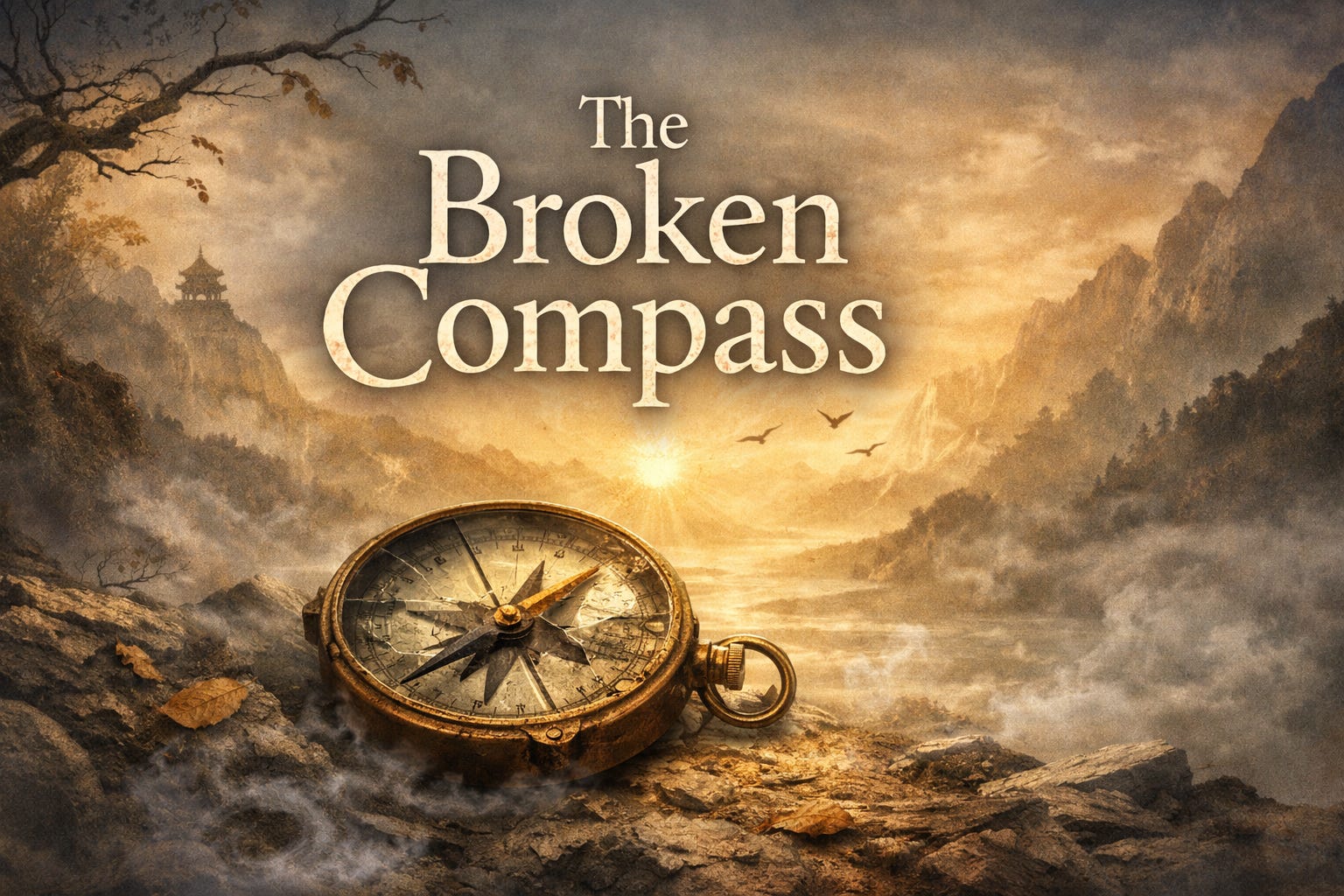
What Guides You When Fear No Longer Does?
Have you ever reached a moment when your most familiar emotional tools suddenly stopped working? Perhaps you cried, blamed, predicted, or panicked, waiting for that well-rehearsed outcome of comfort, control, or attention, only to be met with silence. That silence can seem frightening, like a void where certainty used to live. For our Inner Child, this moment seems like abandonment; the tools it depended on for safety and control no longer open the doors they once did.
But this isn’t punishment. This is your invitation. It’s the sacred pause before a deeper truth is revealed, where the Tao begins to whisper new possibilities. When the old emotional compass no longer points the way, we are not lost; we are being asked to look beyond the familiar. What seems like the collapse of everything known is often the beginning of a more profound spiritual alignment: one that invites us to replace emotional habits with Shen-guided clarity and live in harmony with wu wei, the art of effortless effort.
Most of us learn early on that emotions such as fear, guilt, and shame can serve as tools to gain control, attention, reassurance or become a victim. Our Inner Child misinterprets these reactive emotions as instincts and constructs an emotional compass from them. But that compass is not calibrated to truth. It’s skewed toward survival, not Shen.
What happens when that fear-led compass breaks? What rises when we no longer try to control the unknown with emotion? This is the sacred opportunity we explore today. This journal post will gently guide us through the unravelling of emotional manipulation, the loss of childhood emotional strategies, and the profound birth of Shen-led living. We will explore Taoist and wu wei teachings that point the way toward alignment, truth, flow and a deeper form of inner safety.
We’re not talking about suppressing emotion or denying fear. We are learning to trace it back to the belief beneath. In Taoist terms, we are letting go of the cracked compass to follow the current of the Tao with effortless effort.
When the Emotional Compass Breaks
Many of us don’t realise we’ve been using emotion as a form of control until it stops working. Our Inner Child believes emotions are a means to an end. As children, crying might have meant being picked up. Panic may have drawn attention. Avoidance might have prevented punishment. Slowly, we learn a rule: “If I panic enough, they will help me; if I shame myself first, I won’t be rejected. And if they don’t, then it’s because there’s something wrong or missing in me”
These patterns become so internalised that they seem authentic. One client insightfully shared: “I learned that I could achieve anything through emotions, then all of a sudden the pattern stopped working.” That moment is not a failure. It is sacred.
It is the Tao clearing the way. The Tao removes what no longer aligns so that we can learn to trust a different guide, our Shen. This experience is deeply disorienting. Our Inner Child nags us: “Do something! Say something! Be emotional! Get control!” But nothing works. This is when the cracked compass must be laid down.
As the Tao Te Ching reminds us in Verse 64: “When the path is unknown, simplicity is the way. The wise do not cling to patterns; they walk with trust.” When fear ceases to deliver results, we are not being abandoned. We are being invited into integrity.
The Illusion of Control
Let us pause and look deeper. The cracked compass of our Inner Child does not rely on truth, but on emotional logic. It regards fear as persuasive rather than revealing. It believes that love, approval, or worth must be earned. But fear is a terrible teacher. It only teaches how to shrink, duck and dive.
Our Inner Child’s emotional logic says: “If I can’t control the future, I must be in danger and I will not be able to cope!” But Shen, the spiritual essence within, knows that the unknown is not dangerous; it is sacred. That is the great divide between emotional logic and Shen logic. Shen logic knows that we have always coped and always will.
As another client reflected: “I found myself in the unknown… I started copying what others around me were doing, especially my mom. That’s how I chose to be fearful of the unknown; fearful that I wouldn’t survive if I didn’t prove to my mom I was worthy; fearful of being alone.” This is the unconscious echo of so many stories.
When emotions stop regulating outcomes, our Inner Child blames itself. But what if nothing is broken? What if fear has tried to do a job and failed? Isn’t it time to retire it? As we often teach, “Without a mistake, there’s no way to learn about the existence of another choice.” The moment fear fails is not the end; it is the beginning of trust and truth.
Fear and the Unknown: The Invitation to Trust
Fear often arises when we encounter the unknown. But is the unknown truly dangerous, or have we simply misunderstood its nature? Not to Shen. To Shen, the unknown is not a threat; it is home. It is the source from which all possibilities arise. “The Tao flows everywhere. It is in everything and beyond everything. Trust it, and it will guide you”. The unknown is where the Tao quietly waits, not in chaos, but in potential. It is the blank page on which a new chapter begins, not the end of the story.
Our Inner Child, however, cannot see this yet. Trapped in black-and-white thinking and rooted in emotional dependency, it equates unfamiliarity with danger. To our Inner Child, not knowing feels like not being in control. And without control, it cannot guarantee safety or attention. So, it cries out, protests, or shuts down, believing that certainty is safety, and silence is abandonment. But in truth, we have always lived in the unknown. The belief that we were ever fully in control was an illusion, an innocent misinterpretation by our Inner Child trying to future-proof life through emotional strategies.
In our Wu Wei Wisdom teachings, we often return to this gentle but profound truth: ‘the unknown is not something new, it is something we’ve always lived within’. It is the environment of life itself. From our very first breath, we have never truly known what comes next, and yet we have always managed, always adapted, always grown. When we resist the unknown, we resist our own nature. When we embrace it, we return to flow, to Shen, to the Tao.
The I Ching reminds us that life is change. It is movement, not stagnation. It is a constant unfolding of mystery and transformation, not a fixed script. The moment we stop demanding guarantees and begin trusting the moment, we align with wu wei, effortless effort. In this space, the unknown is no longer an enemy to be controlled, but a creative force to move with.
So, the question is not “How do I avoid the unknown?” but rather, “Can I remember that the unknown is where I belong?” The unknown is not emptiness; it is the fertile ground of renewal, where the deepest truths of Shen are planted and nourished. This is the landscape of the Tao, the stillness before the next step, the silence before the insight, the space where your true path begins.
But as Verse 36 of the Tao Te Ching reminds us: “To contract something, you must first allow it to expand. To weaken something, you must first allow it to grow strong”. This is the subtle teaching of the Tao: “Trust what is hidden. It prepares you for what is becoming.”
When fear no longer brings reward, we panic. We question ourselves. We mimic others. But all of this arises from the belief that fear is safer than truth. This is the spiritual threshold. This is where Shen begins to speak. Not through red-light emotion, but through spiritual clarity. Not through panic, but through alignment and flow.
Shen: The True Guide Beyond Emotion
The journey from fear to faith is a return to Shen. Shen does not use fear to motivate. Shen creates calm, clarity, curiosity, and courage. The Tao does not punish us when fear fails; it invites us to realign. One of our past journal posts put it this way: “Shen cannot lead if our Inner Child is holding the map.”
This is a crucial life lesson: fear was never meant to guide us forever. Emotion-based control was a childhood survival strategy, not a truth. When we step off that path, we discover what has always been beneath: a current flowing toward alignment. This is wu wei, effortless effort. It asks nothing more than honesty and integrity.
The I Ching offers a powerful echo in Hexagram 24, ‘The Turning Point’: “Return is the movement of the Tao. Going out and coming in without regret, aligning again with the source brings joy. Nothing is forced; all is restored in its time.” This suggests that when fear stops working, it is because it was never the appropriate tool. Our return to Shen is the natural rhythm of life. We are not failing; we are finally free to trust something deeper.
The New Compass: Clarity, Not Control
So how do we rebuild our compass? We start by telling ourselves the truth. We ask: “What belief created this emotion? Why do I believe it? Is it mine or inherited?” Then we pause. We listen. We stop chasing emotional certainty and begin choosing spiritual alignment. We no longer say, “I feel rejected,” but “I believe I need others to accept me to believe I have worth.” We do not say, “They made me feel anxious,” but “I chose to create anxiety based on my belief that I must predict the future.” That is clarity. That is honesty. That is Shen.
The cracked compass said, “Avoid pain.” The new compass says, “Seek truth.” The cracked compass said, “Predict the future.” The new compass says, “Trust your integrity.” The cracked compass said, “Panic to protect.” The new compass says, “Pause to align.” This is the shift from emotional logic to Shen logic. This is the return to wu wei.
Letting Go of the Broken Compass
We began with the question: “What happens when fear ceases to function?” The answer is: your actual journey begins. When fear no longer controls the outcome, we discover what has been waiting all along, our Shen. The unknown is not a void. It is a field of possibility.
We are no longer using emotion to manipulate, control, or avoid. We are choosing beliefs rooted in clarity, not childhood needs. We lay down the cracked compass, not in despair, but in gratitude. Because it brought us here, we trust in the teachings of the Tao. We believe that life is a journey of discovery, not protection.
Let us walk with small, consistent steps. Not driven by fear, but guided by truth. Not judged by outcomes, but supported by integrity. No Criticism, Comparing, or being Judgmental (CCJ). Just quiet alignment, honest questions, and gentle redirection.
Affirm: “I trust in my Shen. I welcome the unknown as my teacher. I no longer navigate by fear. I live in alignment with truth.” Let us remember: ‘The Broken Compass’ is not a loss, but a liberation. You are not lost. You are being led.
Moments of Inspiration…
The Disarming of False Belief
Have you ever noticed how a belief can feel so true until it’s not? For years, we may walk through life guided by inner scripts we never chose. “I’m not enough,” “I must earn love,” or “If I don’t control, I’ll be hurt.” These beliefs are not truths, but emotional echoes written long ago by our Inner Child, small, scared, and doing their best to survive.
But here is the sacred turning point: when we finally dare to trace that emotion back to its source, when we ask, “Why do I believe this?” and “Is this belief mine or inherited?” something powerful happens. The illusion begins to dissolve. False beliefs cannot survive the light of honest inquiry.
They shrink.
They fall quiet.
They lose their grip.
This is not the destruction of who we are; it is the unveiling of who we’ve always been beneath the emotional noise, Shen-led, calm, clear and aligned.
In our Wu Wei Wisdom teachings, we don’t fight false beliefs. We expose them. And in that compassionate exposure, they lose their power. We don’t rip them out; we outgrow them. We become the Sage who smiles at fear, knowing it is no longer needed.
Let this week be a time to pause, to listen, and to ask the questions that dissolve illusion and return us to truth.
Affirm: “Each time I question what I once believed, I uncover who I truly am.”
Join us in this week’s journal as we walk together from emotional illusion to spiritual clarity, stepping lightly but boldly on the path of truth.
In the Next ‘Inner Circle’ (Paid) Journal…
Soaring Without Chains
Beyond the Applause
Unshakeable Light
Moments of Inspiration
In the Next Free Journal…
Resilient Silence
The Power Paradox
Unshakeable Ground
Moments of Inspiration
Journal #F066 02/02/2026
Contact: info@wuweiwisdom.com
Website: www.wuweiwisdom.com
YouTube: www.youtube.com/user/WuWeiWisdom
Facebook Community: www.facebook.com/groups/wuweiwisdomcommunity/