
The Sacred Divorce
This week reclaiming your true self without pushing love away, filling your 'well' of love and worth and observing your patterns, without becoming them. Finally, beliefs are not 'set in stone.'

“We affirm that our peace is not earned by managing other people’s emotions, and our worth cannot be raised or lowered by a passing opinion, because Shen remains whole even when the world seems noisy. As we continue reading, we choose ‘The Sacred Divorce’ from old contracts and CCJ, and we take one small, honest step into alignment, trusting that truth does not need performance to be real.”

Releasing Emotional Dependency Without Losing Love
There are moments on our Taoist journey when life presents us with a quiet, revolutionary invitation: to release what no longer aligns with us, without rejecting love. To step away from inherited roles and emotional contracts, not in anger or bitterness, but in calm certainty. This is the teaching at the heart of ‘The Sacred Divorce’, a graceful separation from beliefs that bind us to roles we never truly chose.
For many, this realisation arises in relationships that reflect outdated ideas: duty disguised as devotion, submission masked as love, emotional dependency confused with connection. It can manifest as a parent who believes children must submit to be worthy, or as a partner who views dominance as love’s rightful posture. These beliefs are not usually malicious; they are inherited. But they are not yours.
This journal post will explore the powerful and transformative act of ‘The Sacred Divorce’, the spiritual and emotional uncoupling from beliefs, dynamics, and unspoken agreements that do not honour your Shen. We will look at how emotional dependency is created and maintained, how our Inner Child clings to it in the hope of safety, and how you can release those contracts without needing others to change. We’ll walk the gentle path of alignment, not rebellion, drawing deeply from the Tao Te Ching and I Ching to illuminate the way.
The Emotional Contract: Love as a Transaction
Somewhere early in life, many of us unconsciously agreed to a contract we never signed: “If I meet your emotional needs, you’ll protect me. If I make myself small, I’ll be safe. If I agree with you, you’ll love me.” These are not spoken aloud but absorbed in subtle ways: when praise came for obedience, not authenticity; when silence was rewarded; when disagreement led to withdrawal or criticism.
This is the beginning of emotional dependency: when love becomes a transaction. When our Inner Child learns to trade truth for approval, these contracts were often born from necessity, not malice. But they harden into roles we live as adults, dutiful daughter, agreeable spouse, people-pleasing friend. Over time, our Shen becomes buried beneath the armour of performance.
The problem is not that we loved. It is that we confuse love with submission, alignment with obedience. Your mother’s belief that children are subordinate, or your partner’s idea that you must conform to their authority, may reflect their inner world, but they do not define yours. ‘The Sacred Divorce’ begins when you say, “Their beliefs are not my truth. I can release the role without abandoning the relationship.”
As the Tao Te Ching teaches in Verse 19: “Give up cleverness, abandon gain; the people will benefit a hundredfold. Return to the source.” The source is your Shen, free, creative, sovereign.
Safety Isn’t Earned, It’s Claimed
Our Inner Child believes safety is something others give us in exchange for compliance. It believes, “If I do what they want, they’ll love me. If I disappoint them, I’ll be punished.” This belief is not based in truth; it’s based in emotional logic, formed when we were too young to challenge it.
But Shen sees differently. Shen knows that true emotional safety comes from clarity, from alignment, from living in the ‘Power of Three,’ truth, honesty and integrity rather than performance. Safety is not something others can bestow; it is a state of inner trust. You cannot feel secure while living a lie. You cannot feel peaceful while betraying your essence to maintain someone else’s comfort.
When you begin to notice how much energy is spent pleasing, placating, or performing, it’s a sign you’re ready to divorce the contract. Not to fight, not to punish, but to realign. You do not need to prove your worth, nor explain your freedom. You act from truth. The Tao does not justify its flow. It simply flows. As the I Ching says in Hexagram 49, “Transformation brings renewal. When the old shell no longer fits, it must be cast off. Not in haste, but in clarity.” This is not rebellion. This is evolution.
You Are the Centre, Not the Counterbalance
One of the most exhausting emotional roles is that of the peacekeeper, the one who stays calm while others rage, who brings light to balance their shadows. Many believe this is both noble and necessary. “If they’re negative, I must be positive,” we say. “Then harmony will be restored.”
But this is a misunderstanding of balance. Taoist balance is not about compensation; it’s about your alignment and continued flow. You are not here to offset their chaos. You are here to live in your truth. If someone chooses negativity, it does not become your duty to neutralise it with false positivity. Your responsibility is to your own integrity, not their emotional turbulence.
Continuing to perform the counterbalance role means remaining in an energetic dependency, because we are still organising our worth around managing someone else’s emotional weather. The moment we stop curating other people’s emotions and begin honouring ourselves, we step toward ‘The Sacred Divorce’, a release from the illusion that our value is measured by how well we stabilise others, or by how closely a family, friendship, or career matches the story we imagined, rather than the reality we are actually living.
Remember, we are not here to fix what others refuse to face, nor to convert anyone to our beliefs, because truth never needs coercion; it only needs clarity. We are here to live in truth, and to let our example do the speaking, as Verse 70 reminds us: “The Sage’s teachings are easy to understand, Because you have always known them to be true.” When we stop managing, persuading, or performing, wu wei becomes real, it is allowing, not controlling, and it is trusting that what is ready will meet us, while what is not ready is not ours to force.
Spiritual Parenting: Hug Yourself, Don’t Armour Up
When we sense criticism or disapproval, many of us instinctively cross our arms, emotionally and physically. This is the posture of defence, of bracing for impact, and it reveals our Inner Child’s emotional logic, the belief that love is conditional and safety is scarce. In that moment, our Inner Child tends to treat any feedback as CCJ, Criticising, Comparing, or being Judgmental, as if every comment is a verdict on our worth, rather than a simple piece of information. It makes the moment personal, then it panics, because it believes being “wrong” leads to rejection, and it forgets the most liberating truth: ‘we are the creators of our emotions, not the victims of other people’s reactions.’
This is where the inner boxing match begins. Our Inner Child assumes there is an attacker, so it reaches for a defence, a speech, a counterpunch, or a shutdown, not because it is bad, but because it believes protection must be loud. Yet Taoist wisdom teaches something calmer and more powerful: our task is not to participate in the trial; our task is to retire the judge and return authority to where it belongs: within our own integrity. When we stop handing our worth over to someone else’s mood, tone, or opinion, the ‘Carousel of Despair’ slows, and we can meet feedback without turning it into identity. We can listen, clarify, accept what is useful, and release what is not, not as a performance, but as wu wei, effortless effort, aligned action without the strain of proving ourselves.
But there is another posture: open arms, wrapped around ourselves. Not in self-pity, but in spiritual parenting, a quiet self-love that says, “We belong with ourselves first.” This is self-acceptance in action, protection born not of fear, but of the steady recognition that our worth is innate, and no comment, opinion, or passing mood can add to it or subtract from it. When we catch ourselves armouring up, we pause and soften our shoulders, we choose breath over battle, and we ask: “What belief am I protecting right now? Is this the calm clarity of Shen, or the emotional logic of our Inner Child that assumes every word is a threat and every moment is a trial?” Then we remember: “we are not here to spar for value; we are here to live from it and to respond from alignment, not emotional reflex.”
Often, what we are defending is a belief we no longer even agree with. “I must obey to be loved.” “I must please to be accepted.” These are the old contracts. You can let them go. You can parent your Inner Child with compassion, not compliance. You can say: “We don’t need to hide anymore. We are not in danger. We are not wrong. We are free.” And when that belief arises again, as it may, repeat: “I am not here to obey illusions. I am here to live in alignment with my truth.”
Renewal Without Rebellion
There is a common myth that we must fight or flee to be free. But wu wei shows another way: release without resistance. Quiet departure from roles that no longer serve. You do not need to justify your evolution. You only need to trust it. Nature renews itself without fanfare. The snake does not mourn its old skin. The tree does not cling to dead leaves. You, too, are invited to renew, not by force, but by letting go. Let go of the role. Let go of the guilt. Let go of the belief that you must sacrifice your Shen to be loved.
As the Tao teaches, “The way to do is to be.” That is the essence of ‘The Sacred Divorce’. You are not divorcing a person. You are divorcing a belief that love must be earned through self-abandonment. You are divorcing roles, not relationships. You are releasing emotional dependency, not connection. You are choosing alignment over approval. And in doing so, you rediscover love that is whole, not negotiated.
Walking Forward in Shen
The path ahead is not about confrontation, but clarity. Not about rebellion, but return. Each time you notice yourself performing, pleasing, or placating, pause. Ask: “Is this an act of alignment or emotional dependency?” Then gently redirect. You are not wrong for having learned these roles. But you are not required to keep playing them. Take small, manageable steps. Speak one truth today that you’ve been hiding. Say “no” once, kindly and clearly. Let one belief go. These are not acts of resistance; they are acts of return, to yourself, your Shen, your Tao. Affirm often: “I do not need anyone’s permission to live in alignment. I release the roles I was given. I choose the truth I know.” You are not broken. You are not disloyal. You are simply outgrowing childhood illusions.
As the Tao reminds us in Verse 64: “A tree as big as a man’s embrace begins as a tiny shoot. The journey of a thousand miles begins beneath your feet.” Every time you choose alignment over approval, truth over transaction, you reclaim your path. ‘The Sacred Divorce’ is not a tragedy. It is a turning point. A reorientation toward your truth. A spiritual separation from roles that no longer reflect your spiritual essence so that love can be experienced freely, without condition, without compromise.
You are not here to maintain outdated contracts. You are here to create from spiritual alignment with your innate worth and value. To live in clarity and flow. To love without losing yourself. So, begin quietly, bravely, consistently. And never doubt your worth again. Take each step gently, with no CCJ, no Criticising, Comparing or being Judgmental with yourself or anyone else. Trust your Shen. Trust the Tao. And trust that you are already everything you were waiting to become.
You are not becoming free. You already are. Now you’re simply learning to believe it.
The Cost of Conditional Love and the Truth of Overflowing Worth
Have you ever poured yourself into someone, convinced that if you just gave them enough love, they would finally offer it back the way you needed? Have you tried to teach others how to love you, through kindness, loyalty, and patience, believing that if they saw your effort, they would mirror it? And when they didn’t… did you wonder what was wrong with you?
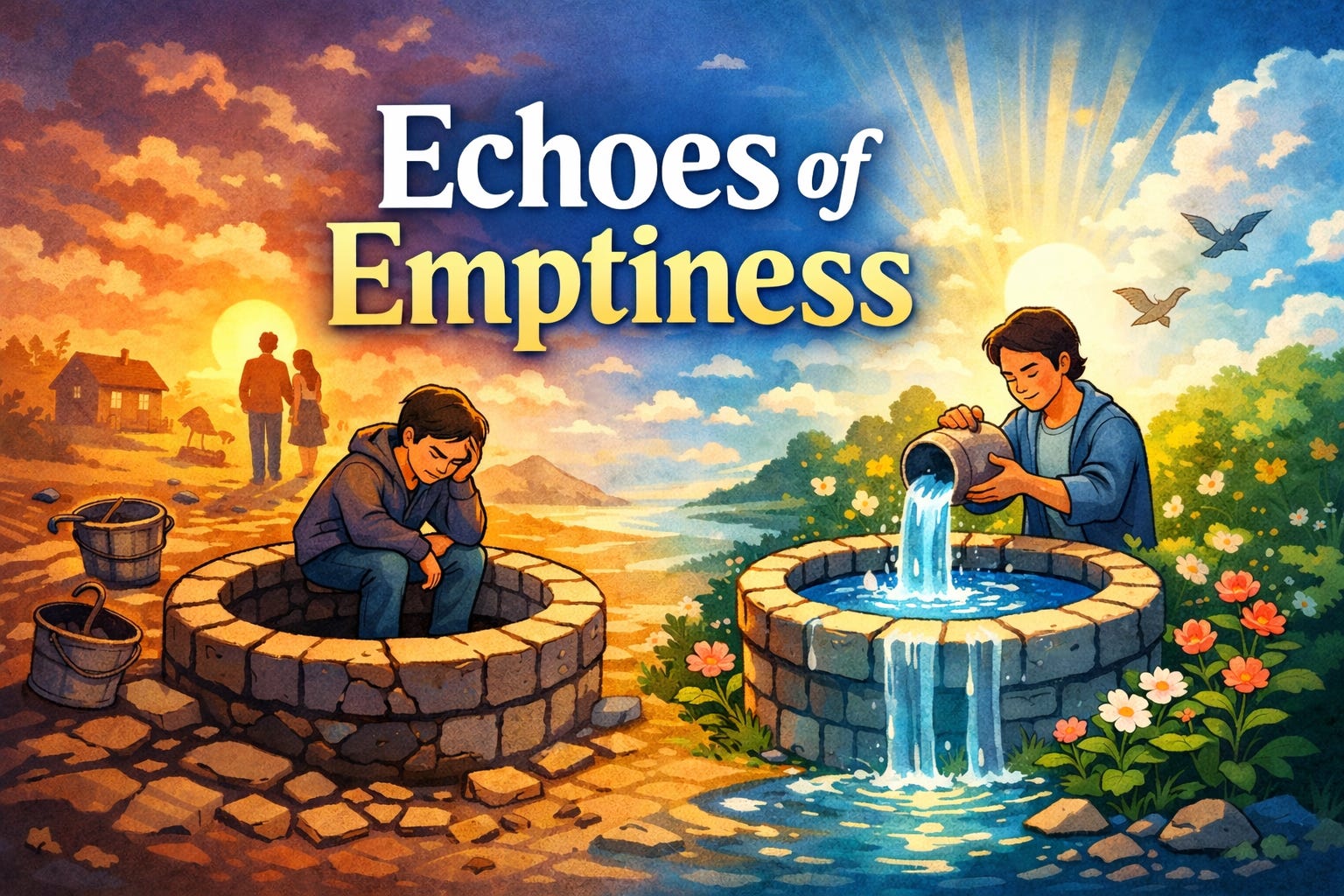
This journal post, ‘Echoes of Emptiness’, is about the quiet ache we create when we try to receive our worth from another person, as if our value is something they can hand to us. It is like trying to drink from a well of love and worth that is not ours, then blaming the well when we are thirsty. Together, we will explore how these hidden emotional transactions form, why our Inner Child believes love must be mirrored to be real, and how emotional logic pressures us to rewrite parents, partners, and close friends to get reassurance that only water from our own inner well can provide.
We will offer a fresh perspective rooted in Taoist wisdom and the practice of wu wei, and reveal why the only well that can truly nourish us is our own, and that we are the only ones who can fill it. When we keep reaching into someone else’s bucket for worth, we stay dependent on their mood, their limits, and their willingness. Still, when we return to our own spiritual wellspring, we become accountable for its upkeep: the beliefs we pour in, the stories we repeat, the standards we live by, and the truth, honesty, and integrity that keep the water clear. And together, we will answer the deeper question: “What happens when we stop waiting to be seen and begin overflowing, not by proving ourselves, but by maintaining our own ‘inner well’ until love becomes something we share, not something we chase?”
The Emotional Transaction That Never Pays
Many of us live under the belief that if someone is worthy of our love, they must naturally love us back with the same intensity, in the same form, and on the same timeline. That is the fairytale our Inner Child clings to: “If we love you this way, you will love us back the same way.” It may seem rational and even romantic, but it is not love; it is a hidden emotional transaction, and the other person has never agreed to its terms. When reality does not match the contract, our Inner Child takes the gap personally and creates rejection, not because rejection was delivered into our body, but because a faulty belief was exposed.
Then our Inner Child badgers us with its harshest conclusion: “If they do not love us our way, we are not lovable.” And from that belief, we start trying to fix the unfixable. We become emotional architects, attempting to remodel the people we love into vessels that can deliver the reassurance and validation we crave, and we call it devotion when it is really control. Yet the Tao keeps pointing us back to what is clean and true: love is not an invoice, and worth is not proven by being mirrored. When we release the contract, we stop rewriting others, stop chasing confirmation, and return to alignment, where our love can be offered freely, and our value remains untouched whether it is returned or not.
When we change our expectations, everything else changes with them. For instance, we can still love a parent deeply and kindly understand that they may not be able to fill our well with the kind of reassurance we once wanted. That is not a punishment, nor a tragedy; it is reality. The moment we accept that our worth and value do not come from them, we stop waiting for their response to “prove” we matter, and we stop depending on them to top up our worth and value.
And this is where the teaching becomes even clearer, especially when the person we are reaching for is a parent. A parent can be important in our lives, and still not be the one who defines our worth. Their limitations do not become our identity. Their tone, their approval, their absence, or their inability to express love the way we want does not add to or subtract from our value, because our value is not a verdict they can deliver. The moment we understand that, our tone shifts almost on its own. We no longer speak like we are asking for permission to be loved, because we are not. We explain ourselves with calm honesty, not to convince them to change, but to express what is true for us, and our words become simpler, steadier, and more direct, because we are no longer pleading with a dry well of worth desperate to be filled. This is the Taoist turn: we return responsibility to our own inner source, we keep our well-tended through truth, honesty, and integrity, and the relationship often becomes lighter, not because they finally become different, but because we are no longer asking them to supply what only we can choose to claim within ourselves.
If our well is dry, no amount of pleasing or perfection produces water; it only produces more effort, more striving, and more disappointment that our Inner Child quickly labels as rejection. Yet nothing called rejection is being placed in our bodies; what is happening is simpler: our expectations are colliding with reality. When we accept what is available, we stop bargaining and performing and begin building what is stable: our own spiritual wellspring, maintained by the daily choice to remember our innate worth, even when someone else cannot reflect it. And from that steadiness, we can still love them, but we love without dependency, we love without the hidden invoice, and we stop trying to fill the wrong well: “We thought our parents were a source of love. So, to receive the love we wanted, we believed we had to keep that source full. We were trying to fill them with the kind of love we wanted so they could give it back to us. We were filling the wrong well.”
This emotional insight is not a failure. It’s awakening. It’s the moment Shen speaks through the noise of our Inner Child’s emotional logic and gently reveals the truth: ‘You are your own well keeper.’
Mirrored Love Is Not Real Love
The logic of emotional mirroring is seductive. It promises equilibrium: “If I treat you well, you’ll treat me the same. If I show up for you, you’ll show up for me. If I explain how I want to be loved, and you care, you’ll do it.” But love doesn’t operate under logic. Love, especially freely given love, flows from the Shen, not from proof or instruction.
The Tao Te Ching reminds us in Verse 65: “True wisdom appears as foolishness. True kindness is mistaken for weakness. The Sage does not try to convince, only to align. Without needing approval, the way is clear.” This is the Tao’s quiet teaching: stop striving for symmetry and return to flow. Love is not proof of your value. Their failure to mirror your love does not mean you are unlovable. It means they are not your source. And if we are honest, what we were trying to do all along was this: create a proxy source of love and worth outside ourselves, and pour our energy into it, hoping it would become so full that it would overflow back into us. But that was never their job. And it was never love. It was a trade, one that depleted us every time.
Filling the Wrong Well
The belief that your mother, father, friend, or partner must reflect your worth to you is born not from Shen, but from our Inner Child’s emotional logic. It sees others as mirrors because it does not yet understand that love and worth are not reflections; they are expressions. To our Inner Child, the idea is simple: ‘If I change them to love me, I will be safe. If they love me, I am lovable.’ So, we try to pour into their emotional systems the love, values, and beliefs we want to see in return. We hope they’ll become kinder, more understanding, more like us. We hope they will ‘fill up’ with our standards of love and reflect it, proving that we matter. But this only works in fairy tales, not in reality.
We cannot put our emotions into another person’s body. We cannot make someone give us worth. We cannot install our definition of love inside them and expect them to pour it back out. That is a form of control, not love. What an insight. The well itself is not outside us. And worth, to be real, must originate from our Shen, not from another’s mouth, behaviour, or mirror.
The Stillness That Rises
Once we understand that our well of worth is our own, the next question becomes: “How do we fill it?” This is not a doing. This is not a striving. It is a return. When we stop trying to be seen, validated, mirrored, or proven, we begin to hear our Shen again. In that stillness, we are reminded: worth is not something we earn; it is something we already are.
The I Ching offers a rarely quoted but deeply resonant line from Hexagram 50, ‘The Cauldron’: “The spirit’s food is cooked over a slow, steady flame. If you rush, it spoils. If you wait, it nourishes.” Worth is not something you need to demand. It is cultivated through slow, steady, consistent alignment. You cannot force love to return to you. But you can stop abandoning yourself in the hope that it will. When you align with Shen, you stop trying to pour love into others. You begin to offer it to yourself, without agenda, without trade, without waiting for return. That is the essence of wu wei: effortless effort, choosing to let go of what was never yours to control.
Overflow Is the Answer
Love is only powerful when it is demonstrated freely, not reciprocated. It only transforms when it flows from truth, not lack. That’s the difference between needing love and creating love. This teaching, ‘Echoes of Emptiness’, invites us to leave behind the wells we’ve tried to fill for years, parents we wanted to approve of us, friends we tried to make understand us, partners we hoped would change, and return to the only well that was ever ours to tend: our own.
Let go of the strategy that love must be mirrored to be real. Instead, become your own overflowing well. Not because others deserve it, but because it is your nature. As one past journal post reminded us: “Greatness is not cultivated through grand gestures, but through the everyday choices to show up, persevere, and believe in the power of our Shen.” This is not about giving more. It’s about overflowing from wholeness, not emptiness.
Walk Back to Your Well
Let us finish where we began: with the ache of trying to teach someone how to love you. The truth is, you no longer need to. ‘Echoes of Emptiness’ is no longer your home. The silence you’ve been waiting to fill with others’ words of validation was never meant to be filled by them. That emptiness wasn’t a flaw in you; it was a sign you were looking in the wrong direction. There is an amazing wellspring within you, ancient, undamaged, overflowing. It was never empty; it was just forgotten and abandoned.
You are not the reflection of another’s love. You are the source. So, take small, consistent steps today, steps of alignment. Refuse CCJ. Do not criticise yourself for having looked outward; honour yourself for now turning inward. Do not compare your path to those who still seek validation; celebrate your decision to realign with truth. And never be judgmental about how long it has taken. The Tao does not hurry. And still, everything is accomplished. Affirm gently: “I am the well. I am full. I overflow, not to be noticed, but because it is my nature.” Now walk forward, not to fill others, not to wait for return, but to live from your own well of love and worth.
That is wu wei. That is alignment. That is freedom. That is ‘Echoes of Emptiness’ transformed into an overflowing well of love and worth.
Learning to See Without Becoming What We See
Have you ever watched yourself act in a way that didn’t seem aligned with your truth, but somehow, you couldn’t stop? Do you notice yourself caught in the same emotional reactions, anger, shame, panic, or guilt, only to wonder, “Why do I always do this?” Does it ever seem as though some younger version of you has taken over, driving the situation with a voice that is desperate, emotional, and persuasive?
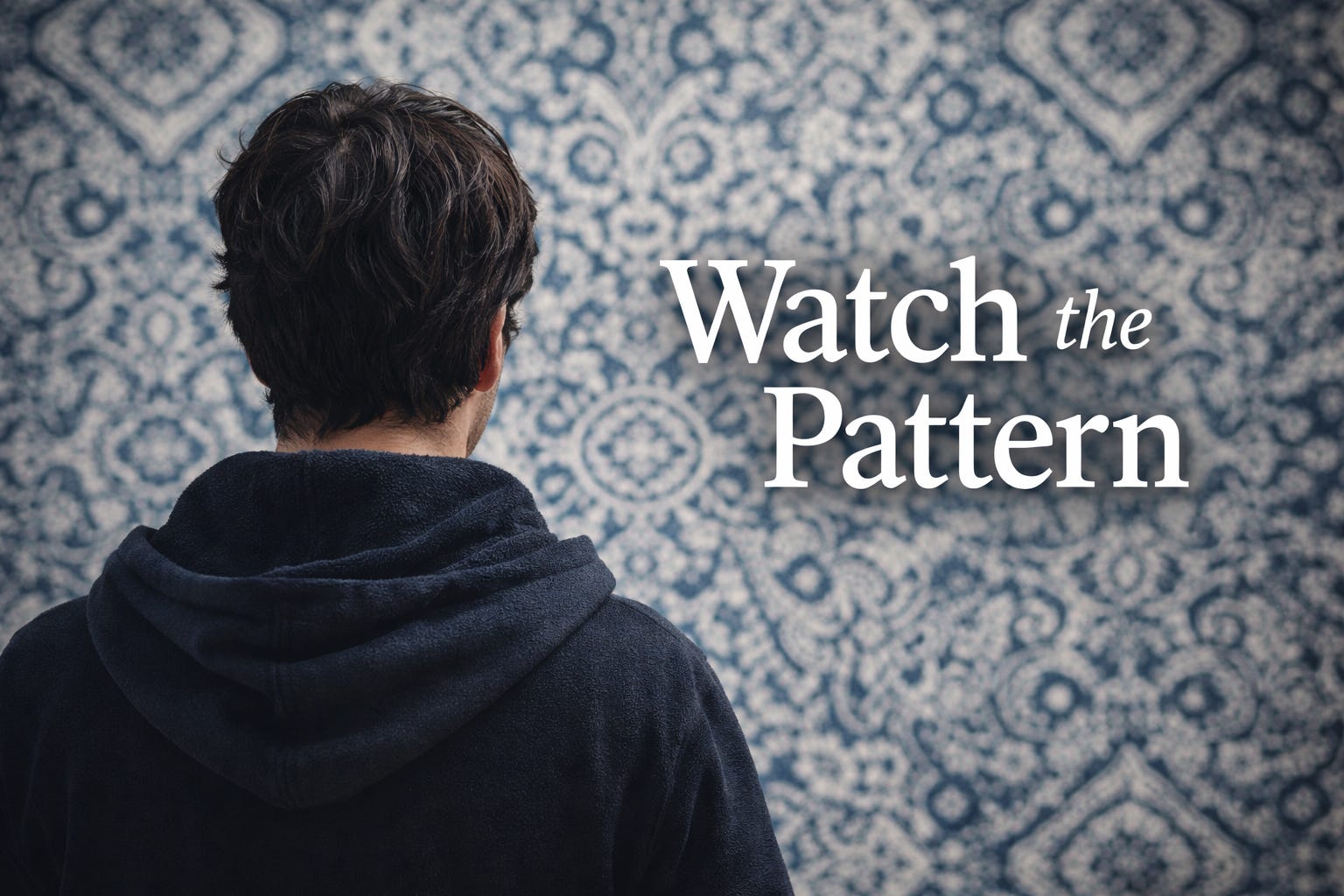
In this journal post, we explore the quiet, powerful teaching that has transformed many lives: how to see the emotional pattern without becoming the pattern. When we identify the part of the mind responsible for the reactivity, the frightened, defensive Inner Child, and learn to observe rather than obey, we open the way to a very different kind of life: one aligned with our Shen, not steered by emotional logic. We learn to ‘Watch the Pattern’ and return to the flow of wu wei.
This is not about controlling emotions or suppressing who we are. It’s about seeing clearly, leading wisely, and responding from truth, not habit. Together, we will explore how our Inner Child creates emotions based on outdated beliefs, how to guide rather than resist gently, and why this practice is one of the most profound acts of spiritual alignment. Let’s begin at the most familiar place: when the pattern takes over.
When our Inner Child Drives
There is a moment many of us recognise. It starts with a sensation, perhaps a tightening in the chest, a rush of anxiety, a wave of shame, or a flare of anger. Before we can pause, we are already reacting. Words leave our mouths. Actions unfold. And when the moment passes, something wiser inside us says, “That wasn’t me”. And in a way, it wasn’t. Or rather, it wasn’t our Shen. It was our Inner Child.
Our Inner Child is the immature, emotionally reactive part of our mind that was shaped in early experiences of misunderstanding, rejection, or unfairness. It learned that the only way to feel safe was to demand certainty and control. It learned to use emotion, panic, drama, and withdrawal as leverage.
It doesn’t reason with logic. It reacts with emotion. We call this ‘emotional logic’: a system built not on clarity but on past conclusions. So, when we create the emotion of shame, our Inner Child interprets it as proof: “I am not good enough.” When we create fear, it insists: “This must be dangerous.” When we create anxiety, it assumes: “I am about to fail.” These reactions are not thoughtful, spiritual, or genuine. But to our Inner Child, they seem real.
And so, they drive us. This is why we often hear our Inner Child nag, reproach, or badger with internal commentary like: “You always mess it up,” or “They’ll leave you,” or “You’re not as good as them.” If we are not careful, we mistake this commentary for insight. But it is only emotional logic, not Shen logic. And here is the quiet miracle: ‘We don’t have to argue. We have to observe.’
Stepping Back to See
There is immense spiritual power in a single moment of awareness. The moment we notice we are reacting, we create space. That space is nothing; it is everything. Observation creates distance. And distance creates choice. The Tao Te Ching reminds us in Verse 16: “To return to the root is to find peace. To find peace is to know stability. From stability comes clarity; from clarity, truth.” In that pause, we are no longer lost in the pattern. We are watching it. This is what it means to ‘Watch the Pattern.’
And when we watch, we are not passive. We are reclaiming our authority. We are refusing to hand the steering wheel to the emotional logic of our Inner Child. We are remembering that although the emotion may be loud, it is not in charge. It is not the truth; it is a clue. This is where reparenting begins, not as punishment, not as denial, but as redirection. We say: “Thank you for letting me know what you believe, but let me show you what is true.”
Seeing the Pattern Without Becoming It
Here is the heart of this teaching: the pattern can only control us if we believe it is true. The moment we observe it clearly, we observe the lie; its grip loosens. And we are never observing with coldness. We are watching with compassion. In the I Ching, Hexagram 20 speaks of this higher view: “Contemplate the world from the tower. The view is broad; the self becomes clear.” This higher vantage point isn’t detachment; it’s discernment. It’s seeing the whole emotional landscape, including our Inner Child’s argument, and choosing not to live by it.
Our Inner Child will protest: “But I’ve always believed this.” And we reply: “That doesn’t make it true.” It may pressure us to obey through emotional volume, but when we stand rooted in our Shen, we realise: we are not the pattern. We are the ‘Watcher.’ We are not the storm; we are the sky it passes through.
And this changes everything. We begin to respond, not from fear, but from truth. We stop asking, “How do I fix this feeling?” and start asking, “What belief created this emotion?” And this brings us to one of our most powerful tools.
The Golden Thread: Reclaiming the Truth
The ‘Golden Thread Process’ is a spiritual enquiry that leads us from the emotion to the belief beneath it. This process unravels the emotional knot, not by force, but by awareness. We ask: “What emotion am I creating? What belief is that emotion based on? Is this belief aligned with my Shen, or a message from my Inner Child?” This is how we step out of the reaction and into alignment. We stop treating emotions like truth and begin treating them like messages. And not every message deserves a follow.
This is not indulgence. This is spiritual maturity. We often say, “You cannot change what you do not understand and accept.” When we trace an emotion back to a false belief, we don’t suppress the feeling; we dissolve its foundation. This is reparenting in real-time. We guide our Inner Child back to truth. We lead with compassion and strength. And as we do, the carousel slows.
Real Strength Is Quiet
The world teaches us to fight feelings or fix them. But Taoism teaches us something different: ‘to understand them.’ The Tao Te Ching says in Verse 43: “The softest thing under heaven overcomes the hardest. It enters where there is no space. This is the power of non-action.”
We do not need to overpower our Inner Child. We need only observe and guide. This is wu wei, effortless effort. The strength that does not resist, but redirects. We see clearly, speak honestly, and act with calm alignment. We stop negotiating with fear and start leading with Shen.
And as we do, the emotional habits lose their urgency. Not because we silenced them, but because we replaced emotional logic with truth. We show our Inner Child: “I see your pain, but I will not make decisions based on it. I will lead us with clarity.”
Moving Forward with Watchful Compassion
What happens when we learn to ‘’Watch the Pattern?’ We create freedom. We reclaim leadership. We guide ourselves back into the flow of Tao. The patterns may still arise; this is normal. But we are no longer caught in them. We witness, we enquire, and we choose. So today, we invite you into this practice, when an emotional pattern arises, fear, guilt, anger, shame, pause. Step back. Ask: What belief created this feeling? Then gently affirm: “I am the ‘Watcher’. I see clearly, and I choose truth.”
Let this become your mantra. Not to escape emotion, but to understand it. Not to control our Inner Child, but to reparent it. Not to suppress the pattern, but to outgrow it. You are not the pattern. You are not the voice of our Inner Child. You are the ‘Watcher’ behind the wave. And you are never without choice.
Reclaiming Shen, One Pattern at a Time
When we learn to ‘Watch the Pattern,’ we return to our Shen. We stop being driven by emotion and start living from truth. We step off the ‘Carousel of Despair’ and into the effortless rhythm of wu wei. No longer lost in emotional logic, we remember: clarity was always there, just waiting to be chosen.
Let this journal post be your encouragement to take small, consistent, manageable steps. There is no need for grand breakthroughs. Just one moment of awareness, followed by another. Let go of Criticism, Comparing, and being Judgmental (CCJ). You are not behind. You are awakening. You do not have to fight your emotions. Just see them for what they are, creations of belief. And then choose again.
Say this to yourself, again and again: “I am the one who sees. Because I see, I choose. Because I choose, I lead.” In every moment, remember: “You are not the pattern. You are the ‘Watcher’.” And this is where absolute freedom begins.
Let us walk in that freedom, one step at a time, together as the spiritual watchers. ‘Watch the Pattern,’ and you will no longer be ruled by it. You will return, gently and powerfully, to who you truly are, awesome!
Moments of Inspiration…
Beliefs in Motion
Have we ever noticed how a single belief can colour an entire day, like a pair of tinted glasses we forgot we put on? We wake up, and our Inner Child begins to pressure us with old conclusions: “I always mess this up,” “People cannot be trusted,” “I have to earn love,” “If I relax, everything will fall apart.” These sentences may seem like the truth, but they are usually just familiar. And familiar is not the same as truth.
Taoist wisdom reminds us that our beliefs are not set in stone. They are more like paths in tall grass, walked so often they become easy to follow, even when they lead us somewhere we no longer want to go. Wu wei, effortless effort, begins when we stop wrestling the mind and start watching it. We notice the belief beneath the emotion, and we ask a calmer question: “Is this belief aligned with Shen, or is it emotional logic trying to keep us safe by keeping us small?”
When we question a belief with kindness, we do not lose ourselves. We reclaim ourselves. We make room for truth, honesty, and integrity to guide our next step. And slowly, our words change, our choices change, and our life begins to match who we truly are, not who we learned to be.
Affirm: “We are not our old beliefs; we are the awareness that can choose again, and we let Shen lead us into clearer, kinder truth.”
This week, choose one repeating belief, write it down, then rewrite it into a truer sentence you can live today, and practise it in one small, manageable action, without expectations and without CCJ.
In the Next ‘Inner Circle’ (Paid) Journal…
Truth Over Threat
Unburdened Love
Soft Truths
Moments of Inspiration
In the Next Free Journal…
Sacred Seasons
Bartering for Belonging
Beyond the Blame Game
Moments of Inspiration
Journal #F069 23/02/2026
Contact: info@wuweiwisdom.com
Website: www.wuweiwisdom.com
YouTube: www.youtube.com/user/WuWeiWisdom
Facebook Community: www.facebook.com/groups/wuweiwisdomcommunity/