
The Unperformed Self
This week, do you perform to ‘feel’ safe? Stop digging the hole of familiarity, and are you still looking for that special love? Finally, Shen will never desert you!

“I no longer shrink, explain, or hide to earn my place in the world; I choose to trust the quiet brilliance of my Shen and let it guide my steps. Like a river returning to the sea, I am gently finding my way back to the unperformed self that has been waiting for me all along.”
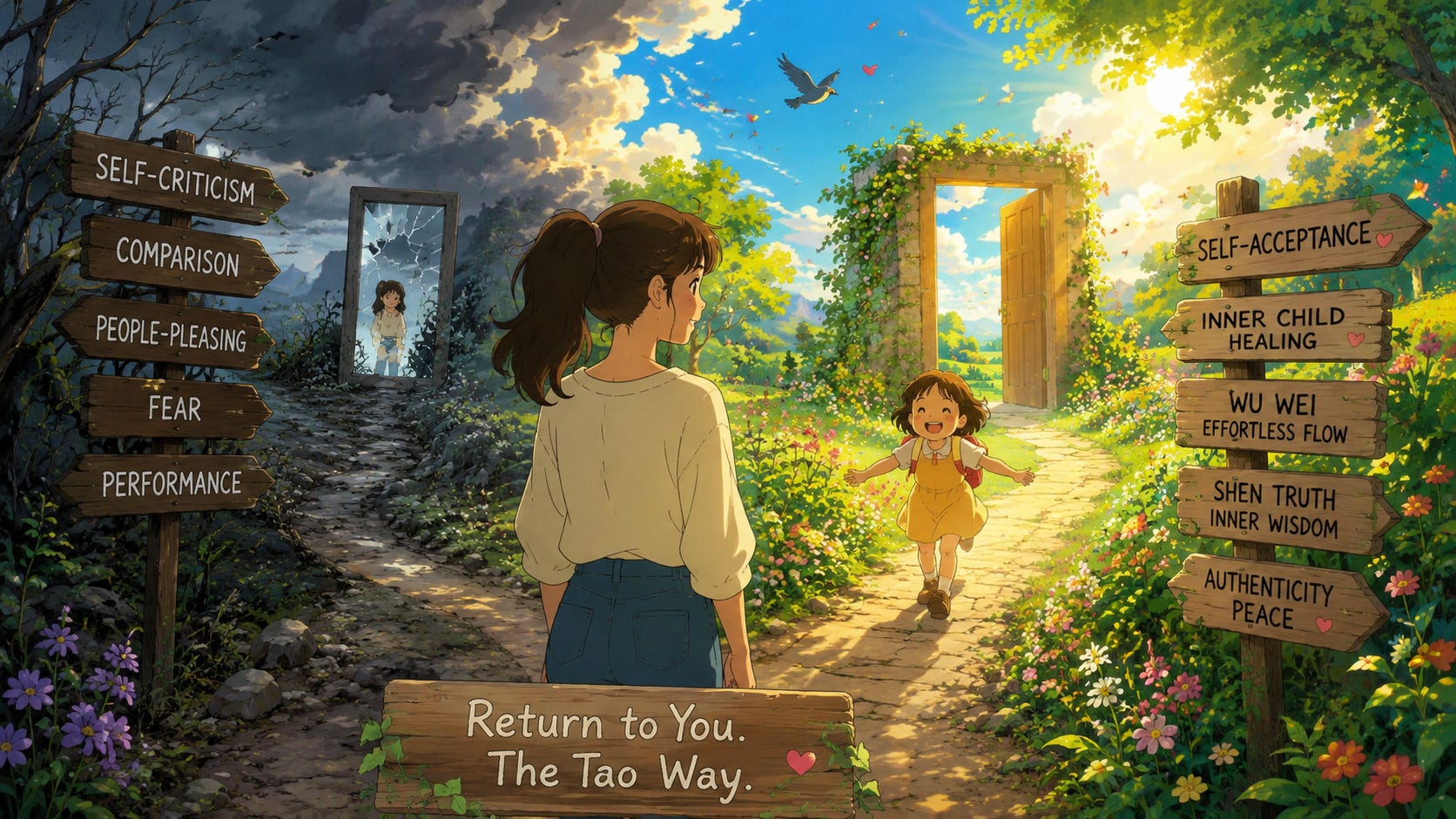
Have you ever wondered how much of your daily life is truly yours, and how much is a carefully performed act designed to be accepted, admired, protected, or misunderstood as little as possible? Do you dress, speak, smile, explain, apologise, shrink, impress, or stay silent because it expresses your Shen, or because your Inner Child is trying to manage how others see you?
In this journal post, ‘The Unperformed Self’, we will explore the subtle difference between authentic expression and strategic self-presentation, and why this matters so deeply if we want to live in alignment with the Tao. We will look at humility, trust, gratitude, social conditioning, and the quiet ways we lose ourselves in our attempts to belong. Most importantly, we will ask whether our choices arise from Shen clarity or from our Inner Child using ‘Emotional Logic’ to avoid discomfort, accountability, or rejection.
When Humility Becomes Hiding
Humility is one of the most misunderstood spiritual qualities. Many of us were taught that being humble means becoming smaller, quieter, less visible, less proud of our gifts, less willing to enjoy what we have created, and more careful not to make others uncomfortable. On the surface, this can seem thoughtful and kind, yet beneath it, there may be a hidden strategy. If we are managing our success, intelligence, beauty, privilege, kindness, or confidence so others will not criticise us, envy us, challenge us, or leave us, then we are no longer practising humility; we are practising emotional image control. Our Inner Child may pester us with the belief, “If we appear too much, we will be judged; if we appear less, we will be safe.” That belief may seem gentle, but it is still a form of control.
True humility does not need to display itself or conceal itself. The Taoist Sage does not boast, yet neither does the Sage apologise for existing. Water does not announce its usefulness, but neither does it refuse to flow because the dry earth might resent its abundance. This is where wu wei, the way of effortless effort, guides us beautifully. Wu wei invites us to act naturally, without forcing an identity, whether superior or inferior. The unperformed person does not try to seem grand, modest, spiritual, ordinary, impressive, or harmless. They return to ‘The Power of Three’, truth, honesty and integrity, and allow their words and actions to arise from Shen.
Our Tao Te Ching translation, Verse 56, gives us a profound doorway into this teaching: “Those who know do not speak about it. Those who speak about it do not know. Stillness and quietness centre on it; it softens sharpness and untangles knots.” This verse does not tell us to remain silent out of fear of being seen. It reminds us that truth does not need decoration. When we are centred in Shen, our expression carries a quiet steadiness. We do not need to oversell, defend, or hide ourselves. We soften the sharpness of performance by no longer asking identity to do the job of authenticity.
‘The self we perform is often the self we fear would not be loved if it stood still.’
Trust Without Control
Trust in a Taoist relationship is not a guarantee that another person will always behave exactly as we prefer. That version of trust belongs to our Inner Child, which wants certainty, reassurance, and future-proofing. It says, “I will trust you only if you never disappoint me, never change, never misunderstand me, and never activate my unresolved issues.” This is not trust; this is a contract written by fear. Real trust begins when we stop trying to place our emotional stability inside another person’s behaviour and return it to our own beliefs, choices, and interpretations.
No one can make us feel loved, validated, or rejected because we cannot put our emotions into another person’s body, and they cannot put emotions into ours. We create our emotional experience through the meanings we give to events. When someone keeps a promise, we may ‘feel’ warmth, safety, and appreciation because we interpret their action as an expression of care. When someone forgets, our Inner Child may trigger a red-light emotion, interpreting the event as proof that we do not matter. The event is one thing; the belief beneath the emotion is another. This is why trust must begin with self-trust. We trust ourselves to pause, examine, respond, and return to Shen before our Inner Child drags us onto the ‘Carousel of Despair’.
This does not mean we ignore behaviour. Taoism is not passivity dressed as spirituality. If someone repeatedly acts without truth, honesty and integrity, we notice. We respond, set boundaries, and make choices. Yet we do not confuse control with wisdom. We can trust our capacity to meet reality as it unfolds, rather than demanding that reality stay arranged around our comfort. This is ‘Shen Logic’, steady, mature, flexible, and honest. Our Inner Child’s ‘Emotional Logic’ wants trust to mean, “I will never be unsettled.” Shen teaches trust as, “Whatever arises, we can remain aligned with the Tao and choose wisely.”
The Borrowed Personality
Many of us believe we are expressing ourselves when we are actually expressing what we have absorbed. Our clothes, opinions, hobbies, ambitions, speech patterns, relationship roles, spiritual identity, and even our version of kindness may have been shaped by family expectations, cultural trends, school experiences, social media, religion, class, gender rules, or the silent pressure to be acceptable. This is not something to criticise. It is something to observe with compassion. A child learns by copying. Our Inner Child watches what receives praise, what causes tension, what brings a sense of belonging, and what leads to shame. Over time, those observations become so familiar that we call them our personality.
This is where ‘The Shen Test’ becomes useful. Before making a choice, we can ask, “Is this expression coming from Shen, or is this a performance designed to manage belonging?” We might ask this before agreeing to something we do not want, buying something to seem current, hiding our joy to avoid envy, presenting ourselves as more spiritual than we are, or pretending to want less because wanting has become uncomfortable. This question is not meant to create suspicion toward everything we enjoy. It is designed to return authorship to us. A hobby, style and a tradition can be genuine. The issue is not whether something comes from culture or family; the issue is whether we have consciously chosen it, or whether our Inner Child is still obeying an old rule.
In our previous teaching, we offered a line that fits beautifully here: “We can choose truth over performance, authenticity over strategy, and alignment over fear.” That is the invitation of ‘The Unperformed Self’. We are not trying to become unusual to prove we are free. Rebellion can become another costume. We are learning to notice when we mistake acceptance for alignment, popularity for truth, and familiarity for identity. The Tao does not ask us to become dramatic. It asks us to become natural.
‘Authenticity is not a louder identity; it is a quieter allegiance to truth.’
Gratitude, Desire, And Natural Expression
Gratitude is a beautiful green-light emotion when it arises from Shen. It steadies us, softens comparison, and helps us recognise the abundance already present in ordinary life. Yet even gratitude can become a performance if our Inner Child uses it to avoid desire, disappointment, responsibility, or honest self-enquiry. Sometimes we say, “We should just be grateful,” when what we mean is, “It seems safer not to want anything, because wanting may lead to disappointment.” This distinction matters. Shen gratitude opens the heart to life. Protective gratitude closes the door quietly and calls it peace.
Wanting is not automatically misalignment. Wanting can be a natural expression of creativity, growth, curiosity, service, and joy. The problem begins when our Inner Child attaches worth to the outcome. It says, “If we get this, we are enough; if we do not, we are rejected by life.” Then desire becomes tension, comparison, and control. Wu wei offers a wiser way. We can hold aspirations lightly, take small, consistent, manageable steps, and remain rooted in enoughness as we move. We can create, enjoy, explore, and express without turning every outcome into evidence of our value.
So, the practice is simple but not always easy. When a red-light emotion arises, we use the ‘Golden Thread Process’ and ask, “What belief created this emotion?” Then we ask, “Does this belief belong to Shen, or is our Inner Child protecting an old identity through the ‘Pit of Familiarity’?” We may discover a ‘Dual Belief System’: one part of us wants authenticity, while another wants approval. That discovery is not a failure. It is a ‘Life Lesson’. Once we can see the pattern, we no longer have to live inside the ‘Maze of Confusion’.
Let us close ‘The Unperformed Self’ with encouragement. We do not need to strip away every role in one dramatic moment. We can begin with one honest sentence, a genuine choice, an act of kindness without performance, or one pause before explaining ourselves, a breath before shrinking to make others comfortable, that connects you back to your authenticity.
Never doubt yourself, because our Inner Child can become emotionally noisy. But noise is not truth. Pressure is not guidance. Old fears are not your destiny. The stories we have repeated for years are not the same as wisdom, and the emotions we create are not predictions of what is possible. The Tao never asks us to become someone else. It gently invites us to remember who we were before we learned to perform, compare, and seek permission to be ourselves. Beneath all the striving, beneath every mask and expectation, there remains a quiet and steady presence within us. That is Shen. It has never been broken, diminished, or lost.
Take small, consistent, manageable steps, free from expectations and without Criticising, Comparing, or being Judgemental toward yourself or others: one kind word to yourself, one honest conversation, a moment of choosing authenticity over performance. Great transformations rarely arrive in a single dramatic moment. They unfold through these gentle acts of courage, repeated with patience and compassion.
Let Shen lead. Let wu wei, effortless effort, soften the need to force, struggle, or prove and encourage your natural flow. Trust that you do not have to rush your becoming. The oak tree does not hurry to become an oak, and the river does not criticise itself for taking a winding path. Nature unfolds into what it already is. And whenever doubt returns, as it sometimes will, use the ‘Shen Test’: Would you say these words to a physical child you loved? Would you tell that child they were too much, not enough, or destined to fail? Or would you remind them of their courage, their goodness, and their infinite potential? Speak to yourself with the same tenderness.
As we have written in our previous teachings, “I am the embodiment of infinite possibility.” Those words are not an aspiration. They are a quiet truth waiting to be remembered. The Tao brings us back to the simple courage of being who we are before performance begins. Before, we believed we had to earn our worth before we forget that we already belong.
So, let us leave this teaching with a gentle promise to ourselves: “We will stop performing our lives and begin living them. We will trust our Shen more than our fears. We will honour our Inner Child without allowing its emotional noise to lead the way.” And step by step, breath by breath, we will return to the person we have always been.
Because the most beautiful performance we will ever give to the world is not perfection, it is the quiet, courageous act of being authentically ourselves.
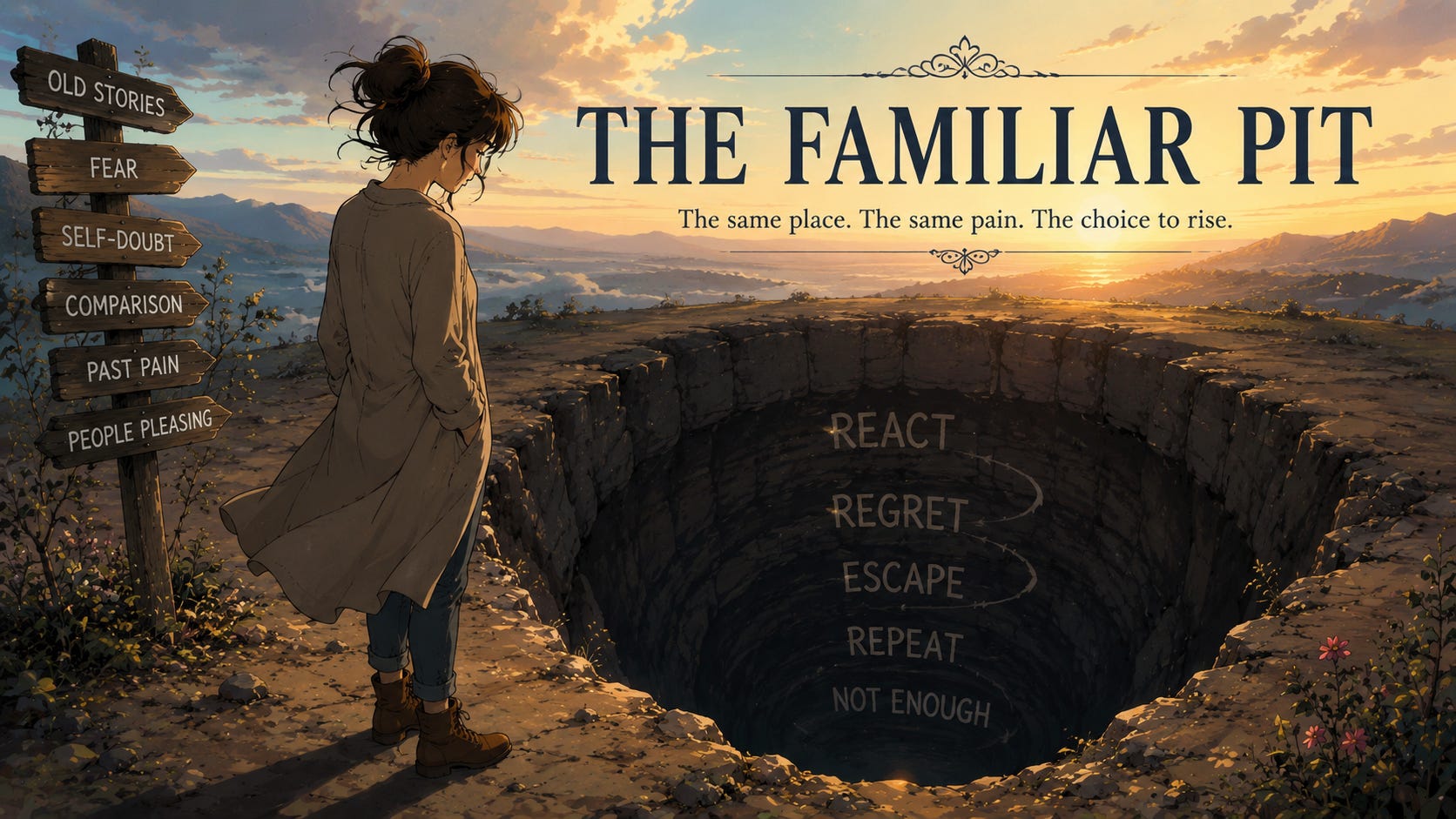
Have you ever wondered why we keep returning to the same familiar pit, even when we know it holds no peace and offers no new answers? Have you promised yourself that this time you will respond differently, only to find your Inner Child badgering you back toward the old reaction, the old defence, the old silence, or the story you thought you had already left behind?
This journal post, ‘The Familiar Pit’, explores one of the most important truths in Taoist and Wu Wei Wisdom teachings: we do not usually become trapped all at once. We lower ourselves gradually, through repeated familiar choices that our Inner Child mistakes for safety. Each avoidance, each justification, each “quick yes” when we mean “no”, each blame story, refusal to look honestly at the belief beneath the emotion, becomes another spadeful of earth removed beneath our feet. At first, the ground only dips slightly. Then the sides rise around us. Eventually, the familiar place becomes so deep that the sky of possibility seems far away, and our Inner Child calls the pit “home” simply because it recognises the walls.
In this teaching, we will look at accountability, justification, emotional avoidance, and the way our Inner Child uses ‘Emotional Logic’ to keep repeating what is known rather than choosing what is aligned. We will also explore a compassionate counterpoint, because our Inner Child is not evil, foolish, or broken. Our Inner Child is often frightened by the unfamiliar and deeply attached to whatever once helped us cope. Yet compassion does not mean giving the Inner Child permission to keep digging. Real compassion includes guidance, clarity, and accountability. So, we will learn how to stop deepening ‘The Pit of Familiarity’, how to use the ‘Golden Thread Process’ to find the belief beneath the red-light emotion, and how to return to Shen through ‘The Power of Three’, truth, honesty and integrity.
The Pit We Dig Slowly
Most of us imagine change as a dramatic doorway, something we either walk through or refuse to cross. Yet many of the patterns that shape our lives are not dramatic at all. They are small, repeated choices. We say “yes” because conflict seems uncomfortable. We blame another person because accountability seems exposing. We over-explain because silence seems unsafe. We stay in resentment because it keeps us feeling right. We delay an honest conversation because our Inner Child complains that now is not the right time. None of these choices may seem life-changing on their own, but repetition gives them weight. A familiar reaction becomes a familiar path, and a familiar path, walked downward often enough, becomes ‘The Familiar Pit’.
This is why familiarity can be more persuasive than fear. Fear is loud and obvious, but familiarity is quiet and convincing. It says, “We know this place. We know this story. We know how to survive here.” Our Inner Child may even prefer an unhappy, familiar pattern to an unfamiliar, aligned step because the known emotional landscape seems predictable. This is the great misunderstanding. Predictability is not the same as safety. Repetition is not the same as truth. A well-practised belief is not automatically Shen wisdom. It may simply be an old survival map drawn before we had the maturity, language, or spiritual awareness to understand life differently.
‘A familiar place becomes a pit when we keep returning to it to avoid truth.’
Our Tao Te Ching translation, Verse 64, offers a beautiful reminder: “A tree that fills a man’s arms grows from a tiny shoot. A journey of a thousand miles begins beneath your feet.” We often use this verse to encourage gentle beginnings, but here it also reveals a deeper warning. The pit begins beneath our feet, too. The emotional habit begins with one small repeated step. The excuse begins with one avoided truth. The identity begins with one belief our Inner Child keeps protecting. This is not a reason for shame. It is a reason for awareness, because the same smallness that created the pit can also become the smallness that helps us climb out.
Accountability Is Reality
Accountability is often misunderstood as punishment, blame, or harsh self-judgement. Our Inner Child may resist it because it imagines accountability as a courtroom where we will be condemned. So, it creates red-light emotion, then uses that emotion to avoid the truth beneath it. It may pester us with, “It was not my fault,” “They made me do it,” “I had no choice,” or “If people understood my pain, they would not expect me to be responsible.” These arguments may seem convincing when our emotional system is activated, but they belong to ‘Emotional Logic’ rather than ‘Shen Logic’.
Taoism invites us into a clearer view. Accountability is not an optional moral decoration. It is part of being alive. Every choice creates movement. Every belief creates emotion. Every avoidance creates a consequence. Even when we try to avoid accountability, we become accountable for the avoidance itself. If we hide from the truth, we are accountable for hiding. If we justify what misaligns with Shen, we are accountable for the justification. If we blame others for emotions we created through our interpretations and beliefs, we are accountable for handing away our authorship. This is not cruelty; it is spiritual reality. The sun does not stop setting because we refuse to watch it. The Tao does not stop flowing because our Inner Child argues with the current.
In our previous teaching, we said, “You are the creator of your emotions, not the victim.” This line is important here because it removes the illusion that someone else can place love, validation, rejection, anger, or shame inside us. Others may behave in ways we like or dislike, but the emotion we create comes from the meaning we give their behaviour. When we say, “They made me feel rejected,” we hide the belief behind it. A more accountable sentence might be, “I created rejection because I believed their choice meant I was not important.” That language changes everything. It does not excuse others’ poor behaviour, nor does it ask us to accept what is unhealthy. It simply returns emotional authorship to where it belongs.
The Inner Child’s Stories
Our Inner Child often avoids accountability by creating long, emotionally charged stories. These stories may contain truth, history, unfairness, and genuine unresolved issues, yet they can still become a fog if they keep us from naming the belief beneath them. A story may explain the background, but a belief explains the emotion. This is why the ‘Golden Thread Process’ is so essential. We begin with the red-light emotion and trace backwards, gently asking, “What must I be believing to create this?” Then we ask, “Does this belief align with Shen, or is our Inner Child protecting familiarity?”
For example, we may tell a long story about being overlooked, misunderstood, criticised, or unsupported. The details may matter, but beneath them may lie a simple belief such as, “I believe I only matter when others notice me,” “I believe disagreement means rejection,” or “I believe accountability means I am bad.” Once the belief is spoken plainly, the ‘Maze of Confusion’ begins to clear. Our Inner Child may reproach us for simplifying the story because complexity can be a hiding place. Yet Shen does not need drama to see the truth. Shen can hold compassion and accountability together without turning either into a weapon.
This is where we may notice a ‘Dual Belief System’. One part of us wants freedom, while another part wants the comfort of the ‘Familiar Pit.’ One part wants truth, while another part wants sympathy without change. One part wants alignment, while another part wants the old identity to remain untouched. This inner split is not a failure; it is a ‘Life Lessons’ moment. We are seeing the exact place where our next step begins. We do not need to attack our Inner Child. We guide it. We speak with loving authority: “We understand why this old story seems safe, but we are no longer going to dig deeper just because the walls are familiar.”
‘The story may explain the pit, but only accountability begins the climb.’
Climbing With Shen
Climbing out of ‘The Familiar Pit’ does not require grand gestures, dramatic confessions, or instant transformation. The Tao rarely moves through force. It teaches through steady alignment, through wu wei, the effortless effort of taking the next appropriate step without panic or self-attack. The first step may be as simple as changing our language. Instead of saying, “I cannot help it,” we say, “I have practised this pattern, and now I am learning another way.” Instead of saying, “They upset me,” we say, “I created a red-light emotion because I believed something painful about their words or actions.” Instead of saying, “This is just who I am,” we say, “This is familiar, but I will test whether it is true.”
This is the ‘Shen Test’. We pause and ask: “Would I say these words to a physical child I loved?” If we wouldn’t, then why do we hold ourselves to a different standard? Why do we speak to ourselves in ways we would never speak to someone we cherish? We then ask whether this belief, choice, or reaction carries truth, honesty, and integrity. Does it deepen the pit or help us climb out of it? Does it create clarity or more fog? Does it guide our Inner Child, or surrender to its emotional pressure? If the answer is uncomfortable, we do not use Criticism, Comparing, and being Judgmental (CCJ) against ourselves. CCJ only digs the pit deeper. Instead, we respond with clarity and kindness, because our Inner Child learns through consistency, compassion, and gentle guidance rather than condemnation.
So, let us bring this teaching into daily life. The next time we notice ourselves justifying, delaying, blaming, people-pleasing, over-explaining, withdrawing, or repeating a familiar emotional reaction, we can pause before the next spadeful deepens the pit. We can breathe and ask, “Are we climbing or digging?” That one question may become a lantern. It does not shame us. It wakes us. It reminds us that every moment offers direction. Even if we have spent years in a familiar pit, the Tao has not abandoned us, and Shen has not left us. The way out begins beneath our feet, exactly where Verse 64 told us to look.
As we close ‘The Familiar Pit’, let us remember that accountability is not the enemy of compassion. Accountability is compassion with a spine. It helps us stop pretending that avoidance is safety and reminds us that our lives are shaped by the choices we keep repeating. We do not need to doubt ourselves because our Inner Child complains or because the old walls seem high. We take small, consistent, manageable steps without expectations or Criticism, Comparing, or being Judgmental (CCJ). We stop digging one honest moment at a time. We choose one truthful sentence, one aligned action, a questioned belief, a released excuse, and one step returning to Shen. Step by step, you find the pit always had steps that become a path, the path becomes flow, and flow returns us to the Tao.

Have you ever wondered why a kind word from one person can pass through us gently, while a simple comment, a moment of silence, or an act of indifference from a parent or close relative can seem to shake the very foundation of our worth? Why does the Inner Child place such extraordinary importance on certain people, while the opinions of others seem to fade quickly into the background? In ‘Waiting For Original Love’, we explore one of the deepest emotional misunderstandings carried by our Inner Child: the belief that the “original source” of love possesses a special authority to confirm our value, remove uncertainty, and finally quiet the emotional arguments we have carried since childhood.
For many people, this belief remains invisible because it disguises itself as hope, loyalty, compassion, or family connection. Yet beneath those understandable desires, a much deeper emotional dependency can exist. Our Inner Child reasons through ‘Emotional Logic’, not ‘Shen Logic’. It does not think in balanced adult perspectives. Instead, it creates simplistic emotional conclusions. “If they finally choose me, then I will be enough.” “If they finally understand me, then my pain disappears.” “If they finally approve of me, then I can stop doubting myself.” These beliefs can quietly shape entire relationships, careers, friendships, and emotional patterns for decades.
As children, we do not understand the complexity of adulthood. We do not understand financial stress, emotional exhaustion, relationship tension, unresolved issues, or emotional immaturity. We interpret life through ourselves. If affection seems inconsistent, our Inner Child may conclude, “I must not be lovable enough.” If attention is missing, it may decide, “I must work harder to deserve it.” If approval seems conditional, the child’s mind often begins to perform emotionally in hopes of securing reassurance. This is where emotional bartering quietly begins. The child does not yet know how to create internal emotional stability, so it seeks certainty externally.
In our previous teaching, we explored how our Inner Child often creates beliefs through innocent but distorted interpretations of life events. Here, we take that understanding further by recognising that parental validation carries a unique emotional “frequency” within the Inner Child’s belief system. A stranger’s kindness may seem pleasant. A friend’s encouragement may seem supportive. A partner’s affection may seem meaningful. But parental or family approval often seems existential. The Inner Child believes the original source of love can somehow rewrite the original emotional story.
‘The Inner Child waits for proof from the past, while Shen quietly lives in the truth of the present.’
The Emotional Button
One of the most profound misunderstandings explored in this teaching is the belief that emotions are transferred from one person to another. Our Inner Child often behaves as though someone else must arrive and emotionally activate us, as though love, happiness, peace, confidence, and worth are buttons another person presses inside our body. This misunderstanding creates an enormous dependency, as we begin waiting for emotional permission to experience peace within ourselves.
This pattern reveals itself in subtle ways throughout life. Someone compliments us, and for a few moments, we seem uplifted. Someone criticises us, and suddenly our emotional world collapses in on itself. Someone becomes distant, and our Inner Child immediately starts badgering us with fearful interpretations. “What did we do wrong?” “Why are they pulling away?” “What if they stop loving us?” Yet the emotional reaction is not being injected into us by another person. It is being created by the beliefs our Inner Child already carries.
This is why Taoist teachings encourage deep self-enquiry rather than emotional blame. Others can trigger emotional reactions, but they cannot physically place rejection, worthlessness, love, or insecurity inside us. We create these emotions through our interpretations, assumptions, expectations, and unresolved beliefs. Understanding this can initially seem confronting because our Inner Child prefers the idea that someone else controls the emotional button. Why? Because if someone else controls it, then perhaps someone else can eventually rescue them emotionally as well.
This explains why many people become emotionally exhausted in relationships. They unconsciously turn others into emotional charging stations. Approval becomes a temporary emotional battery. Reassurance becomes a form of emotional sedation. Attention becomes proof of existence. Silence becomes interpreted as rejection. Our Inner Child remains trapped on the ‘Carousel of Despair’, endlessly chasing emotional certainty while never recognising that certainty built upon another person’s behaviour will always remain fragile.
Our Tao Te Ching translation offers beautiful guidance in Verse 59: “When rooted deeply, the foundation is firm. When aligned with the Tao, nothing is lost. Everything returns to balance.” This rootedness cannot come from emotional dependency because dependency constantly shifts with external circumstances. Shen alignment emerges when we recognise that our worth does not fluctuate according to someone else’s mood, attention, or emotional availability.
Hope, Fantasy, And Emotional Preservation
There is another subtle layer to this teaching that deserves careful attention. Sometimes our Inner Child does not merely seek love. Sometimes it clings to the fantasy that love will eventually arrive in exactly the way it once imagined. This is where wishful thinking quietly disguises itself as hope.
Healthy hope remains open to reality. It allows movement, truth, and adaptability. Wishful thinking often resists reality because the fantasy itself has become emotionally protective. If our Inner Child finally admits that a parent may never offer the emotional reassurance it longs for, then it must also face the grief of that unmet expectation. So instead, our Inner Child continues to wait. It pressures us to hold on to emotional negotiations with the past. “Maybe one more conversation.” “Maybe one more achievement.” “Maybe if we explain ourselves differently.”
What makes this especially painful is that many people are not waiting for ordinary affection. They are waiting for retroactive emotional proof. Our Inner Child believes that if the parent finally changes, then the entire meaning of childhood changes too. Suddenly, all the confusion would seem justified. All the striving would seem worthwhile. All the emotional bargaining would finally pay off. Yet life rarely unfolds through emotional bargaining.
In our previous teaching, ‘Already Whole’, we explored the Taoist understanding that worth is uncovered rather than earned. This teaching deepens that insight by revealing how the Inner Child continues trying to earn what Shen already knows was never absent. The tragedy is not that love was imperfect; the tragedy is that our Inner Child concludes imperfection means unworthiness.
Some may argue that these teachings minimise the influence of childhood. But this is not what Taoism teaches. Childhood conditioning absolutely shapes beliefs. Early experiences influence interpretations. Emotional environments matter deeply. Yet Wu Wei Wisdom also teaches accountability and alignment. The child was innocent in creating the belief. The adult becomes responsible for questioning whether the belief still reflects truth, honesty and integrity.
This is where the ‘Golden Thread Process’ becomes transformational. Instead of becoming consumed by the red-light emotion itself, we gently trace it back to its originating belief. “What must I believe to create this emotion?” Perhaps we discover: “I believe their approval determines my value.” Or: “I believe being overlooked means I am insignificant.” Or even: “I believe love must be earned through performance and sacrifice.” Once clearly seen, these beliefs begin to lose their emotional authority. If you observe the pattern, you cannot be the pattern.
‘The moment a belief becomes visible, the Tao invites us to choose again.’
The Exhaustion Of Emotional Bartering
Many people trapped in this pattern become exceptionally caring, giving, attentive, and emotionally available. On the surface, these qualities may seem deeply compassionate. Yet beneath the surface, our Inner Child may still be emotionally bargaining. It reasons, “If we do enough, perhaps we will finally receive the emotional proof we crave.” This often creates people-pleasing, overgiving, emotional caretaking, and constant monitoring of others’ reactions.
A child who once believed love depended upon performance may grow into an adult who constantly tries to manage emotional outcomes. They may become hyperaware of tone, silence, body language, and approval. They may exhaust themselves attempting to maintain emotional harmony because uncertainty seems dangerous to the Inner Child. Yet the more we attempt to control emotional outcomes externally, the further we drift from wu wei and effortless alignment.
Water does not force the riverbank to approve of its direction before it flows. Trees do not pause their growth waiting for applause. Nature does not emotionally negotiate its worth before expressing itself. The Tao moves naturally because it is aligned with its essence. Shen functions in the same way when it is no longer trapped beneath emotional dependency.
In our previous teaching, ‘Anchored in Truth’, we explored how emotions are messengers rather than masters. Some emotions originate from Shen and reflect peace, joy, compassion, and alignment. Others are created through our Inner Child’s unresolved beliefs and signal disharmony. The teaching is not asking us to suppress emotion. It is inviting us to distinguish the source. A red-light emotion does not automatically reveal truth. Often, it reveals our Inner Child attempting to avoid uncomfortable realities or preserve old emotional stories.
This understanding softens self-judgement enormously. We stop treating ourselves as broken. We stop criticising ourselves for creating emotional reactions. Instead, we become curious. We begin asking deeper questions. “What belief is my Inner Child protecting right now?” “What emotional story am I still trying to preserve?” “Am I seeking love, or am I seeking emotional proof?”
Returning To Original Truth
The path forward is not emotional detachment. Taoism does not ask us to stop loving others or to pretend that relationships do not matter. Instead, it encourages us to relate from authenticity rather than emotional dependency. We can love deeply without handing another person authority over our worth. We can appreciate affection without requiring it for emotional survival. We can honour family relationships without turning them into emotional courts deciding our value.
This is the deeper invitation of ‘Waiting For Original Love’. Our Inner Child waits beside the old emotional doorway, hoping someone from the past will finally arrive carrying certainty, reassurance, and proof. Shen quietly reminds us that what we were searching for was never absent from us in the first place.
Our I Ching translation beautifully reflects this movement back toward inner clarity: “The answers we seek have always been within us, quietly resting in the depths of our being.” When we stop demanding that others repair our emotional interpretations, we begin returning to alignment with the Tao. We discover that love shared freely is beautiful, yet love used as proof becomes emotionally imprisoning.
So, let us continue taking small, manageable, honest steps. Let us observe our emotional reactions without Criticism, Comparing and being Judgemental (CCJ). Let us recognise when our Inner Child reproaches us for not receiving enough attention, enough reassurance, or enough approval. Let us gently guide it back toward ‘Shen Logic’, where truth no longer depends upon emotional negotiation. And when we notice ourselves waiting for someone else to press the emotional button, may we pause and remember this quiet Taoist truth: our Shen was never waiting to become worthy. It was only waiting for us to recognise what has always existed within.
In the end, ‘Waiting For Original Love’ is not really about losing hope. It is about letting go of the exhausting belief that our love and worth must come from another significant person’s recognition. The Tao has never asked us to prove our value before flowing. Nature has never required permission to bloom. So, why should we?
Moments of Inspiration…
Always Waiting
Shen never deserts us. It is there at the beginning, there at the end, and quietly present in every moment between. Even when our Inner Child becomes loud with fear, doubt, or old emotional logic, Shen remains steady, like a candle protected from the wind.
We may ignore it. We may chase external approval, wait for others to confirm our worth, or believe that love must come from“external sources” before we can rest. Yet Shen does not withdraw its light because we forget to look inward. It waits without judgment, because our authentic spirit is not fragile, offended, or conditional.
This is one of the most comforting truths in the Wu Wei Wisdom teachings. We are not trying to earn Shen. We are learning to reconnect with the innate spirit that has always been our birthright. In the previous teaching, ‘Waiting For Original Love’, we explored how the Inner Child can look outward to parents, family or community for the love and approval it believes will finally make us whole. But Shen reminds us that wholeness was never waiting outside us.
The Tao does not force the flower to bloom. It simply provides the quiet conditions for unfolding. In the same way, we return to Shen through small moments of truth, honesty, integrity, and gentle self-acceptance.
Affirm: “My Shen has never left me. I now return to its quiet wisdom, trusting that I am already held, already worthy, and already whole.”
This week, let us stop searching outside for what has always lived within. Let us return, breathe, listen, and allow Shen to lead.
In the Next ‘Inner Circle’ (Paid) Journal…
The Known Cage
Protected From Life
The Thawing
Moments of Inspiration
In the Next Free Journal…
The Private Kingdom
The Emotional Stage
Authentic Harmony
Moments of Inspiration
Journal #F087 29/06/2026
Contact: info@wuweiwisdom.com
Website: www.wuweiwisdom.com
YouTube: www.youtube.com/user/WuWeiWisdom
Facebook Community: www.facebook.com/groups/wuweiwisdomcommunity/