
Unborrowed Inner Safety
This week, stop chasing others to prove your worth; let go of old stories and find the freedom to live your own life. Finally, you cannot escape self-responsibility.

“We begin to discover a deeper peace when we stop searching for proof of our worth in the hands of others and gently return to the quiet wisdom of our own Shen. As we follow this journey together, we may uncover that the safety we have been seeking has been waiting within us all along, patiently inviting us home.”

Have you ever reached for reassurance and noticed that it calms you only for a moment, before the same question returns wearing a different face? Have you ever loved others with great effort, patience and loyalty, while quietly believing that giving yourself the same care would be selfish, undeserved, or somehow unsafe? Have you ever looked to a partner, parent, friend, child, teacher, or community to soothe what you have not yet learned to soothe within yourself?
In ‘Unborrowed Inner Safety’, we approach a fascinating and significant doorway in our Wu Wei Wisdom teaching: the doorway of understanding that safety, worth, and emotional stability cannot be borrowed from another person and held as our own. We may receive compassion, support, and encouragement from others, which are wonderful blessings, but they do not define our worth. They may remind us of what is real, but they cannot serve as the foundation for our own truth unless we choose to believe it.
The Reassurance Loop
Many of us begin our lives by learning what love means from the emotional environment around us. If care was uneven, approval was unexpected, or grownups around us were emotionally unavailable, our Inner Child may have formed a simple but powerful belief: “If I can get enough reassurance from outside, I will finally be safe inside.” This belief may not be expressed overtly, but it can subtly alter our relationships over time. We may appear calm in work life, capable of handling obligations, and even successful in the outside world, but our personal lives are where this old belief manifests itself. Our Inner Child begins to pester, criticise, whine, and badger: “Ask again. Check it again. Make sure they love us. Ensure they do not depart. Make sure we are enough.” This is not love leading us; it is ‘Emotional Logic’ seeking assurance.
The challenge is that reassurance might become like sipping salt water when we are thirsty. It appears to help for a moment, but the deeper thirst persists because the underlying idea has not changed. If we believe “I cannot soothe myself,” we must repeat every reassurance we get from others because we have not acknowledged the fact that we may be our own safe harbour. In our previous teaching, we stated that “Rooted worth begins with understanding that personal value is inherent.” It is not something to earn or prove; it is something to be acknowledged. This marks the beginning of a new perception. We are not attempting to eliminate the need for others, nor are we denying the importance of connections. We are learning not to hold another person accountable for an emotional condition we create via our own ideas.
‘Reassurance can comfort the moment, but truth must steady the roots.’
The Childhood Vow
When love appears ambiguous in childhood, a powerful childlike view typically emerges. A child may not be mature enough to declare, “The adults around me are limited, struggling, unavailable, or unable to meet my needs.” Instead, our Inner Child may make the heartbreaking vow: “It must be me. If I were more lovable, calmer, better, easier, or useful, I would get the love I need.”
This is ‘Emotional Logic’ because it gives our Inner Child a sense of control. If the problem is us, then perhaps we can fix ourselves and finally receive love. But this innocent conclusion becomes a cage. We begin trying to earn what was never meant to be earned. We overgive, overexplain, overadapt and overlove others, while withholding tenderness from ourselves because our Inner Child still believes self-love must be deserved.
This is where ‘The Shen Test’ becomes essential. Would we tell a physical child that a parent’s limitations prove the child is unworthy? Would we teach a small child that love must be earned by self-abandonment? Would we say, “You must soothe everyone else first, and only then may you matter”? Of course not. So, we must ask why we allow our Inner Child to continue living under a rule we would never teach to a physical child we love. Shen brings a different logic, ‘Shen Logic’, which is clear, steady and truthful. Shen says, “Another person’s limitation is not evidence of our lack of value.” “We can love others deeply without making their response the measure of our worth.” “We are allowed to care for ourselves without apology.”
The Source of the Emotion
This teaching asks us to be more precise in our language because vague emotional language keeps us in the ‘Maze of Confusion’. When we say, “They made me ‘feel’ rejected,” we lose sight of our creative power. No one can put rejection into our bodies. No one can give us love as an emotion or remove it. No one can inject validation into our emotional system or take away our worth with their thoughts or opinions. What we experience emotionally is shaped by our interpretations and beliefs. A person may not reply, but we create the red-light emotion through the belief, “Their silence means I do not matter.” A partner may seem distracted, but we create anxiety through the belief, “If they are not focused on me, I am unsafe.” A family member may be limited, but we create shame through the belief, “Their inability to love me properly means I was difficult to love.”
This is not to blame. This is freedom. Once we see that the emotion comes from the belief, we can use the ‘Golden Thread Process’ to trace it back with compassion and accuracy. We ask, “What must I be believing to create this red-light emotion?” Then we ask, “Is this belief aligned with Shen, or is our Inner Child using emotion to avoid an uncomfortable truth?” Emotions are natural and normal. Peace, contentment and joy can arise from Shen and reflect alignment. Other emotions, especially those filled with urgency, control, panic, resentment or demand, may be created by our Inner Child’s beliefs and may be trying to deflect accountability. They may seem honest because they are intense, but intensity is not truth. It is a signal asking us to look deeper.
Our Tao Te Ching translation, Verse 38, gives us a beautiful teaching for this moment: “Being in yu wei means swinging to the extremes of imbalance, seeking reassurance, gratification and approval from others. When you act from your wu wei balance, there is nothing to show off and nothing to boast about.” This verse points directly to the difference between borrowed safety and inner alignment. Yu wei is the pushing, grasping, proving and seeking. Wu wei is effortless effort, the calm movement of truth that does not need to manipulate life into making us feel secure. When we act from wu wei, we do not need to demand constant reassurance because we are learning to stand in the centre of our Shen.
Becoming Our Own Safe Place
The counterargument may arise quickly: “But people need people.” Yes, we do. Connection is part of life’s beauty and diversity. We are not teaching emotional isolation, cold detachment, or pretending that love does not matter. We are teaching emotional responsibility. There is a profound difference between receiving love and needing another person to prove our worth. There is a difference between enjoying reassurance and depending on it to survive emotionally. There is a difference between allowing support and handing over the steering wheel of our inner world. Taoist wisdom does not ask us to close our hearts; it asks us to stop making our hearts dependent on conditions we cannot control.
So, how do we practise ‘Unborrowed Inner Safety’ in daily life? We begin with small moments of self-love, not as a technique to get rid of emotion, but as a teaching to our Inner Child. When the urge to seek reassurance rises, we pause before acting. We might say inwardly, “We are creating this red-light emotion because we believe we are unsafe without their response. Let us check whether that belief is true.” We may place a hand on the heart, breathe gently, and respond with honesty: “We can want connection without making it proof of our worth. We can wait without abandoning ourselves. We can care without chasing.” This is not a performance. It is a new relationship with ourselves based on ‘The Power of Three’: truth, honesty and integrity.
In our previous teaching, we offered a practical reminder that remains useful here: “When we shift our language to, ‘I am creating this red-light feeling,’ we reclaim our power.” This sentence is more than a phrase; it is a doorway. It brings us out of helplessness and into responsibility. It teaches our Inner Child that emotions are not enemies, but neither are they masters. We can listen without obeying. We can care without collapsing. We can guide without Criticism, Comparing and being Judgemental (CCJ).
The ‘Power of Familiarity’ will still pull us back at times. Our Inner Child may prefer the old pattern because it knows the steps, even when the dance leads to the ‘Carousel of Despair’. It may say, “This is too difficult. Just ask them again. Just get the reassurance. Just make the discomfort stop.” But we are learning that stopping discomfort is not the same as creating alignment. Sometimes the most loving response is not to give our Inner Child what it demands, but to give it what it needs: truth, steadiness, and patient guidance. This is ‘The Power of Three’: truth, honesty and integrity. Truth asks what is real. Honesty asks what we believe. Integrity asks whether we will live from Shen or continue feeding an old emotional habit.
‘The safety we seek from others becomes stable only when we awaken it within ourselves.’
As we bring ‘Unborrowed Inner Safety’ to a close, let us return to the pain points we began with. If we keep needing reassurance, the problem is not that we are weak; it may be that our Inner Child still believes safety must arrive from outside. If we struggle to love ourselves, the problem is not that we are unlovable; it may be that an old childhood vow taught us to prioritise earning love over recognising worth. If we create anxiety in relationships, the problem is not necessarily the relationship; it may be the belief that another person’s behaviour has the power to define us. These are not reasons for shame. They are ‘Life Lessons’, invitations to return to Shen with greater clarity.
Let us take small, consistent, manageable steps without expectations. Let us practise pausing before seeking reassurance, naming the belief beneath the red-light emotion, and answering our Inner Child with love, patience and truth. Let us stop outsourcing our worth and begin remembering what Shen has always known. Never doubt yourself. Doubt the belief that says you cannot love yourself. Doubt the story that says love must be chased. Doubt the emotional argument that says another person’s response decides your value. Then return to the Tao, wu wei, and the quiet inner centre where worth is not borrowed, safety is not begged for, and love flows from alignment rather than need.
This is the gentle promise of ‘Unborrowed Inner Safety’. We are not becoming worthy; we are recognising that we have always been worthy. We are not forcing ourselves to be independent; we are learning to stand in our Shen while remaining open to love. We are not closing the door on others; we are opening the door within ourselves. And from that inner doorway, we walk forward with truth, honesty and integrity, one calm step at a time.
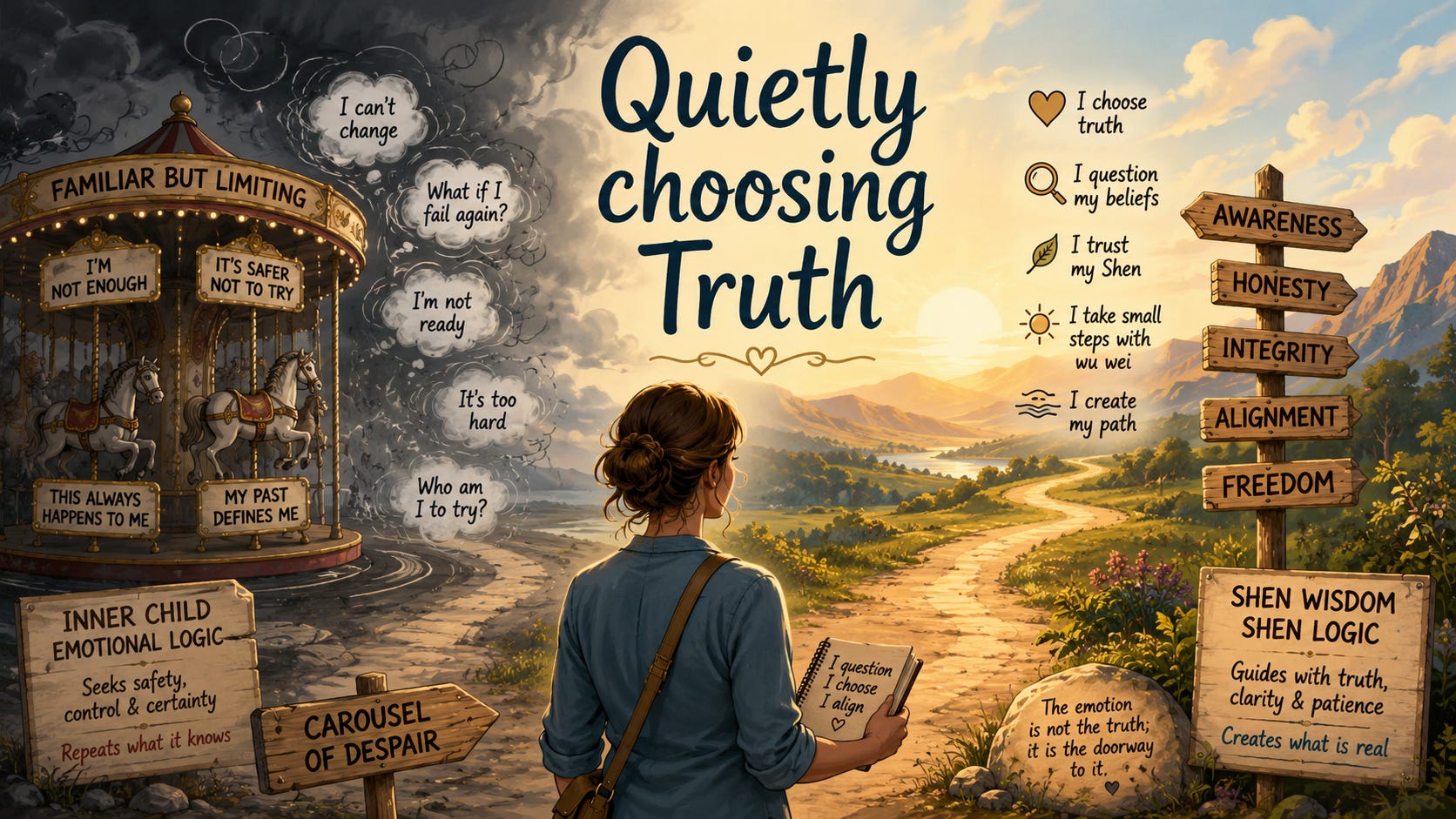
Have you ever noticed how quickly you can explain yourself, justify your reactions, or defend your situation, not to others, but within your own mind? Have you ever paused mid-thought and wondered whether what we are telling ourselves is actually true, or simply familiar? And more importantly, have you ever questioned why certain beliefs seem so convincing, even when they quietly limit your growth, your confidence, and your ability to move forward?
In ‘Quietly Choosing Truth’, we explore a subtle but powerful shift in awareness. Not a dramatic transformation, not a forceful change, but a gentle and consistent return to truth, honesty and integrity. Many of us are not held back by a lack of ability, opportunity, or intelligence. Instead, we are held in place by beliefs that have become so normal, so rehearsed, that they seem like reality. Our Inner Child, operating through ‘Emotional Logic’, creates convincing arguments for why we should remain where we are, while our Shen, the spiritual essence, through ‘Shen Logic’, quietly invites us to question, observe, and choose differently.
The challenge we face is not whether we can change. The challenge is whether we are willing to look beyond the story we have been telling ourselves. Because often, what seems like truth is simply a repeated conclusion, reinforced by emotion and protected by familiarity. And so, this teaching is not about fixing ourselves, but about seeing clearly, perhaps for the first time, that we are not stuck; we are choosing, and that choice, once seen, becomes the doorway to alignment.
There is something deeply compelling about the stories we create about our lives. They give us context, identity, and a sense of continuity. When something difficult happens, our Inner Child does not sit quietly and reflect with patience. It reacts, interprets and concludes. It builds meaning quickly, often without depth, but with strong emotional conviction. A moment of disappointment becomes, “This always happens to me.” A moment of rejection becomes, “I am not enough.” A moment of uncertainty becomes, “It is safer not to try.” These are not just passing thoughts; they become foundations upon which future decisions are made.
Over time, these beliefs become less visible. They move from conscious thoughts into automatic responses. We no longer hear them clearly, but we see their effect. We hesitate, withdraw, procrastinate and avoid. And when asked why, we may genuinely say, “I don’t know.” Yet, beneath that uncertainty lies a quiet knowing, a belief that has already decided the outcome before we have even begun. This is why the teaching, “I am never surprised by what I already know,” resonates so deeply within us. It reminds us that our behaviours are rarely random. They are consistent with what we believe to be true.
‘What we refuse to question, we unknowingly obey.’
So, the question is not whether we have beliefs shaping our lives, but whether we are willing to examine them honestly. And, honestly, in this context, honesty is not harsh or critical. It is curious, open, and grounded in ‘The Power of Three’: truth, honesty and integrity. When we begin to apply this to our inner dialogue, we notice something important. Many of the beliefs we defend would never be offered to someone we care about. We would not tell a child, “There is no point trying,” or “Your past defines your future.” We would not encourage them to give up, to withdraw, or to see themselves as limited. Yet, within our own thinking, these beliefs can seem reasonable, even justified.
This is where the ‘Shen Test’ becomes essential. We ask ourselves, “Would I teach this belief to someone I love?” If the answer is no, then we must question why we are teaching it to ourselves. This is not about rejecting our Inner Child, but about guiding it. Our Inner Child is not flawed; it is inexperienced. It uses ‘Emotional Logic’ to create certainty in uncertain situations. It seeks control, validation, and reassurance. It may complain, nag, reproach or pressure us into staying with what it knows, because what it knows seems safe.
But safety, when based on limitation, becomes a quiet form of restriction. It keeps us within the same emotional patterns, the same conclusions, the same outcomes. This is how we find ourselves on the ‘Carousel of Despair’, repeating the same experiences, not because life is against us, but because our beliefs are guiding us back to what is familiar. The familiarity itself becomes the comfort, even when it does not bring fulfilment.
At this point, it is natural for a counterargument to arise. We may think, “But my past was difficult,” or “My situation is genuinely challenging.” And this is valid. Life presents circumstances that are not always fair, easy, or predictable. However, the teaching does not deny this. Instead, it invites us to look deeper. The event itself may be beyond our control, but the meaning we give it, the belief we form from it, and the identity we create around it are within our awareness.
Our Tao Te Ching translation offers a powerful insight into this in one of its lesser-visited teachings: “When you release the need to hold, the path opens without effort; when you cling, even the smallest step becomes heavy.” This speaks directly to the nature of wu wei, effortless effort. It is not that we stop acting, but that we stop forcing ourselves to hold onto beliefs that no longer serve us. We stop defending the story and begin exploring the truth.
The truth is often simpler than the story. The story says, “I am stuck because life is difficult.” The truth says, “I am choosing to believe that difficulty means I cannot move forward.” The story says, “They made me ‘feel’ rejected.” The truth says, “I am creating rejection by believing their actions define my worth.” These shifts in language may seem subtle, but they are profound. They move us from reaction to awareness, from victimhood to responsibility, from confusion to clarity.
This is where the ‘Golden Thread Process’ becomes our guide. We take a red-light emotion and follow it back. Not to the event, but to the belief. We ask, “What must I believe to be creating this emotion?” And then we gently examine that belief. Is it true? Is it helpful? Does it align with Shen? Or does it reflect the protective, yet limiting, reasoning of our Inner Child?
‘The emotion is not the truth; it is the doorway to it.’
When we begin to practise this consistently, something shifts. Not suddenly, not dramatically, but steadily. We become less reactive and more reflective. We begin to notice when our Inner Child is taking control, using emotion to protect a belief. And instead of following it unthinkingly, we pause, listen and acknowledge. And then we choose. Choosing differently does not require force. It requires awareness. This is the essence of wu wei. Effortless effort is not the absence of action; it is the absence of resistance. When we stop resisting truth, when we stop defending limitation, change becomes natural. We do not have to push ourselves into a new identity. We stop reinforcing the old one.
In our previous teaching, we explored how emotions are not masters but signals that guide us toward alignment. This aligns beautifully with what we are discovering here. Emotions created by Shen bring clarity, calm, and steadiness. Emotions created by our Inner Child often bring urgency, intensity, and a demand for immediate reaction. Neither is wrong, but they serve different purposes. One reflects alignment, the other reveals misalignment.
‘Our task is not to eliminate emotions, but to understand and ‘own’ their source.’
When we understand this, we step out of the ‘Maze of Confusion’. We stop asking, “Why is this happening to me?” and begin asking, “What am I believing that is creating this experience?” This question does not trap us; it frees us. It brings us back to choice. And choice, when grounded in Shen, is powerful.
It allows us to take small, consistent, manageable steps forward, not with pressure, not with expectation, but with clarity. We do not need to solve everything at once. We do not need to transform overnight. We need to be honest in the next moment. To question the next belief. To respond authentically in the next situation. This is how we step off the ‘Carousel of Despair’, not by jumping, but by slowing it down, observing it, and choosing to step off when we are ready.
‘Change begins the moment we stop defending what limits us.’
As we bring this teaching to a close, let us return to the essence of ‘Quietly Choosing Truth’. This is not a loud declaration. It is not a dramatic shift. It is a quiet, consistent practice. It is the willingness to look at ourselves with honesty, to guide our Inner Child with patience, and to trust our Shen with confidence. We are not here to criticise ourselves. We are not here to compare or judge. We are here to understand. And from that understanding, we find alignment.
So, let us move forward without expectations, without Criticism, Comparing and being Judgemental (CCJ), and with a gentle commitment to truth. One belief at a time. One step at a time. One moment of awareness at a time. Never doubt yourself. Question the belief, not your worth. Question the story, not your ability. Because you are not the limitations you have believed. You are the awareness that can choose again.
And in choosing again, quietly, consistently, and honestly, we return to flow, to alignment, and to the deeper truth that has always been within us. This is the path of ‘Quietly Choosing Truth’.

Have you ever wanted freedom, but still waited for permission? Have you ever said, “I do not want to be controlled,” while quietly hoping someone else would approve of your choices? Have you ever resisted another person’s authority, yet still treated their opinion as more important than your own truth?
This is one of the most subtle emotional contradictions we can carry. We want autonomy, but we also want a stamp of approval. We want to walk our own path, but we keep glancing over our shoulder to see who is pleased, disappointed, impressed, or disapproving. We say we want to live authentically, yet our Inner Child keeps badgering us with the same old question: “But what will they think?”
In this journal post, ‘Choose Your Authority’, we will explore a powerful doorway into self-trust. We will look at why giving someone authority over our worth also gives them control over our emotional world, why approval can become a hidden form of dependency, and why our Inner Child’s ‘Emotional Logic’ often mistakes others’ confidence for truth. Most importantly, we will return to the Taoist path of wu wei, where we stop forcing others to agree with us and begin aligning with our Shen through truth, honesty and integrity.
The Hidden Contract of Approval
Approval seems harmless. It can even seem loving. We may tell ourselves, “I only want them to understand,” or “I just want their blessing,” but beneath this longing lies a hidden contract. The contract says: “If you approve of me, I can trust myself. If you disapprove of me, I must doubt myself.” This is not love. This is borrowed authority.
When we give someone the power to validate our choices, we also give them the power to invalidate them. We cannot hand someone the crown and then complain when they sit on the throne. This is the contradiction our Inner Child often refuses to see. It wants approval without control. It wants another person to say, “Yes, you are right,” while still insisting, “But I am free.” Yet authority and control are closely linked. If we decide someone has the authority to confirm our worth, then their disagreement will seem threatening, their silence will seem rejecting, and their criticism will seem powerful.
‘The person we ask to crown us is the person we allow to unseat us.’
The Tao does not ask us to disrespect others. It does not teach coldness, rebellion, or emotional distance. It teaches alignment. We can love, listen and respect someone, and still not give them authority over our Shen. Love does not require obedience. Respect does not require submission. Family, friendship, tradition, or history do not automatically outrank our inner truth.
Our Tao Te Ching translation reminds us in Verse 65: “The ancient ones taught by inspiring, Not dictating what they should do to others. Why did they allow people to find their way? To create self-responsibility, virtue, and alignment with the Tao.” This is a profound teaching because it shows us the difference between guidance and domination. True wisdom inspires responsibility. Control weakens it. When we are constantly seeking approval, we may believe we are being humble, but we may actually be avoiding responsibility for our own path.
When Our Inner Child Wants Permission
Our Inner Child often believes that approval equals safety. This belief usually began long before we had the maturity to question it. As children, approval from authority figures may have seemed essential. Their praise brought comfort. Their criticism created red-light emotion. Their disappointment may have seemed like a threat to their sense of belonging. So, our Inner Child learned a simple rule: “If they approve, I am safe. If they disapprove, something is wrong with me.”
This is ‘Emotional Logic’. It is not foolish, but it is immature. It is based on old interpretations, repeated experiences, and unresolved issues that were never examined through adult clarity. ‘Shen Logic’ is different. ‘Shen Logic’ asks: “Is this true? Is this honest? Is this aligned with integrity? Would we teach this belief to a physical child we loved?” This is where ‘The Shen Test’ becomes essential. If our Inner Child says, “I need their approval before I can trust myself,” we pause and ask, “Would we teach a child that their worth depends on another person’s permission?” Of course, we wouldn’t. We would teach that child to listen, reflect, learn, and then stand in their truth. So why would we teach ourselves anything less?
In our previous teaching, ‘Beyond the Illusion of Control’, we offered this reminder: “You are not on trial. You are in flow. And the Tao does not judge what it creates; it supports it.” This line matters here because approval-seeking puts us back on trial. It makes life into a courtroom and others into judges. But the Tao is not a courtroom. It is a river.
The Circle That Keeps Us Small
One of the most powerful questions we can ask through the ‘Golden Thread Process’ is this: “Why do I choose their authority over my own worth and value?” At first, our Inner Child may resist. It may complain, pester, or chastise us with answers like, “Because they know better,” or “Because they are family,” or “Because they sound so confident.” But confidence, position, volume and repetition are not truth.
Often, the belief becomes circular. “They are right because they have authority, and they have authority because they are right.” But where is the truth in that? Where is the evidence? Where is ‘The Power of Three’: truth, honesty and integrity? When we investigate this circle, we may discover something fundamental. The issue is not really the other person. The issue is self-trust. We are not only asking, “Do they approve of me?” We are really asking, “Can I trust myself if they do not?” This is the breakthrough.
The moment we see this clearly, the ‘Maze of Confusion’ begins to loosen. We stop blaming others for having opinions. We stop demanding they become different before we can be peaceful. We stop putting our emotional system in their hands. We remember that others cannot make us feel validated or rejected. They can agree, disagree, praise, criticise, include, exclude, speak, or stay silent. The emotion we create comes from the meaning we give to their behaviour.
‘Approval is pleasant, but self-trust is freedom.’
Returning to Inner Authority
To choose our authority does not mean becoming rigid, defensive, or dismissive. That would be another form of control. It means we return to our Shen and ask clearer questions. “What do I believe?” “Why do I believe it?” “Is this belief aligned with truth, honesty and integrity?” “Am I choosing from Shen, or am I reacting from my Inner Child’s red-light emotion?”
This is wu wei; we are not forcing ourselves to be confident, or fighting our Inner Child. We are not demanding instant transformation. We are simply taking the next honest step. We listen, question, soften, and realign. When our Inner Child badgers us for approval, we can respond with warmth and firmness: “I hear you. I understand why approval seems important. But we will not trade our truth for permission. We can love them and still lead ourselves.” This is spiritual maturity. This is inner parenting. This is the beginning of freedom.
So, this week, let us take one small, consistent, manageable step. Before seeking reassurance, pause. Before explaining ourselves for the tenth time, pause. Before turning another person’s opinion into a verdict, pause. Ask the ‘Golden Thread Process’ question: “Why am I giving this person authority over my worth?” Then breathe. Return to Shen. Choose alignment over approval. Choose responsibility over resentment. Choose clarity over Criticism, Comparing and being Judgemental (CCJ).
In ‘Choose Your Authority’, we are not rejecting love, family, or guidance. We are simply remembering that our deepest authority was never outside us. It lives in Shen, steady and whole, waiting for us to stop doubting ourselves and walk forward, step by step, with the Tao beneath our feet and truth lighting the way.
Moments of Inspiration…
Own Your Path
We cannot avoid self-responsibility; we can only delay meeting it.
At times, our Inner Child may wish someone else would decide, approve, rescue, or explain life for us. Yet the Tao gently brings us back to the same doorway: our emotions are created by the beliefs, thoughts, and choices we hold. This is not blame. It is freedom.
When we say, “They made me ‘feel’ this way,” we hand away our power. When we ask, “What am I believing that created this feeling?” we return to Shen. We stop waiting for the world to change before we become peaceful. We stop asking life to remove every challenge before we choose alignment.
Self-responsibility is not heavy when guided by wu wei; it is simply the honest next step. We pause, breathe and listen within. We guide the Inner Child with kindness and firmness. As our previous teachings remind us, “You are more than your circumstances, more than your past, more than any self-imposed limitations.”
This week, let us notice where we are still giving away our authority. Let us choose truth, honesty and integrity, not as pressure, but as a return to our natural steadiness.
Affirm: “I lovingly accept responsibility for my beliefs, my choices and my path; through Shen, I return to peace, clarity and the Tao within me.”
Please explore our previous Substack Journal Posts, and let each serve as a quiet mirror for deeper self-trust.
In the Next ‘Inner Circle’ (Paid) Journal…
The Fear Trap
Student of Source
Meaning We Choose
Moments of Inspiration
In the Next Free Journal…
Familiarity’s False Shelter
Love Needs Truth
The Integrity Threshold
Moments of Inspiration
Journal F084 08/06/2026
Contact: info@wuweiwisdom.com
Website: www.wuweiwisdom.com
YouTube: www.youtube.com/user/WuWeiWisdom
Facebook Community: www.facebook.com/groups/wuweiwisdomcommunity/